Dutch Smoushond

Dutch Smoushond

Quick Facts

🐕 Breed Group
FCI Group 2 - Pinscher and Schnauzer, Molossoid and Swiss Mountain and Cattledogs
📏 Size Category
Small
📏 Height
Males: 14-17 inches, Females: 14-17 inches
⚖️ Weight
Males: 20-22 pounds, Females: 20-22 pounds
⏱️ Life Expectancy
12-15 years
🧣 Coat Type
Rough, wiry, shaggy outer coat with dense undercoat
🎨 Coat Colors
Yellow in all shades, from straw to dark yellow
😀 Temperament
Friendly, lively, affectionate, adaptable, alert, good-natured
🏃 Exercise Needs
Moderate
🎓 Training Difficulty
Low to Moderate - willing to please and responsive
👶 Good with Children
Yes
🐾 Good with Other Pets
Yes - generally sociable; some prey drive toward very small animals

Other Names & Breed Recognition

The Dutch Smoushond is the English-language name for a small, rough-coated companion and ratter breed native to the Netherlands. In its home country, the breed is formally known as the Hollandse Smoushond, with Smoushond deriving from the Dutch word smous, meaning moustache, a reference to the breed's prominent wiry facial furnishings that give it its characteristically scruffy, whiskered appearance. The moustache, combined with bushy eyebrows and a wiry beard, creates a facial expression that is simultaneously earnest and slightly comical, and it is this feature more than any other that gives the breed its name and its visual identity.

The breed has also been called the Dutch Ratter, a name that references its historical function as a vermin controller in Dutch stables, homes, and urban settings. This functional name appeared more frequently in older English-language breed references before the breed's near-extinction and subsequent revival brought the formal name Dutch Smoushond into wider international use. In the Netherlands, informal references sometimes shorten the name simply to Smous, which is widely understood among Dutch dog enthusiasts to reference this specific breed. The breed should not be confused with the Schnauzer, despite superficial similarities in facial furnishings and coat texture, as the two breeds have distinct origins, breed standards, and breed group classifications.

The Dutch Smoushond is recognized by the FCI under Group 2, Pinscher and Schnauzer, Molossoid and Swiss Mountain and Cattledogs, within Section 1.3, Smoushond, with the Netherlands designated as the country of origin. The Raad van Beheer op Kynologisch Gebied in Nederland, the Dutch national kennel club and FCI member organization, maintains the breed standard and oversees the breed's registry. FCI recognition was established in 1955, though the breed's documented history extends back considerably further.

The breed is not recognized by the AKC, the UKC, the Kennel Club in the United Kingdom, or the CKC. Its absence from these registries reflects the breed's extreme rarity outside the Netherlands rather than any deficiency in the breed's documentation or standardization. The Dutch Smoushond's population remains concentrated almost entirely within the Netherlands, with only a handful of individuals and breeders existing elsewhere in Europe. This geographic concentration makes the breed essentially unknown to most dog enthusiasts in the English-speaking world, where it remains one of the rarest and least familiar of the European companion breeds.

Dutch Smoushond Organizations & Standards

The Club van Liefhebbers van de Hollandse Smoushond, the breed club dedicated to the Dutch Smoushond in the Netherlands, serves as the primary organizational body responsible for the breed's preservation, promotion, and continued development. The club was established to coordinate the breed's revival following its near-extinction after World War II and has played a central role in rebuilding the population from the very small number of foundation dogs that survived. The club maintains the breed registry, provides breeder referrals, publishes breed information, and promotes responsible breeding practices that balance genetic diversity with breed type preservation in a population where every breeding decision carries outsized significance.

The FCI breed standard describes the Dutch Smoushond as a small, lively, well-proportioned dog with a coarse, wiry coat of uniform yellow color and an expression that is friendly, alert, and intelligent. The standard specifies that the ideal height for both males and females falls between 35 and 42 centimeters at the withers, roughly 14 to 17 inches, with a weight proportional to height that typically falls between 9 and 10 kilograms, approximately 20 to 22 pounds. The overall silhouette should be square, with the body length from point of shoulder to point of buttock approximately equal to the height at the withers. The standard emphasizes that the breed should convey an impression of sturdiness and substance without heaviness, with a lively, animated carriage that reflects its cheerful temperament.

The standard places significant emphasis on the coat and its distinctive qualities. The outer coat should be coarse, harsh, wiry, and straight, with a shaggy, unkempt appearance that is natural rather than artificially created. The coat should not be curly, woolly, or silky. The color must be uniform yellow in all shades, from a light straw yellow to a darker yellow, with the darker shades being preferred. The facial furnishings, including the eyebrows, moustache, and beard, are essential breed characteristics and should be well developed. The undercoat is dense and soft, providing insulation beneath the protective outer coat. The standard specifically states that the coat should not be trimmed to achieve an artificially neat appearance, as the natural, rough look is fundamental to breed type.

Breed standards across all organizations that recognize the Dutch Smoushond agree on the fundamental type: a small, sturdy, yellow-coated companion dog with a rough, wiry coat, expressive facial furnishings, and a temperament that combines cheerful sociability with alert intelligence. The standard penalizes aggression, excessive shyness, and any structural feature that would compromise the dog's soundness or quality of life. Given the breed's extremely small population, the breeding community faces the ongoing challenge of maintaining genetic diversity while adhering to a standard that specifies a narrow range of acceptable colors and coat types, a tension that requires careful management by breeders who understand both breed preservation and population genetics.

Kennel Club Recognition

  • FCI: Recognized in 1955, Group 2 - Pinscher and Schnauzer

Dutch Smoushond Physical Description

The Dutch Smoushond is a small, sturdy, squarely built dog that stands 14 to 17 inches at the shoulder and weighs approximately 20 to 22 pounds. The breed's proportions are essentially square, with the body length from point of shoulder to point of buttock matching the height at the withers, creating a balanced, compact silhouette that conveys both sturdiness and agility. The bone is moderate, the musculature well developed but not heavy, and the overall construction reflects a dog bred for practical utility in an urban and rural companion role rather than for extreme physical specialization. The Smoushond should look capable, cheerful, and ready for activity without appearing either delicate or coarse.

The head is broad and short, with a slightly rounded skull, a well-defined but not abrupt stop, and a muzzle that is slightly shorter than the skull length, broad and blunt at the end. The nose is broad and black. The eyes are large, round, and dark brown, set wide apart, and convey an expression that is bright, alert, and friendly, with the prominent eyebrows framing the eyes in a way that adds intensity and character to the face. The ears are small, set high on the skull, and hang forward close to the cheeks with a thin, triangular shape. The overall facial impression, dominated by the wiry eyebrows, the substantial moustache, and the shaggy beard, gives the Smoushond its distinctive scruffy charm and its namesake whiskered appearance.

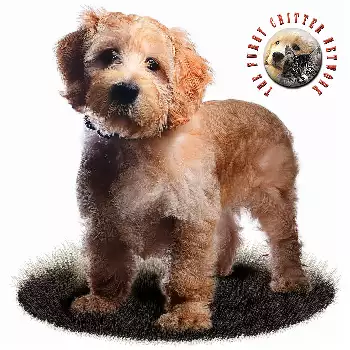
The coat is the breed's most visually defining characteristic beyond the facial furnishings. It is coarse, harsh, wiry, and straight, covering the body in a shaggy, tousled layer that has a natural, ungroomed appearance that is intentional rather than neglected. Beneath the outer coat lies a dense, soft undercoat that provides insulation. The coat color is uniform yellow, ranging from a light straw shade to a deeper golden yellow, with darker shades preferred. No other colors are accepted under the breed standard. The legs are covered with shorter hair that lies closer to the skin, and the tail carries a moderate amount of coat without forming a heavy plume. The overall coat impression should be of a working-quality rough coat that serves a practical protective function rather than a cosmetic one.

The tail is typically docked to about one-third of its natural length in countries where docking is permitted, though natural tails are increasingly common and accepted in countries with docking bans. A natural tail is carried cheerfully but should not curl tightly over the back. The legs are straight, well boned, and parallel when viewed from front or rear, with compact, round feet and well-arched toes. Movement is free, lively, and ground-covering, with the animated, springy gait of a dog that approaches life with enthusiasm. The overall picture is of a small, square, rough-coated dog whose cheerful expression, distinctive facial furnishings, and warm yellow coloring create an appearance that is both charming and unpretentious.

Affectionate With Family
The Dutch Smoushond is an openly affectionate breed that bonds deeply with every member of its household and expresses its devotion through constant companionship, enthusiastic greetings, and a persistent desire for physical closeness. These dogs are not reserved or aloof in their affections. They give warmth freely and consistently, seeking out laps, leaning against legs, and positioning themselves at the center of family activity. Their cheerful, loving nature is the breed's most defining behavioral characteristic.
Good With Young Children
The Smoushond's gentle, patient, and playful nature makes it a reliable companion for families with children of most ages. The breed's sturdy build for its size handles the bumps and enthusiastic handling that come with young children better than more fragile toy breeds, and its high tolerance for noise and commotion means it rarely becomes overwhelmed by household chaos. Supervision is appropriate for very young children primarily to protect the dog from unintentional rough treatment rather than to protect the children from the dog.
Good With Other Dogs
Dutch Smoushonds are generally sociable and amicable with other dogs, lacking the intense same-sex aggression or territorial confrontation that characterizes some terrier breeds. They approach unfamiliar dogs with friendly curiosity and typically integrate well into multi-dog households. Their non-confrontational social style makes them easy companions for dogs of various sizes and temperaments, though early socialization strengthens these natural tendencies.
Shedding Level
The rough, wiry coat sheds modestly compared to smooth-coated breeds, with loose hair tending to get caught in the surrounding coat rather than falling freely onto furniture and clothing. Seasonal shedding increases occur during spring and fall coat transitions, but the overall volume of loose hair is manageable with regular grooming. The breed's coat type is one of its practical advantages for owners who value cleanliness.
Coat Grooming Frequency
The Dutch Smoushond's rough coat requires regular but not excessive maintenance. Weekly brushing with a slicker brush and comb prevents matting, and hand stripping two to three times per year preserves the correct harsh texture and color. The breed's coat is designed to be functional rather than glamorous, and it should have a natural, slightly unkempt appearance rather than a sculpted or manicured look. Owners who prefer a lower-maintenance approach can clip the coat, though this softens the texture over time.
Drooling Level
The Dutch Smoushond is a tidy, low-drool breed. Its compact muzzle and tight lip structure produce virtually no visible drool under normal circumstances, and even during meals, exercise, or warm weather, moisture around the mouth remains negligible. The facial furnishings may collect food and water debris, but this is a grooming consideration rather than a drool issue.
Coat Type
The breed carries a rough, wiry, shaggy double coat with a coarse outer layer and a dense, soft undercoat. The coat has a natural, unpolished appearance that should look tousled rather than groomed to perfection. Prominent facial furnishings including eyebrows, a moustache, and a beard give the breed its characteristic scruffy, expressive face and contribute to the name Smoushond, which derives from the Dutch word for moustache.
Openness To Strangers
The Dutch Smoushond is a naturally friendly breed that approaches unfamiliar people with confident curiosity rather than suspicion or wariness. While some individuals may display brief initial reserve, the breed's default response to strangers is welcoming and warm. This openness makes the Smoushond a poor guard dog but an excellent companion for socially active households that receive frequent visitors or enjoy taking their dog into public settings.
Playfulness Level
The Smoushond possesses a genuine, lively playfulness that persists through adulthood and well into the senior years. These dogs enjoy interactive games including fetch, tug, and chase, and they bring enthusiasm and energy to play sessions without the manic intensity that characterizes higher-drive breeds. Their playful nature makes them engaging companions for families and individuals who value an active, fun-loving dog that is equally happy to settle down when the games are over.
Watchdog/Protective Nature
The Dutch Smoushond will alert bark at unusual sounds, unexpected visitors, and changes in its environment, providing a reasonable alarm function despite its small size and friendly disposition. However, its fundamental sociability means that most alert barking quickly transitions to enthusiastic greeting once the visitor is identified as non-threatening. The breed lacks the sustained suspicion or territorial aggression of dedicated watchdog breeds and is more announcer than enforcer.
Adaptability Level
The Dutch Smoushond adapts remarkably well to a wide range of living situations, from city apartments to rural homes, and adjusts to changes in routine, environment, and household composition with minimal stress. Its moderate size, manageable exercise needs, and sociable temperament make it suitable for virtually any domestic setting. The breed's historical role as a versatile urban and rural companion has produced a dog that takes new situations in stride and transitions smoothly between different activity levels and environments.
Trainability Level
The Dutch Smoushond is intelligent, eager to please, and responsive to positive reinforcement training methods, making it considerably more trainable than many breeds with terrier heritage. These dogs enjoy the interaction that training provides and work enthusiastically for food rewards, praise, and play. They learn quickly and retain commands well, though like most intelligent breeds, they may occasionally test boundaries or improvise on learned behaviors in ways that are endearing if not always precisely obedient.

Dutch Smoushond History & Development

The Dutch Smoushond traces its origins to the small, rough-coated ratting and companion dogs that were common throughout the Netherlands and the broader Low Countries during the 18th and 19th centuries. These dogs were practical urban and rural companions, valued for their ability to control vermin in stables, warehouses, and homes while providing cheerful companionship to their owners. The breed's exact ancestral composition is debated, but it is generally believed to be related to the broader family of rough-coated European terrier and schnauzer-type dogs that served similar functions across central and western Europe. Some breed historians suggest a connection to the yellow-coated dogs that were culled from early German Schnauzer breeding programs, with the theory that these rejected yellow puppies found their way to the Netherlands and contributed to the Smoushond's foundation.

By the mid-19th century, the Dutch Smoushond had become a recognizable and popular breed in the Netherlands, particularly among the urban middle class and the horse-keeping community. The dogs were frequently seen in the stables and coaching inns of Dutch cities, where they earned their keep as ratters while also serving as pleasant companions for the gentlemen who frequented these establishments. The breed's association with this social milieu earned it a reputation as a gentleman's companion, a characterization that reflected both its sociable temperament and its popularity among the prosperous urban classes. The breed was first shown at Dutch dog exhibitions in the 1870s, and a breed standard was formalized as cynological organizations in the Netherlands began the systematic documentation of native Dutch breeds.

The Second World War devastated the Dutch Smoushond's population almost to the point of extinction. The wartime conditions in the Netherlands, including famine, displacement, and the general disruption of civilian life during the German occupation and liberation, reduced the breeding population to a critically small number. By the end of the war and through the immediate postwar period, the breed had effectively disappeared from the Dutch dog scene. For several decades, the Dutch Smoushond existed only in historical records, breed books, and the memories of older fanciers who had known the dogs before the war.

The breed's revival began in the 1970s when Henrica Barkman van der Weel, a dedicated Dutch cynologist, undertook the systematic reconstruction of the breed using the small number of dogs that could be identified as carrying Smoushond heritage, supplemented by carefully selected crossbreedings with other rough-coated breeds of appropriate type and temperament. This reconstruction program was necessarily slow and careful, requiring multiple generations of selective breeding to re-establish consistent breed type, correct coat texture and color, and the characteristic temperament that had defined the original breed. The program's success represents one of the more remarkable breed conservation stories in European cynology, bringing the Dutch Smoushond back from virtual extinction to a sustainable, if still small, population. Today the breed remains rare even within the Netherlands, with annual registrations numbering in the low hundreds, and it is essentially unknown outside its country of origin.

Dutch Smoushond Temperament & Personality

The Dutch Smoushond possesses a temperament that has been shaped by centuries of selection for a dual purpose: functional vermin control and pleasant human companionship. This combination has produced a dog that is lively and alert enough to be an effective ratter, sociable and affectionate enough to be a thoroughly enjoyable household companion, and adaptable enough to transition smoothly between work and relaxation without the intense drive that makes some terrier breeds difficult to live with. The Smoushond occupies a temperamental sweet spot that gives it enough spirit to be interesting and enough mellowness to be manageable, a balance that accounts for much of its appeal among those who know the breed.

Affection and sociability are the cornerstones of the Smoushond's personality. These dogs bond openly and warmly with their families, expressing their attachment through constant proximity, enthusiastic greetings, and a genuine desire to participate in whatever their people are doing. They are not one-person dogs but rather distribute their affection across the entire household, adapting their behavior to each family member's individual personality and activity level. Their sociability extends beyond the immediate family to encompass visitors, neighbors, and strangers encountered on walks, toward whom the Smoushond typically displays friendly curiosity rather than suspicion or wariness.

The breed's cheerful, even-tempered nature makes it one of the more easygoing dogs in the terrier-adjacent family. While the Smoushond possesses the alert, lively spirit that its ratting heritage demands, it lacks the intense prey obsession, hair-trigger reactivity, and confrontational attitude toward other dogs that can make some terrier breeds challenging companions. The Smoushond is spirited without being manic, watchful without being paranoid, and independent enough to entertain itself during brief absences without the separation anxiety that plagues some companion breeds. This temperamental moderation is the breed's greatest practical virtue and the quality that makes it suitable for a wider range of households and lifestyles than many similar breeds.

The breed does retain a mild prey drive that reflects its ratting heritage, and owners should be aware that squirrels, rabbits, and other small outdoor creatures will attract the Smoushond's focused attention. This drive is considerably less intense than that found in dedicated hunting terriers, and it does not typically extend to household cats or other pets with which the dog has been raised. The Smoushond's prey interest is more accurately described as alert interest than as obsessive pursuit, and it can be managed effectively through normal training and environmental controls without the extraordinary measures required by higher-drive breeds.

Dutch Smoushond Family Life & Living Requirements

The Dutch Smoushond adapts to family life with an ease and flexibility that reflects its centuries-long history as a companion dog designed to fit comfortably into the rhythms of a human household. The breed's moderate size, manageable exercise needs, and sociable temperament make it suitable for a wide range of living situations, from city apartments to suburban homes to rural properties. The Smoushond does not demand a large yard, extensive property, or specialized facilities. It needs companionship, moderate daily activity, and the inclusion in family life that its social nature requires, and these needs can be met in virtually any domestic setting.

The breed integrates into family dynamics with particular smoothness, adjusting its behavior to match the household's energy level and daily patterns. Smoushonds are gentle and patient with children, tolerant of visitors, and generally amicable with other household pets. Their moderate activity level means they are active and engaged during periods of family activity and calm and settled during quieter times, without the restless pacing or demand behavior that higher-energy breeds display when understimulated. This ability to match the household's rhythm makes the Smoushond an exceptionally comfortable dog to live with, one that enhances daily life rather than complicating it.

The breed's need for human companionship should not be underestimated despite its otherwise low-maintenance temperament. Smoushonds that are left alone for extended periods without interaction can develop the mild anxiety and attention-seeking behaviors that are common in breeds selected for close human partnership. Households where someone is home for the majority of the day, where family members have staggered schedules, or where the dog can accompany its owner to a dog-friendly workplace provide ideal environments. When absences are unavoidable, a second pet for companionship or a midday visit from a dog walker helps bridge the gap.

Financially, the Dutch Smoushond is an economical breed to maintain, with costs typical of a small, healthy, low-maintenance dog. Food costs are modest given the breed's small appetite. Grooming costs are minimal if managed at home through regular brushing and periodic hand stripping, though professional grooming is available for owners who prefer to outsource coat care. Veterinary costs are typically average for a small breed with a favorable health profile, though the breed's rarity means that finding a veterinarian with breed-specific experience may be challenging outside the Netherlands. The most significant cost challenge prospective owners face is acquiring a dog in the first place, as the breed's extreme rarity means that waiting lists are long, travel to the Netherlands may be necessary, and import logistics can be complex and expensive.

Dutch Smoushond Training & Exercise Needs

Training a Dutch Smoushond is a generally pleasant and rewarding experience that benefits from the breed's intelligence, eagerness to please, and genuine enjoyment of interactive engagement with its owner. Unlike many breeds with terrier heritage that possess a stubborn independence that makes training a negotiation, the Smoushond actively participates in the training process and appears to derive satisfaction from learning new behaviors and performing them for positive reinforcement. Food rewards work well, but the breed also responds strongly to verbal praise, physical affection, and the social interaction that training sessions provide. This cooperative spirit makes the Smoushond considerably more trainable than many similar-sized rough-coated breeds.

Positive reinforcement methods are highly effective and appropriate for the Smoushond's sensitive, people-oriented temperament. These dogs learn quickly when the connection between behavior and reward is clear and immediate, and they retain commands well once learned. Harsh corrections are counterproductive and unnecessary, creating anxiety and wariness that undermine the willing cooperation that makes training enjoyable for both parties. Training sessions should be kept short and engaging, typically five to fifteen minutes, with enough variety to maintain the dog's interest. The Smoushond responds particularly well to trick training, which channels its intelligence and love of human interaction into entertaining behaviors that strengthen the bond between dog and owner.

Housetraining proceeds at a pace typical of small breeds, which means prospective owners should expect a timeline that may extend somewhat longer than for larger breeds. The combination of small bladder capacity, occasional willfulness, and possible sensitivity to inclement weather conditions can slow the process. Consistent scheduling, immediate reinforcement of outdoor elimination, crate training, and patient acceptance of setbacks form the foundation of successful housetraining. Indoor elimination options can serve as useful supplements during winter conditions, which in the Netherlands and similar northern climates can make outdoor trips unpleasant for both dog and owner.

Exercise needs are moderate and easily satisfied within the framework of normal daily routines. A healthy adult Smoushond benefits from one or two walks daily, each lasting twenty to thirty minutes, supplemented by indoor or outdoor play sessions and access to a secure area for free exploration. The breed enjoys play activities including fetch, tug, and interactive puzzle toys, and many Smoushonds find scent work and similar enrichment activities particularly engaging, reflecting the breed's ratting heritage and keen nose. The Smoushond does not require the high-intensity exercise demanded by sporting or herding breeds, but it does need regular physical and mental activity to maintain a healthy weight and prevent the boredom that can lead to nuisance behaviors such as excessive barking or destructive chewing.

Dutch Smoushond Health Concerns

The Dutch Smoushond's health profile reflects both the advantages and the risks of a breed that was reconstructed from a very small foundation population following its near-extinction during World War II. On the positive side, the breed has been spared many of the health problems that plague breeds with extreme physical conformations, as the Smoushond's moderate proportions, functional structure, and lack of exaggerated features place minimal stress on its anatomical systems. The breed's lifespan of 12 to 15 years is healthy for a dog of its size, and most individuals remain active and vigorous well into their senior years. On the cautious side, the severe population bottleneck that the breed experienced during and after the war reduced genetic diversity to critically low levels, creating a heightened vulnerability to the accumulation and spread of recessive genetic disorders within the small breeding population.

The limited genetic diversity within the breed is the overarching health concern that underlies all other breed-specific health considerations. When a breeding population descends from a very small number of founders, the probability increases that harmful recessive alleles are carried by a large proportion of the population, and the probability of producing affected offspring rises with each generation of breeding within the restricted gene pool. Responsible breeders monitor coefficients of inbreeding carefully, avoid doubling up on popular sires, and make breeding decisions that maximize genetic diversity within the constraints of maintaining breed type. The breed's governing body in the Netherlands plays a critical role in coordinating breeding decisions across the small community of active breeders.

Orthopedic and ocular conditions represent the most commonly reported health concerns in the breed. Patellar luxation, in which the kneecap slides out of its normal position, occurs with regularity in the Smoushond as it does in many small breeds. Hereditary cataracts have been documented in the breed and can progress to vision impairment if not monitored through periodic ophthalmologic examination. Hip dysplasia, while less commonly discussed in the context of small breeds, has been identified in the Smoushond population at rates that warrant radiographic screening in breeding stock.

Dental disease is a significant ongoing health concern for the Dutch Smoushond, as it is for most small breeds. The compact jaw structure creates conditions that favor tartar accumulation, and the dense facial furnishings can trap food debris near the mouth and teeth. Without proactive dental care through daily brushing, appropriate chewing opportunities, and periodic professional cleanings, periodontal disease can progress rapidly to painful tooth root infections, tooth loss, and systemic health complications. The breed's wiry facial hair also requires attention around the mouth to prevent the moisture retention and bacterial growth that can occur when food and water accumulate in the moustache and beard.

Common Health Issues

  • Patellar luxation - Medial displacement of the kneecap that is relatively common in small breeds; ranges from intermittent slipping to chronic displacement requiring surgical correction. Screening of breeding stock is recommended.
  • Hereditary cataracts - Progressive opacity of the lens that can impair vision and eventually cause blindness; ophthalmologic screening of breeding stock helps identify affected dogs and carriers before breeding decisions are made.
  • Hip dysplasia - Abnormal development of the hip joint that can lead to arthritis and lameness; while less common in small breeds than in larger breeds, the condition has been documented in the Smoushond population and warrants screening in breeding stock.
  • Allergies and skin sensitivities - Environmental and food-related allergies can cause itching, skin irritation, and secondary infections; the wiry coat can sometimes conceal early signs of skin conditions, making regular hands-on inspection important.
  • Dental disease - Small breeds are predisposed to rapid tartar accumulation and periodontal disease; the Smoushond's compact jaw can contribute to crowding that accelerates dental problems if preventive care is not maintained.

Preventive Care & Health Monitoring

  • OFA patellar luxation evaluation - Veterinary physical examination of both stifles recommended for all breeding stock to screen for kneecap displacement.
  • Ophthalmologic examination by a veterinary ophthalmologist - Annual eye examination to screen for hereditary cataracts and other ocular conditions; particularly important in a breed with a small gene pool where heritable conditions can spread rapidly.
  • Hip screening for breeding stock - Radiographic evaluation of both hips recommended for breeding animals to identify dysplasia and prevent propagation of affected genetics.
  • Regular dental care program - Daily tooth brushing with enzymatic toothpaste, appropriate dental chews, and periodic professional cleanings to prevent the periodontal disease to which small breeds are particularly susceptible.
  • Regular skin and coat inspection during grooming - Thorough hands-on inspection of the skin beneath the wiry coat during weekly brushing sessions to detect allergic reactions, hotspots, parasites, or other skin conditions that the coat may conceal.
  • Genetic diversity awareness in breeding decisions - Given the breed's extremely small population and historical bottleneck, breeders should prioritize genetic diversity through coefficient of inbreeding calculations and avoid linebreeding on popular sires.

Dutch Smoushond Grooming & Maintenance

Grooming a Dutch Smoushond requires regular but not excessive attention, with the breed's rough, wiry coat designed to be functional and low-maintenance rather than cosmetically demanding. The breed standard explicitly calls for a natural, slightly unkempt appearance rather than a sculpted or manicured look, which means that the grooming goal is to maintain coat health and cleanliness while preserving the tousled, scruffy character that defines the breed's visual identity. Owners who enjoy the process of meticulously grooming a dog to show-ring perfection may find the Smoushond's deliberately casual aesthetic unsatisfying, while owners who prefer a more natural, lived-in look will appreciate a breed whose grooming philosophy aligns with minimal intervention.

Weekly brushing with a slicker brush and a wide-toothed comb keeps the coat free of tangles and removes loose hair before it accumulates in the surrounding coat. The areas most prone to matting are behind the ears, in the armpits, around the beard and moustache, and along the inner thighs, and these zones should receive particular attention during each brushing session. The coat should be brushed in the direction of hair growth, working through any tangles gently with fingers or comb before they develop into tight mats that require cutting. The facial furnishings, including the eyebrows, moustache, and beard, should be combed through regularly and kept clean of food debris and moisture that can cause odor and skin irritation.

Hand stripping two to three times per year preserves the correct harsh, wiry texture and the rich yellow color that define the breed's coat. Hand stripping involves pulling out dead outer coat hairs by hand or with a stripping tool, allowing new growth to come in with the proper rough texture. The process is time-consuming but not painful for the dog when performed correctly on a properly prepared coat. Many pet owners opt for clipping as a less labor-intensive alternative, and while clipping is perfectly acceptable for companion dogs, it gradually softens the coat texture over successive sessions and may lighten the color, producing a coat that lacks the harsh, weather-resistant quality specified by the breed standard.

Beyond coat care, the Dutch Smoushond requires regular attention to ears, eyes, teeth, nails, and the facial furnishings that are the breed's signature feature. Ears should be checked weekly for signs of infection, moisture buildup, or debris, and cleaned as needed with a veterinary-approved solution. The eyes should be monitored for discharge or irritation, with tear staining managed through gentle daily cleaning if it occurs. Nails should be trimmed every two to three weeks. The moustache and beard require particular attention to hygiene, as they readily trap food, water, and environmental debris that can create odor and promote bacterial growth if not cleaned regularly. Many owners find that a quick wipe of the facial furnishings after meals and water sessions significantly reduces the grooming burden and keeps the dog's face fresh and comfortable.