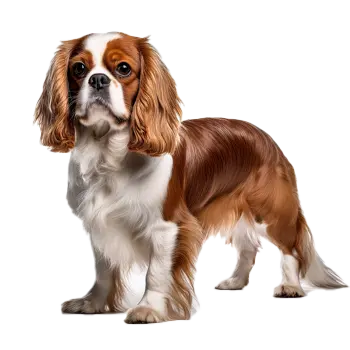
The first thing most people notice about a CKCS is the face - those large, round, dark eyes set well apart and framed by long, silky ear feathering give the breed an expression that is hard to look away from. There is genuine warmth in that face, and it is not just anthropomorphism. Breeders have selected for this look for decades because it reflects the breed's actual character. The head is nearly flat on top, the stop is shallow, and the muzzle tapers gently without any trace of the pushed-in profile you see in related breeds.
The ears are set high and hang close to the face with abundant feathering that often blends seamlessly into the feathering on the chest. In a well-groomed dog, the ears frame the face like a halo and are one of the breed's most recognizable visual features. Bite should be regular, with a scissors bite considered ideal by the breed standard.
The body is moderate and balanced throughout. These are not extreme dogs in any structural sense beyond their expressive face. The neck flows into well-laid shoulders, and the chest has enough depth and spring of rib to give the dog a substantial look despite its small size. The back is level, and the overall outline is that of a dog built for moderate, steady movement rather than speed or power. Tail carriage is naturally jaunty and expressive - the breed standard allows for docking in countries where it is still practiced, but undocked tails are entirely correct and equally common.
Legs are straight and well-boned for the breed's size, with round, well-padded feet. Movement should be free and flowing, covering ground with an easy, effortless stride. Hackney gait or choppy movement are considered faults. The CKCS should look like it is gliding when it moves well.
The coat is the breed's most dramatic physical feature outside of the face. It is silky in texture, moderately long, and slightly wavy rather than curly or straight. Feathering appears on the ears, chest, legs, and tail, and in a mature dog this feathering can be quite full and flowing. The coat should never be trimmed for the show ring - the standard explicitly calls for the dog to be shown in its natural state. Trimming for pet purposes is a personal choice, and many pet owners opt for a shorter trim around the feet and ears for practical reasons.
The four recognized colors are Blenheim, Tricolor, Ruby, and Black and Tan. Blenheim - chestnut markings on a pearly white background - is the most commonly seen color and has historical ties to the Duke of Marlborough's estate where the strain was developed. Ruby is a solid, rich red that is striking in a well-conditioned coat. Tricolor and Black and Tan both require precise tan point placement to be considered correct.
Overall, the CKCS presents as a balanced, elegant small dog without any exaggerated features apart from those expressive eyes and abundant ear feathering. The impression should be one of gentle substance - not fragile, not coarse, but a compact and well-made companion built to last through a normal active life.
Size consistency across the breed is reasonably good. Most properly bred CKCSs fall within the 12 to 18 pound range with minimal outliers, and the overall silhouette - slightly longer than tall, well-proportioned neck and head, level topline - is recognizable across colors. When you see a well-bred Cavalier move across a room, the combination of flowing coat, elegant head carriage, and easy stride is genuinely attractive in a way that photographs but is better in person.
Affectionate With Family
★★★★★
The CKCS lives for closeness with the people it loves. This is a dog that will follow you from room to room and consider your lap the best seat in the house.
Good With Young Children
★★★★☆
Their gentle, patient nature makes them good companions for kids who know how to handle a small dog. Rough play should always be supervised given their small frame.
Good With Other Dogs
★★★★☆
CKCSs are generally sociable and get along well with other dogs. They were bred as companion animals, not competitors, so aggression is rarely part of their personality.
Shedding Level
★★★☆☆
Moderate shedding year-round with heavier periods seasonally. Regular brushing keeps it manageable and keeps the silky coat looking its best.
Coat Grooming Frequency
★★★☆☆
The feathered coat needs brushing a few times a week to prevent tangles, especially behind the ears and on the legs. It is a real coat, not a wash-and-forget situation.
Drooling Level
★☆☆☆☆
Not a drooler. You can have them on the furniture without worrying about that particular issue.
Coat Type
★★★☆☆
Silky, moderately long, and slightly wavy with feathering on the ears, chest, legs, and tail. It gives the breed its elegant, flowing appearance.
Openness To Strangers
★★★★☆
Friendly and approachable with new people. The CKCS does not carry much suspicion toward strangers, which is part of their appeal as a companion breed.
Playfulness Level
★★★★☆
Cheerful and playful without being hyperactive. They enjoy a good game and short bursts of outdoor activity, then are perfectly happy to settle down.
Watchdog/Protective Nature
★★☆☆☆
They may alert to a knock at the door, but protection is not in their wheelhouse. They are lovers, not guards.
Adaptability Level
★★★★★
Apartments, houses, city or country - the CKCS fits most living situations well. What they cannot adapt to is being left alone for long stretches.
Trainability Level
★★★★☆
Eager to please and responsive to gentle handling. They pick up basics quickly and enjoy the interaction that training sessions provide.