Chrysanthemum Dog

Shih Tzu

Quick Facts

🐕 Breed Group
Toy Group
📏 Size Category
Toy
📏 Height
Males: 9-10.5 inches, Females: 9-10.5 inches
⚖️ Weight
Males: 9-16 pounds, Females: 9-16 pounds
⏱️ Life Expectancy
10-18 years
🧣 Coat Type
Long, dense, double coat - flowing and silky
🎨 Coat Colors
All colors and combinations
😀 Temperament
Affectionate, playful, outgoing, friendly
🏃 Exercise Needs
Low to Moderate - 20 to 30 minutes daily
🎓 Training Difficulty
Moderate
👶 Good with Children
Very Good
🐾 Good with Other Pets
Excellent

Other Names & Breed Recognition

Chrysanthemum Dog is the most visually evocative name the Shih Tzu has ever been given, and once you understand where it comes from, you will never look at one of these dogs the same way again. The chrysanthemum flower - the Chrysanthemum morifolium of Chinese and Japanese tradition - has petals that radiate outward from a central point in all directions, forming a full, round bloom. The Shih Tzu's facial hair does exactly the same thing. The hair grows in multiple directions from a central point on the muzzle, spreading outward and upward across the flat face in a radiating pattern that, on a well-maintained dog, is genuinely flower-like. The name is descriptive in the best possible sense: it tells you exactly what you are looking at.

The Chrysanthemum Dog is not a formally registered name or breed designation anywhere in the world - it is a descriptive nickname that has been in use for decades within the Shih Tzu community and has increasingly appeared in breed literature and popular dog writing as a charming alternative to the formal name. You will not find it on AKC registration papers. What you will find is a community of Shih Tzu owners and enthusiasts who use it affectionately to describe the same dog the AKC calls a Shih Tzu, the FCI classifies under Group 9 Section 5, and various registries have recognized since the 1960s and 1970s.

Shih Tzu itself is the Mandarin Chinese transliteration of the name that translates as Lion Dog - a reference to the breed's resemblance to traditional Chinese lions and to the lion of Buddhist iconography. The breed has also been called the Little Lion Dog in English, and the name Songshi Quan (Mandarin for puffy lion dog) appears in some historical contexts. In Chinese imperial history, the breed was occasionally known simply as Xi Shi Quan - meaning beauty dog. Each of these names captures a different aspect of the same animal: the Buddhist symbolism, the physical appearance, the decorative beauty.

The AKC recognized the Shih Tzu in 1969, placing it in the Toy Group where it has remained. The American Shih Tzu Club (ASTC) serves as the AKC parent club. The FCI classifies the breed under Group 9 (Companion and Toy Dogs), Section 5 (Tibetan breeds), reflecting the Tibetan origin thread in the breed's history. The Kennel Club in the UK places the Shih Tzu in the Utility Group. All of these organizations recognize the same breed by the same name - the Chrysanthemum Dog label exists entirely outside formal registration channels as a beloved nickname that captures something the formal names do not.

Chrysanthemum Dog Organizations & Standards

The American Shih Tzu Club (ASTC) is the AKC parent club for the breed in the United States and the primary organizational voice for breed standards, ethics, and health promotion. The ASTC adopted a formal position on health testing in 2021 when it entered the breed into the OFA's CHIC program - a participation that was long in coming, since the Shih Tzu was one of the last toy breeds to join. The CHIC requirements established by the ASTC require a CAER eye examination by a board-certified ophthalmologist and an OFA patellar luxation evaluation for certification. Cardiac evaluation and OFA hip certification are listed as optional but recommended by the club's breeder guidelines.

The AKC breed standard for the Shih Tzu describes a sturdy, lively, alert toy dog with a long flowing double coat. The standard emphasizes that the dog should have a round, broad, wide-between-the-eyes head with a very short muzzle that is not wrinkled. The expression described in the standard is warm, sweet, wide-eyed, and friendly - the same expression that earned the breed its place in Chinese imperial palaces and in modern living rooms alike. The chrysanthemum-like facial hair is not explicitly named in the AKC standard, but the standard's requirement for hair that grows upward on the nose describes exactly the feature that produces the flower effect.

In the UK, The Kennel Club breed standard describes similar characteristics and places particular emphasis on the breed as a companion dog of good general health with a distinct flowing coat. UK breeders work under the BVA/KC health scheme framework, with hip and eye evaluations available through those channels. The FCI standard reflects the Tibetan heritage of the breed more explicitly, grouping it with Tibetan breeds and noting its historical background as a dog of the Tibetan plateau and Chinese imperial court.

The ASTC's breeder guidelines go beyond the minimum CHIC requirements, recommending annual eye testing for conditions including entropion, progressive retinal atrophy, cataracts, and several other documented ocular conditions in the breed. The guidelines also recommend kidney function testing through urinalysis and bloodwork given the breed's specific vulnerability to renal dysplasia - a hereditary kidney condition that is more prevalent in the Shih Tzu than in most other breeds and for which no DNA test is currently available. Asking breeders about kidney health in their lines is a meaningful question when evaluating a litter.

Kennel Club Recognition

  • American Kennel Club (AKC): Recognized in 1969, Toy Group
  • United Kennel Club (UKC): Recognized, Companion Breeds
  • Canadian Kennel Club (CKC): Recognized, Toy Group
  • FCI: Recognized, Group 9 - Companion and Toy Dogs
  • The Kennel Club (UK): Recognized, Utility Group

Chrysanthemum Dog Physical Description

The Chrysanthemum Dog is a small, solid, and distinctly round package. At 9 to 16 pounds and no more than 10.5 inches at the shoulder, the Shih Tzu is firmly in toy territory, but it carries more substance than many dogs its size. The build is compact and sturdy with a surprisingly broad chest for its weight - this is not a fragile dog, though its size means it should be treated carefully around larger animals and young children who may not understand how to handle small dogs.

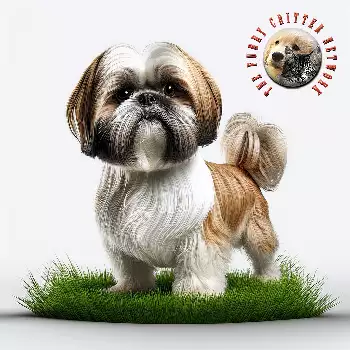
The head is where the chrysanthemum effect lives, and it is the feature that defines the breed's appearance more than anything else. The skull is round and broad, the eyes are large, dark, round, and prominently placed - giving the breed that famously wide-eyed, alert expression. The muzzle is very short, with the nose leather typically pointing upward rather than forward. From this short, flat face, the coat grows outward in all directions - upward from the nose, outward from the cheeks, downward from the top of the skull - creating the flower-like radial pattern that gives the Chrysanthemum Dog its name. The ears are large, hanging, and heavily coated, blending into the neck coat and framing the face on either side.

The body under all that coat is square and compact. The back is level. The chest is broad and deep. The legs are short and straight with good bone. The tail is set high and carried in a curve over the back, covered with flowing coat. When a Shih Tzu moves, it does so with an arrogant, confident gait - head up, tail over the back, covering ground with more energy and purpose than you might expect from the overall decorative appearance.

The coat is the breed's most dramatic feature and its most demanding maintenance requirement. A full-length show coat on an adult Shih Tzu can reach the ground - long, flowing, silky, and parted down the center of the back. The outer coat is straight or very slightly wavy. The undercoat is dense and soft. The complete effect is theatrical and genuinely beautiful, but requires daily attention to achieve and maintain. Most pet owners keep their Chrysanthemum Dogs in a shorter puppy cut or teddy bear cut that keeps the facial hair clear of the eyes and reduces the grooming workload to a more manageable level without sacrificing the breed's characteristic face.

Colors in the Shih Tzu are not restricted - the breed comes in virtually any color or color combination, including solid gold, red, black, silver, white, chocolate, liver, and various brindles and parti-colors. The AKC standard accepts all colors and any marking. A white blaze on the forehead and a white tip on the tail are considered particularly desirable by traditional breeders and appear frequently in the breed.

The eyes deserve specific mention because they are so central to what makes this dog's face so expressive. Large, dark, and round, they are set wide apart and look outward with what owners universally describe as warmth. The prominence of the eyes - which creates the wide-eyed, endearing expression - is also a structural vulnerability: the eyes protrude enough that they are at greater risk of physical injury than recessed eyes would be, and the same flat face that produces the chrysanthemum effect limits the protective depth of the eye socket. Regular eye care and awareness of this vulnerability are part of Chrysanthemum Dog ownership.

Affectionate With Family
The Chrysanthemum Dog lives for its people. Warmth and affection flow naturally in both directions with this breed, and most Shih Tzu will find a way into your lap whether you planned for that or not.
Good With Young Children
Playful, patient, and small enough to make children feel like equals rather than subordinates. Their size requires supervision with very young children, but the temperament is genuinely child-friendly.
Good With Other Dogs
One of the more socially easy breeds with other dogs - the Shih Tzu approaches canine introductions with confidence and goodwill rather than suspicion.
Shedding Level
Despite the long coat, Shih Tzu shed less than most breeds - more hair falls out on the brush than on your furniture. The double coat holds onto shed hair rather than releasing it into the environment.
Coat Grooming Frequency
The long coat demands daily brushing to prevent matting. Many owners opt for a shorter pet trim that reduces but does not eliminate the grooming commitment.
Drooling Level
Not a drooling breed. About as clean in this regard as a dog gets.
Coat Type
Long, flowing, and silky with a soft undercoat - the coat that creates the chrysanthemum effect around the face requires consistent maintenance but produces a beautiful result in a well-groomed dog.
Openness To Strangers
The Shih Tzu was bred as a companion dog for everyone in the imperial household and that orientation has not changed. New people are a source of interest and affection, not alarm.
Playfulness Level
Surprisingly playful for a dog that looks like a decorative object. They enjoy games, toys, and the kind of indoor play that suits their flat-faced breathing limitations.
Watchdog/Protective Nature
Will alert you to activity at the door, but this is an alarm system, not a deterrent. The Chrysanthemum Dog greets intruders with curiosity rather than anything resembling threat.
Adaptability Level
Genuinely one of the most adaptable breeds - apartment or house, single owner or busy family, city or country. The Shih Tzu adjusts to nearly any living situation with equanimity.
Trainability Level
Intelligent and capable of learning, but inclined to decide whether a given request is worth engaging with. Consistent positive reinforcement works; frustration and repetition work against you.

Chrysanthemum Dog History & Development

The Chrysanthemum Dog's history is the history of a companion breed developed at the highest levels of Chinese imperial culture, where producing beautiful, charming dogs was taken as seriously as any other courtly art. The Shih Tzu's origins lie in the crossing of Tibetan breeds - most likely including the Lhasa Apso and possibly the Pekingese - with Chinese court dogs, producing a small companion with the long flowing coat, flat face, and warm personality that Chinese royalty prized for centuries.

Dogs resembling the modern Shih Tzu appear in Chinese art as early as the Tang Dynasty (618-907 CE), suggesting a very long history of companion dogs of this general type in Chinese culture. The breed as specifically developed and standardized is most closely associated with the Ming Dynasty (1368-1644) and then particularly with the later Qing Dynasty, during which the Imperial Kennel maintained careful records and breeding programs for Shih Tzu and other palace dogs. During the reign of the Dowager Empress Cixi in the late 19th and early 20th centuries, palace breeding programs reached their most elaborate development. The palace dogs were so prized that selling, trading, or gifting them outside imperial circles was prohibited.

The Western world's access to the breed came through the careful and sometimes clandestine efforts of people who received or smuggled palace dogs out of China during and after the collapse of the imperial system. When the Qing Dynasty fell in 1912, the royal breeding program was disrupted. Dogs were eventually distributed to Europeans, and small breeding programs established in Europe - particularly in England and Scandinavia - preserved the breed through the tumultuous first half of the 20th century. The Shih Tzu Club in England was established in 1935.

The Chrysanthemum Dog nickname appears in English-language breed literature primarily from the mid-20th century onward, as the breed became established in Western countries and writers sought descriptive ways to capture its distinctive appearance for audiences unfamiliar with the breed's Chinese name. The visual accuracy of the name made it stick. The breed's AKC recognition in 1969 was relatively recent given the breed's ancient Chinese history - American soldiers encountered Shih Tzu in Europe and brought some home after World War II, contributing to growing American interest that eventually led to formal recognition.

Today the Chrysanthemum Dog is among the most popular companion breeds in the United States and Europe, recognized by every major kennel club and maintained by an active community of breeders who take the breed's health and temperament seriously alongside its famous appearance.

The name itself - Chrysanthemum Dog - belongs to the Western tradition of encountering this breed and reaching for the most visually accurate description available in English. The chrysanthemum is a flower with particular significance in East Asian culture: in China it represents longevity and rejuvenation; in Japan, the imperial family's official seal is a sixteen-petal chrysanthemum. That the Shih Tzu, a dog from the Chinese imperial tradition, came to be called the Chrysanthemum Dog in Western countries connects its appearance to a flower deeply embedded in the same cultural world that produced the breed.

Chrysanthemum Dog Temperament & Personality

The Chrysanthemum Dog's personality is the personality of a dog that was bred for centuries to be exactly what you want in a companion - warm, sociable, playful without being exhausting, and genuinely oriented toward the people it lives with. This is not a happy accident of selective breeding; it is the direct result of generations of deliberate selection for dogs that charmed and pleased the people around them. The imperial palace was a demanding audience, and the Shih Tzu's temperament reflects that standard.

With family, the Chrysanthemum Dog is openly affectionate and attentive. These are dogs that seek contact, that follow their people from room to room, that position themselves wherever the household action is. They are not clingy in an anxious way - they are simply social in a way that makes constant proximity feel natural. The warmth they extend is genuine and consistent; there is nothing reserved or conditional about a Shih Tzu's affection for the people it trusts.

With strangers, the Chrysanthemum Dog is notably open for a toy breed. Many small dogs compensate for their size with suspicion and reactivity; the Shih Tzu tends to approach new people with curiosity and goodwill. This reflects both the breed's palace history - where it interacted with a large court of people - and its fundamental temperament, which runs toward engagement rather than withdrawal. A well-socialized Shih Tzu is not a dog that hides from visitors.

With children, the breed is patient and playful in a way that works particularly well with school-age kids who can understand the dog's size limitations. Very small children and Shih Tzu require supervision - not because the dog is dangerous, but because the dog is small and fragile in the hands of a toddler who does not yet understand how to be gentle. The Shih Tzu's impulse with children is to play along, not to establish distance.

There are behavioral realities to acknowledge alongside all of this warmth. Shih Tzu can be stubborn about training - they learn quickly and retain well, but they are opinionated about whether to apply what they know. Harsh training backfires entirely with this breed; positive reinforcement with food rewards works well. They can bark, and some individuals are more vocal than owners expect from a toy companion breed. Separation anxiety is not universal but is documented - a Chrysanthemum Dog that has been socialized only to its one owner and placed in full-time isolation during work hours can develop anxious behavior that is genuinely difficult to manage. Socialization that includes comfort with various people and some time alone helps prevent this.

What the Chrysanthemum Dog gets right, temperamentally, is the fundamental companion dog contract: it is present, warm, adaptable, and interested in the life of the household it belongs to. It does not have working dog demands. It does not have guarding instincts that require constant management. It does not need a job beyond being exactly what it was bred to be - a friendly, cheerful, surprisingly personable small dog that most people find genuinely difficult to dislike.

Chrysanthemum Dog Family Life & Living Requirements

Few breeds are as genuinely adaptable to varied living situations as the Chrysanthemum Dog. Small enough for apartments, sociable enough for busy households, gentle enough for seniors, and playful enough for families - the Shih Tzu spans an unusually wide range of owner profiles without requiring a particular lifestyle to thrive in. The one consistent requirement is human companionship. These dogs were developed to be with people, and a Shih Tzu that spends most of its day alone is not living the life it was built for.

For apartment dwellers, the Chrysanthemum Dog is close to ideal. The exercise needs are modest - twenty to thirty minutes of daily walking is genuinely sufficient for most adults - and the breed's low shedding makes it more apartment-compatible than many dogs with long coats. The flat face means heat is a real vulnerability, so hot-weather exercise management matters, but this is easy to address with timing and awareness. A Shih Tzu in an air-conditioned apartment is a comfortable Shih Tzu.

For families with children, the breed's patience and social ease are genuine assets. The size limitation is the primary management consideration - children should be taught from the beginning that this is a dog that can be hurt by rough handling, and play sessions should be supervised until children are old enough to be reliably careful. With older children who understand the dog's size, the Shih Tzu is a delightful playmate with staying power and genuine enthusiasm for games.

For seniors and people who live alone, the Chrysanthemum Dog provides constant companionship at a physical management level that is genuinely sustainable. The exercise needs, grooming demands, and health considerations are real but manageable for most people. The emotional return - a warm, present, affectionate companion throughout the day - is substantial. Many Shih Tzu owners describe the breed as the best decision they ever made precisely because of how completely the dog integrates into daily life without overwhelming it.

The one household profile that requires more thought is families with very young children. A Shih Tzu can be injured by a toddler who does not yet understand how to handle a small dog, and the dog's instinctive response to feeling pain or fear from handling may be to snap. This is not a temperament problem unique to the Shih Tzu - it is a size-and-developmental reality that applies to all small dogs with toddlers. Supervision, education of children, and setting the dog up to have safe spaces away from small hands are all part of making this combination work well.

Chrysanthemum Dog Training & Exercise Needs

Training a Chrysanthemum Dog is a study in patience over persistence. These dogs are smart enough to learn quickly and independent enough to decide whether following through on what they have learned is currently in their interest. This makes them different from highly biddable breeds like Labradors, and it means that the approach to training matters as much as the content. Short sessions with high-value food rewards and genuine enthusiasm from the trainer produce far better results than long repetitive drills, which the Shih Tzu will simply stop engaging with.

Housetraining is the area where many Shih Tzu owners encounter the breed's stubbornness most directly. It typically takes longer with this breed than with many others - four to six months of consistent effort is realistic for most dogs, and crate training is the most reliable method. Consistency in schedule, immediate reward for correct behavior, and a relaxed but persistent approach get there eventually. Expecting the speed of a herding breed will produce frustration; accepting that this is a breed on its own timeline produces a house-trained dog.

Basic manners - not jumping, not barking excessively, coming when called, walking on a loose leash - are all achievable and important. The flat face means that collar pressure is a consideration on leash, and a harness is generally recommended for Shih Tzu to distribute leash pressure away from the throat. Training these basics from puppyhood and maintaining them consistently sets up the adult dog for success in whatever environments it will encounter.

On the exercise side, the Chrysanthemum Dog's needs are genuinely modest. Twenty to thirty minutes of walking daily is sufficient for most adult Shih Tzu. The breed is not built for sustained high-intensity exercise - the flat face limits efficient thermoregulation during exertion, and the body type is not designed for endurance. What these dogs need from exercise is mental stimulation and physical movement, both of which a moderate daily walk with interesting smells and surroundings provides effectively. Indoor play sessions supplement nicely. Heat management during exercise is essential - a Shih Tzu exercised vigorously in hot, humid weather is at real risk for overheating, and exercise should be shifted to early morning or evening during warm months.

Chrysanthemum Dog Health Concerns

The Chrysanthemum Dog is generally a long-lived breed - lifespans of 12 to 16 years are common, and dogs reaching 18 years are occasionally documented. That long potential lifespan comes with breed-specific health vulnerabilities that owners should understand clearly, because several of them are directly connected to the physical features that make the breed distinctive.

Patellar luxation - kneecap instability - is among the most common orthopedic conditions in the breed. The kneecap slips out of its normal groove, causing the characteristic skipping gait where the dog hops on one hind leg for a few steps before the kneecap pops back into place. OFA patellar evaluation of breeding stock is a CHIC requirement and is the appropriate standard for responsible breeders. Intervertebral disc disease (IVDD) is a risk in this chondrodystrophic breed - the same type of disc structure that makes the breed short-legged also creates vulnerability to disc herniation. Dental disease affects over 80 percent of Shih Tzu by age three due to the brachycephalic skull crowding normal tooth arrangement into a shortened jaw. Progressive retinal atrophy and cataracts are documented ocular concerns; CAER annual eye exam is the CHIC-required screening.

Common Health Issues

  • Brachycephalic obstructive airway syndrome - BOAS, : Structural breathing impairment resulting from the breed's flat face, including narrowed nostrils, elongated soft palate, and narrow trachea. Present to some degree in most Shih Tzu; severe cases require surgical correction.
  • Renal dysplasia: Hereditary kidney developmental disorder documented as more prevalent in the Shih Tzu than most other breeds. Kidneys fail to develop normally, leading to progressive kidney failure. No DNA test is currently available - Responsible breeders screen their lines through kidney function testing.
  • Patellar luxation: Kneecap instability causing intermittent skipping gait - Among the most common orthopedic conditions in the breed. OFA patellar evaluation is a CHIC certification requirement for breeding stock.
  • Intervertebral disc disease - IVDD, : Elevated risk in this chondrodystrophic breed due to the same disc structure that produces short leg length. Disc herniation causes pain, neurological signs, and in severe cases, paralysis.
  • Progressive retinal atrophy: Inherited retinal degeneration causing gradual vision loss - Annual CAER eye examination by a board-certified veterinary ophthalmologist is a CHIC requirement.
  • Cataracts: Documented in the breed with a suspected genetic component - Covered under the CAER examination requirement.
  • Dental/periodontal disease: Over 80% of Shih Tzu affected by age three due to brachycephalic skull structure crowding normal tooth count into a shortened jaw - One of the most impactful chronic health conditions in the breed.
  • Hip dysplasia: Documented in the breed - Though less severe than in larger breeds. OFA hip certification is optional but recommended by the ASTC for breeding stock.

Preventive Care & Health Monitoring

  • CAER eye examination by a board-certified veterinary ophthalmologist - Required for CHIC certification. Covers progressive retinal atrophy, cataracts, entropion, and other documented ocular conditions specific to the breed.
  • OFA patellar luxation evaluation - Required for CHIC certification. Patellar luxation is among the most common orthopedic conditions in the Shih Tzu.
  • OFA cardiac evaluation - Optional but recommended by the ASTC for breeding stock.
  • OFA hip certification - Optional but recommended by the ASTC for breeding stock.
  • Kidney function screening - Urinalysis and bloodwork, given the breed's documented vulnerability to renal dysplasia. Ask breeders about kidney health history in their lines, as no DNA test is currently available.
  • Daily dental care through tooth brushing - Critical for a breed where over 80 percent develop periodontal disease by age three. Annual professional dental cleaning prevents the tooth loss and systemic disease that advanced periodontal disease causes.
  • BOAS assessment: dogs with visibly narrow nostrils - Significant snoring, exercise intolerance, or breathing distress should be evaluated by a veterinarian familiar with brachycephalic airway issues. Corrective surgery significantly improves quality of life in affected dogs.
  • Heat management: the flat face dramatically limits heat dissipation through panting. Exercise only in cool conditions - Provide constant access to shade and water in warm weather, and never leave a Shih Tzu in a hot car or unshaded space.

Chrysanthemum Dog Grooming & Maintenance

The Chrysanthemum Dog is named for its face, and that face requires daily attention to look the way the name implies. The facial hair grows continuously in multiple directions, and without regular brushing it does not form elegant flower petals - it forms a tangled, matted mass that can trap food, moisture, and debris against the skin. Daily face brushing with a soft brush or comb is the baseline maintenance for keeping the Chrysanthemum Dog looking like its name rather than looking like a small, unfortunate mop.

The full body coat compounds the requirement. A Shih Tzu kept in full coat needs daily brushing with a pin brush or slicker brush, working through the coat in sections to prevent mats from forming at the base near the skin - which is where mats always start and where they cause the most discomfort. The topknot on the head - the traditional gathered and tied bundle of head hair that keeps it out of the eyes - requires daily re-doing for most dogs. Many pet owners eliminate this by keeping the hair around the face trimmed short enough that a topknot is unnecessary.

The most practical grooming decision most Chrysanthemum Dog owners make is choosing a shorter cut. A puppy cut or teddy bear trim keeps the coat at two to three inches all over, maintains the characteristic rounded face appearance, and reduces daily brushing from a necessity to a pleasant twice-weekly activity. Professional grooming every six to eight weeks maintains the trim. This approach is not aesthetically inferior to a full coat - a well-maintained shorter Shih Tzu is a beautiful dog - and it is dramatically more sustainable for owners who do not have the time or inclination for daily brushing sessions.

Eye care is particularly important for this breed. The prominent, large eyes are vulnerable to irritation from facial hair, dust, and debris. Wiping the eye area daily with a clean, damp cloth removes discharge before it accumulates and stains. The facial skin folds around the muzzle should be cleaned regularly to prevent moisture buildup and the bacterial or yeast issues that can follow. Ear inspection and cleaning are part of the routine - the pendant ears with their heavy coat covering limit airflow to the ear canal, creating conditions favorable for ear infections. Nail trimming every three to four weeks and dental brushing several times a week complete the regular maintenance picture.