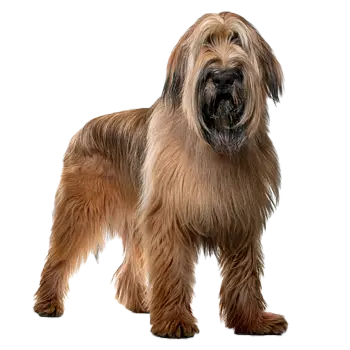
Stand next to a Chien de Berger de Brie and you understand immediately why this dog commanded respect on working farms for centuries. This is a big dog - males range from roughly 23 to 27 inches at the shoulder and can weigh anywhere from 55 to 100 pounds depending on frame and condition. Females are slightly smaller but share the same powerful impression. The overall silhouette is one of rectangular proportion, meaning the body length exceeds the height at the withers, giving the dog a working stride that covers ground efficiently without appearing hurried.
The head is long and broad, well-balanced in proportion to the body, with a pronounced stop that divides the skull from the muzzle at a relatively equal ratio. Strong jaws close in a scissor bite, and the muzzle is square-ended rather than pointed. The eyes are set horizontally in the skull, large, dark, and carrying a calm, observant expression that long-time Briard owners describe as almost humanly intelligent. Ears are set high and, in countries where cropping is practiced, are sometimes cropped upright - though many countries including the UK and much of Europe prohibit this practice, and the breed's natural ear is a folded, drop ear that lies close to the head.
The neck flows into well-laid-back shoulders that allow the front legs to reach forward with purpose. The chest is deep and broad, reaching to elbow level, and the ribs are well-sprung. The topline is level and firm, supported by strong loins and a slightly sloping croup. The tail is long, naturally carried low at rest with an upward hook at the tip, and rises with activity. It is never cropped. The hindquarters are powerful and well-angulated, and here is where a defining breed characteristic appears: the Chien de Berger de Brie is required by breed standard to have double rear dewclaws on both hind legs. These are not vestigial afterthoughts but functional structural requirements. Any Briard lacking them is disqualified in the show ring.
The coat is the breed's most visually striking feature. Long, coarse, and naturally wavy, it has been compared in texture to the coat of a goat - dry to the touch, with enough body to part and fall back without clinging. It lies flat against the body, covers the face with a natural beard and mustache, and forms a heavy fall over the eyes that gives the dog its characteristic shaggy expression. A correct Briard coat is never soft, silky, or curly. The undercoat is fine and tight against the skin, providing insulation for outdoor work in variable weather.
Accepted colors include black, all shades of tawny from fawn to dark, and gray. Black and tawny combinations are also permitted. White hairs scattered through the coat are acceptable but not desirable. White patches on the chest are a fault. The coat is presented in its natural state in the show ring - no sculpting, no trimming into shapes, no artificially enhanced presentation. The Chien de Berger de Brie is a working dog's coat on a working dog's body, and responsible breeders and judges treat it that way.
Movement in a sound Chien de Berger de Brie is fluid and ground-covering, driven from powerful hindquarters with good reach in front. At a trot the dog should move with purpose rather than exaggeration, and the topline should remain firm. A splay-footed or hackneyed gait indicates structural problems that undermine the breed's working capability. Overall, this is a dog that should look capable - big enough to be authoritative, sound enough to work all day, and covered in enough coat to face whatever weather the French countryside might produce.
Affectionate With Family
★★★★★
The Chien de Berger de Brie bonds fiercely to its people and demonstrates deep loyalty that borders on devotion. This dog wants to be wherever the family is and does not do well when left apart from those it loves.
Good With Young Children
★★★☆☆
Older children who understand boundaries do well with this breed, but the Briard's herding instincts and substantial size can make it a challenging match for very young kids. Supervision and early introductions matter.
Good With Other Dogs
★★★☆☆
Dog-to-dog relationships depend heavily on socialization history. The Briard can coexist with other dogs it knows well, but its territorial nature means introductions with unfamiliar dogs require care.
Shedding Level
★★★☆☆
The long coat sheds moderately but the texture means loose hair tends to collect within the coat rather than scatter broadly. Regular grooming pulls out far more than you will find on your furniture.
Coat Grooming Frequency
★★★★☆
The Briard's long, wavy coat requires significant grooming commitment. Without regular brushing sessions, the coat mats quickly, particularly behind the ears, in the armpits, and around the rear.
Drooling Level
★☆☆☆☆
Drooling is not a characteristic of the Briard. This is a dry-mouthed breed that will not leave puddles on your floors or mark your clothes with slobber.
Coat Type
★★★★☆
Long, coarse, and naturally wavy, the Briard coat is described as goat-like in texture and must never be groomed into a sculpted or trimmed appearance. It is a working coat built for all-weather use.
Openness To Strangers
★★☆☆☆
The Chien de Berger de Brie was bred to guard as well as herd, and it carries that wariness of outsiders in its DNA. Strangers are assessed carefully before being accepted, if they are accepted at all without proper introduction.
Playfulness Level
★★★★☆
Despite its working seriousness, this breed has a genuine playful streak that emerges with family members it trusts. It enjoys games, romping outdoors, and activities that engage its body and mind together.
Watchdog/Protective Nature
★★★★★
Protection of home and family is deeply embedded in this breed's character. The Briard is attentive, alert, and will act on perceived threats without hesitation. Early training helps channel this drive appropriately.
Adaptability Level
★★★☆☆
A dog of this size, energy, and working background needs space and activity to adapt well. It can adjust to varied household situations provided its exercise and mental engagement needs are consistently met.
Trainability Level
★★★☆☆
The Briard is highly intelligent but was bred to work independently, making decisions without waiting for commands. It learns quickly but may choose not to comply. Training requires consistency, patience, and a calm authority the dog genuinely respects.