Central Asian Ovcharka

Central Asian Shepherd Dog

Quick Facts

🐕 Breed Group
Working Group
📏 Size Category
Large to Giant
📏 Height
Males: 27.5 inches minimum, Females: 24 inches minimum
⚖️ Weight
Males: 88-110 pounds, Females: 66-88 pounds
⏱️ Life Expectancy
12-15 years
🧣 Coat Type
Short or long double coat
🎨 Coat Colors
White, black, gray, straw, russet, parti-color, brindle
😀 Temperament
Confident, territorial, independent
🏃 Exercise Needs
Moderate
🎓 Training Difficulty
Difficult - independent guardian breed
👶 Good with Children
With family only, extensive socialization required
🐾 Good with Other Pets
Caution required - dominant with other dogs

Other Names & Breed Recognition

Central Asian Ovcharka is the name most people encounter first when researching this breed through Russian-language sources, Soviet-era kennel club records, or the international breed community that developed around the dog's original geographic range. "Ovcharka" is the Russian word for shepherd dog or sheepdog, and it appears in the names of several breeds originating in or around the former Soviet Union - the South Russian Ovcharka and the Caucasian Ovcharka being the most closely related in purpose, if not in precise geography.

The FCI officially uses "Central Asian Shepherd Dog" as the breed's recognized English name, and the AKC formally adopted this name when granting full recognition in 2018. In Russian-speaking countries and among communities with direct cultural ties to the breed's origin regions - Kazakhstan, Uzbekistan, Turkmenistan, Kyrgyzstan, and surrounding areas - the name Alabai is also commonly used and carries significant cultural weight. Some national kennel clubs in those regions register the breed under the Alabai name, treating it as a distinct enough regional variant to merit separate classification, though most international bodies consider Alabai and Central Asian Shepherd Dog to be the same breed.

Searchers who encounter Central Asian Ovcharka in breed databases or forum discussions are encountering the Russian kennel club designation, which was how the breed was standardized and promoted during the Soviet era. The Soviet cynological system did significant work documenting, standardizing, and selectively breeding the dogs it encountered across Central Asia, and the Ovcharka name became attached to this effort. It remains in wide use internationally among serious breeders and working dog enthusiasts who follow the Soviet and Russian breed tradition.

For practical purposes, Central Asian Ovcharka and Central Asian Shepherd Dog refer to the same dog. Both names appear in health records, pedigree databases, and breed club materials, and anyone familiar with the breed understands both references immediately. The Ovcharka name carries the weight of Soviet-era kennel club tradition and is often preferred by breeders working from Russian or Central Asian pedigree lines, while Central Asian Shepherd Dog is the term used by those working within AKC or FCI frameworks. Neither name is more correct than the other, and both point to one of the oldest and most authentic working dog populations on earth.

Central Asian Ovcharka Organizations & Standards

The FCI is the primary international governing body for the Central Asian Shepherd Dog, recognizing it under Standard No. 335 in Group 2. The FCI standard was developed with significant input from Russian and Soviet-era cynological records and reflects the breed as it was documented and selectively developed across the twentieth century. The FCI standard emphasizes the breed's functional requirements above aesthetic ones - health, soundness, working capability, and the specific behavioral profile required of a livestock and property guardian.

The AKC granted full recognition to the Central Asian Shepherd Dog in 2018, placing it in the Working Group. The parent club in the United States is the Central Asian Shepherd Dog Club of America, which maintains the AKC-approved breed standard and provides breeder referrals and health information. The relatively recent AKC recognition means that the American breeding community is still developing the health testing infrastructure and population size that more established AKC breeds have built over decades.

In Russia, the breed has been registered and standardized through the Russian Kynological Federation (RKF) for many decades under the Ovcharka designation. The RKF standard and the FCI standard align closely, reflecting the shared historical documentation. Regional kennel clubs in the Central Asian republics maintain their own registries in some cases, particularly for dogs registered under the Alabai name, and these registries emphasize working performance and regional type characteristics that may vary from the FCI standard in specific details.

The breed standard calls for a large, massively built dog with a broad, slightly domed skull, a well-defined stop, and a powerful muzzle. The neck is strong and short, the chest is deep and well-developed, and the overall body is rectangular in format - longer than it is tall. Movement should be free and ground-covering, with a natural tendency toward a lazy, economical gait that can shift quickly to powerful action when needed. Both short and long coat varieties are recognized and neither is considered superior.

Health testing recommendations from American and European breed organizations include OFA hip and elbow evaluation for breeding dogs, along with cardiac screening. The breed's significant size and deep chest structure mean that bloat risk is a real consideration that breeders and owners should discuss with their veterinarians.

Buyers in North America should ask specifically about OFA test results and verify them through the OFA public database. Given the breed's relatively recent AKC recognition and small registered population, the volume of public health data is limited compared to more established breeds, which makes breeder transparency about individual dogs' health testing all the more important.

Kennel Club Recognition

  • American Kennel Club (AKC): Recognized in 2018, Working Group
  • United Kennel Club (UKC): Recognized, Guardian Dog Group
  • FCI: Recognized, Group 2 - Pinscher and Schnauzer

Central Asian Ovcharka Physical Description

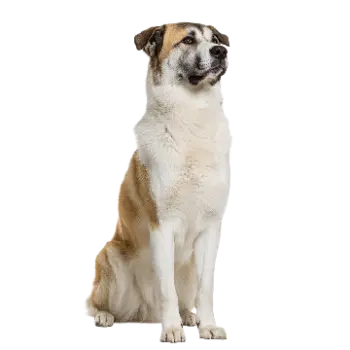
The Central Asian Ovcharka is a large, heavily built dog that communicates presence and authority before it has done anything at all. Standing next to one - especially a mature male - you understand immediately why wolves reconsider their approach. The minimum height for males is 27.5 inches at the shoulder, but many dogs exceed this, and the weight ranges from 88 to well over 110 pounds in large males. Females are distinctly smaller but still substantial animals.

The head is broad, massive, and slightly domed. The skull is wide between the ears, the stop is defined but not abrupt, and the muzzle is deep and powerful with well-developed jaws. The overall head impression is one of capability - this is a dog built to physically engage large predators if necessary, and the skull structure reflects that. Ears are traditionally cropped in working dogs in their countries of origin, an ancient practice intended to reduce the vulnerability of long ear leather in fights with wolves. Uncropped ears are pendulous and fold close to the skull.

The neck is thick and muscular, moderately short, and set into shoulders that are well-laid and powerful. The chest is deep and broad, providing the lung and heart room required for a dog capable of sustained physical effort at elevation in challenging terrain. The back is straight and strong, the loin is slightly arched, and the overall body format is rectangular - somewhat longer than tall. The tail is set high and is often carried in a loose ring or sickle curve over the back, full and well-feathered in long-coated individuals.

The coat comes in two varieties. The short-coated version has a dense, plush outer coat over a well-developed undercoat, lying close to the body without being smooth or thin. The long-coated version has a coarser, longer outer coat with feathering on the ears, legs, and tail and the same dense undercoat beneath. Both types protect the dog against the dramatic temperature swings of the Central Asian climate - scorching summers and bitter winters - and both shed heavily during seasonal coat changes.

Color variety in this breed is significant. White, black, gray, straw, russet, parti-color, and brindle are all acceptable, and the working populations across Central Asia have historically shown substantial color diversity reflecting the genetic breadth of the breed's origin. No color is preferred by the standard, which is consistent with a breed developed for function rather than appearance.

Movement in the Central Asian Ovcharka should be effortless and ground-covering. The natural gait is a loose, somewhat ambling trot that covers distance without apparent effort - the gait of a dog designed to patrol large territories over extended periods. When motivated, the stride shifts to something considerably more powerful and purposeful. Soundness of structure is essential in a breed this size; structural problems translate into welfare problems in a large dog.

The overall physical impression of a mature Central Asian Ovcharka - particularly a mature male - is one of contained power. These dogs do not look ornamental. They look functional in exactly the way a tool designed for a serious job looks functional. The broad head, the deep chest, the powerful hindquarters, the dense protective coat - all of it connects to a specific purpose, and seeing it in person is a different experience from seeing it in photographs. The scale alone changes how you understand what this dog is.

This is also a breed with significant individual variation in size. The minimum height is a floor, not a ceiling, and many dogs - particularly those from certain regional lines - substantially exceed the standard minimums. Buyers should ask about the typical size range in a breeder's lines and be prepared for the upper end of that range.

Affectionate With Family
Devoted to their own household in the quiet, watchful way of a guardian breed - not demonstrably affectionate, but deeply connected to the people and property they have claimed as their own.
Good With Young Children
They can be tolerant of children within their own family when socialized from puppyhood, but their size, power, and protective instincts make close supervision non-negotiable. This is not a breed for families seeking a gentle playmate.
Good With Other Dogs
Dominant with other dogs, particularly of the same sex. Multi-dog households require careful management and consistent supervision. Serious dog-dog conflict is a documented risk with this breed.
Shedding Level
Heavy seasonal shedding in both coat varieties. The dense undercoat comes out in significant quantities during blow-out periods, and regular brushing during those times is a practical necessity.
Coat Grooming Frequency
Outside of shedding season, the coat is relatively low-maintenance. The double coat has natural weatherproofing that does not require frequent washing or elaborate care.
Drooling Level
Some individuals drool moderately, particularly around food or in hot weather. Not a breed known for excessive drooling compared to heavier-jowled molossoid breeds.
Coat Type
Two coat varieties exist - a shorter plush coat and a longer, more heavily coated version. Both have a dense double coat suited to the extreme temperature swings of the Central Asian steppe.
Openness To Strangers
Reserve toward strangers is not a behavioral issue to correct - it is the breed's core function. The Ovcharka assesses unfamiliar people and situations as potential threats until proven otherwise.
Playfulness Level
Not a playful breed in the conventional sense. They engage with their environment purposefully and survey their territory with focus. Play for its own sake is not particularly motivating.
Watchdog/Protective Nature
Guardian instinct is the entire foundation of this breed. The Central Asian Ovcharka was shaped over millennia to protect livestock and settlements from wolves, bears, and human intruders.
Adaptability Level
Best suited to rural or suburban settings with space and meaningful territory to oversee. Urban apartment life is fundamentally incompatible with the breed's spatial and territorial needs.
Trainability Level
Intelligent but self-directed. The Ovcharka was never bred to take instructions from a human in real time - it was bred to make independent decisions. Conventional obedience training requires patience and experience with livestock guardian breeds.

Central Asian Ovcharka History & Development

The name Central Asian Ovcharka reflects a specific moment in this breed's history - the Soviet-era documentation and standardization of the ancient dogs found across the nomadic cultures of Central Asia. The dogs themselves are far older than the name. Archaeological evidence and historical records suggest that large guardian dogs performing this function in the region predate recorded history, and the genetic lineage of the Central Asian Shepherd Dog is among the oldest and least modified of any recognized breed. DNA studies have consistently placed this breed among the most ancient domestic dog populations.

Nomadic peoples of Kazakhstan, Uzbekistan, Turkmenistan, Kyrgyzstan, Tajikistan, and surrounding regions developed and maintained these dogs over thousands of years for a specific purpose: protecting livestock - primarily sheep and goats - and encampments from large predators including wolves, bears, and snow leopards, as well as from human raiders. Selection was entirely utilitarian. Dogs that failed to guard, that showed unsuitable temperament, or that could not withstand the climate and physical demands of nomadic life did not reproduce. The result is a breed of exceptional hardiness, territorial instinct, and physical capability.

The Soviet Union's formal cynological system encountered these dogs as Soviet influence extended into Central Asia through the twentieth century. Soviet cynologists documented the regional populations, developed written standards, and began selective breeding programs aimed at preserving and standardizing what they found. The term Ovcharka - shepherd dog - was applied, and the breed began appearing in Soviet dog show and working dog trial records under the Central Asian Ovcharka designation. This standardization effort introduced the breed to a broader international audience and created the pedigree infrastructure that connects modern dogs to their Central Asian ancestors.

After the Soviet Union's dissolution in 1991, breed development continued through Russian, Central Asian, and international kennel club systems. The breed's recognition by the FCI under the Central Asian Shepherd Dog name brought it into the international show and breeding community, and subsequent recognition by the AKC in 2018 extended that reach to North America. Throughout these transitions, the name Central Asian Ovcharka has remained in active use among breeders and enthusiasts who follow the Russian and Soviet kennel club tradition, and it appears alongside the AKC name in much of the serious breed literature available in English.

The breed's ancient origin and the scale of its geographic distribution mean that regional variation is real and accepted. Dogs from different parts of the breed's range may show differences in size, coat, and structure that reflect the specific populations and selective pressures of their regions. Serious breeders track these regional lines and consider them part of the breed's genetic richness rather than a problem to be standardized away.

For anyone researching the Central Asian Ovcharka, understanding that the name is a recent label attached to something genuinely ancient is important. The dog existed in its essential form for thousands of years before any kennel club wrote a standard for it, and the qualities that define it - independence, guardian instinct, territorial drive, physical hardiness - are the product of that long history, not of recent selective breeding by show enthusiasts.

Central Asian Ovcharka Temperament & Personality

The Central Asian Ovcharka does not have the temperament of a companion breed that happens to be large. It has the temperament of a livestock guardian that has been shaped over thousands of years to make independent life-or-death decisions about threats to its territory. Understanding that distinction is the starting point for understanding this dog.

Guardian instinct in this breed is not trained in - it is innate and requires no encouragement. A Central Asian Ovcharka puppy raised in a household will begin exhibiting territorial behavior, alarm responses, and assessment of strangers as potential threats before its first birthday. This is not problematic behavior that can be trained out; it is the dog functioning as designed. The task for the owner is channeling and socializing that instinct so the dog can distinguish genuine threats from normal human activity rather than treating everything unfamiliar as a danger.

With its own family, the Ovcharka is loyal in a serious, protective way. This is not a lap dog or a breed that seeks physical affection enthusiastically. The attachment is demonstrated through presence, alertness, and protective behavior rather than through soliciting petting or following people from room to room seeking interaction. You will know this dog is bonded to you because of what it does when something unfamiliar appears - it positions itself, it assesses, it acts as a buffer between you and the perceived threat.

With other dogs, the Central Asian Ovcharka requires careful management. Dominance behavior and same-sex aggression are common. This is a breed that has historically operated in situations where establishing and maintaining hierarchical position among working dogs was important. The instinct to assert dominance in multi-dog situations does not disappear in a pet context. Households that successfully keep multiple dogs with a Central Asian Ovcharka invest significant effort in careful introductions, monitored interactions, and management that prevents the triggers for serious conflict.

Socialization during puppyhood is absolutely critical and cannot be replaced by any amount of training later. A Central Asian Ovcharka that has been exposed to a wide variety of people, places, dogs, and situations during the developmental period handles novelty as an adult with the assessment and restraint that distinguishes a well-raised guardian from a liability. An under-socialized Ovcharka is a serious safety concern. This breed has the size, strength, and territorial drive to cause severe injury, and owners bear full responsibility for providing the foundation that allows the dog to function safely in a modern environment.

People who are drawn to the breed for its power and imposing presence without understanding or committing to the socialization and management requirements are a problem for the breed's reputation and the safety of those around them. The Central Asian Ovcharka deserves ownership that respects what it is - not ownership that exploits its intimidating presence without accepting the corresponding responsibility. The breed's needs and its capabilities are inseparable, and both demand the same serious, long-term commitment from the people responsible for this dog. Breed-experienced veterinary care, knowledgeable training support, and honest self-assessment are the starting points for anyone seriously considering ownership.

Central Asian Ovcharka Family Life & Living Requirements

The Central Asian Ovcharka is not a breed for first-time dog owners, apartment dwellers, or households without the space and infrastructure to manage a large, territorial guardian dog responsibly. These are the baseline realities that responsible breed advocates state plainly rather than softening. This dog in the wrong hands is a welfare problem for the dog and a safety problem for everyone around it.

Suitable homes have space - a rural or suburban property where the dog has meaningful territory to oversee, preferably with a securely fenced area of substantial size. Solid, high fencing is essential. An Ovcharka that perceives something outside the fence as a threat will test the barrier, and the barrier needs to win that test without question. Underground or invisible fencing is not appropriate for this breed.

Experienced dog owners who understand livestock guardian breeds specifically, and dominant large breeds generally, are best positioned to provide appropriate handling. The Ovcharka does not respond to dominance-based confrontational training methods, which tend to produce resistance and escalation in a dog this self-confident. It also does not respond to the casual, permissive approach that works with biddable companion breeds. Consistent, calm, experienced handling that establishes and maintains clear boundaries without conflict is the approach that works.

Children within the family can be fine with a well-socialized Central Asian Ovcharka, but the interaction requires permanent adult supervision and children who have been taught to respect the dog's space and signals. The dog may be tolerant of family children but will not necessarily extend that tolerance to visiting children or friends. Any dog-child interaction involving this breed should be treated as requiring active management, not trusted to proceed unsupervised.

The honest summary for anyone considering this breed: it is not a pet in the conventional sense, even when kept as one. It is a working guardian animal living in a domestic setting. The owners who do it successfully approach it that way - providing appropriate outlets for the dog's instincts, managing its interactions with the world responsibly, and investing in the long-term relationship that makes this remarkable animal both safe and genuinely rewarding to live with.

The commitment this breed requires is not temporary. The socialization, the management, the training maintenance - these are ongoing responsibilities for the dog's entire life, not a front-loaded effort that becomes easier after year one. People who commit to that fully, and who have the right circumstances to provide what this dog needs, find the Central Asian Ovcharka deeply impressive and deeply satisfying.

Central Asian Ovcharka Training & Exercise Needs

Training a Central Asian Ovcharka requires a fundamental shift in expectations for anyone coming from experience with biddable breeds. This dog was not developed to follow instructions reliably in real time. It was developed to assess situations independently, make decisions without human input, and act on its own judgment. That independent intelligence is genuine and impressive - and it means that conventional obedience training, applied with the same methods and expectations you would use for a Golden Retriever or German Shepherd Dog, produces frustration on both sides.

What does work is building a relationship of mutual respect and clear communication over time, starting from the day the puppy arrives. The owner needs to be consistently calm, consistent in enforcing boundaries, and patient with the breed's characteristic independent response to instructions. Commands need to be worth following from the dog's perspective, which means the owner needs to be a credible authority rather than someone easily ignored. Force-based confrontational methods are counterproductive with a dog this self-confident and physically capable.

Basic obedience - sit, stay, come, leave it, and reliable leash behavior - is achievable and genuinely important with this breed. A Central Asian Ovcharka that has reliable recall and can be called off a perceived threat is significantly safer to manage in real-world situations. Getting to that point takes consistent work starting in puppyhood and maintained throughout the dog's life.

Exercise needs are moderate relative to the dog's size. The Central Asian Ovcharka is not a high-energy working dog in the sprint-and-retrieve sense. It is built for steady patrol, alert watching, and occasional bursts of intense action. Daily walks of 30 to 45 minutes, supplemented by the opportunity to move freely in a secure outdoor space, meet most individuals' exercise requirements. Over-exercising young dogs before their skeletal development is complete risks joint damage in a breed of this weight and size.

Mental stimulation through varied environments and experiences during the socialization period matters more than physical exercise for the development of a well-adjusted adult. A Central Asian Ovcharka that has seen and processed many different situations will be calmer and more manageable than one whose entire world is a single property and household routine.

Owners should be honest about whether they have the time, experience, and commitment that training and socializing this breed genuinely requires. Working with a trainer experienced in livestock guardian breeds is a worthwhile investment, both for the training guidance and the perspective it provides on what is normal behavior for this type of dog versus what needs to be addressed. This is not a breed where basic obedience classes with other inexperienced dog owners provides sufficient foundation.

Central Asian Ovcharka Health Concerns

Hip dysplasia is the primary documented orthopedic concern in the Central Asian Ovcharka, consistent with the pattern seen in most large and giant breed dogs. The breed's significant body mass places considerable stress on joint structures, and developmental abnormality in the hip joint can produce varying degrees of lameness and discomfort. OFA hip evaluation is the standard pre-breeding screening tool, and breeders who submit results to the public OFA database provide buyers with verifiable documentation of the sire and dam's hip status.

As a breed with a relatively small registered population in Western countries, the Central Asian Ovcharka community is still building the health data infrastructure that more established breeds have accumulated over decades. Breeders who actively participate in health testing and reporting contribute meaningfully to this effort, and buyers who ask for and verify health documentation support the process by creating a market expectation for responsible testing.

Common Health Issues

  • Hip Dysplasia: Developmental abnormality of the hip joint common in large breeds, ranging from mild and manageable to severely limiting in terms of mobility - OFA or PennHIP evaluation is the standard pre-breeding screening tool.
  • Elbow Dysplasia: A developmental condition affecting the elbow joint that can produce front-limb lameness and degenerative joint changes - Screened through OFA elbow evaluation prior to breeding.
  • Gastric Dilatation-Volvulus - Bloat/GDV, : A life-threatening emergency where the stomach fills with gas and twists, cutting off blood supply; the breed's large size and deep chest create elevated risk, and owners must be able to recognize early warning signs and seek emergency care immediately.
  • Cardiac Conditions: Cardiac evaluation is included in pre-breeding health testing recommendations as part of the overall health screening protocol for the breed. - Cardiac Conditions: Cardiac evaluation is included in pre-breeding health testing recommendations as part of the overall health screening protocol for the breed.

Preventive Care & Health Monitoring

  • OFA hip evaluation and OFA elbow evaluation for all breeding dogs - With results submitted to the public database for breed health tracking.
  • Cardiac evaluation by a board-certified cardiologist as part of the pre-breeding health screening protocol. - Cardiac evaluation by a board-certified cardiologist as part of the pre-breeding health screening protocol.
  • Owner education on GDV recognition and emergency response - Knowing the signs of bloat and having an emergency veterinary contact established before a crisis occurs.
  • Discussion with your veterinarian about prophylactic gastropexy as a preventive measure against GDV - Particularly for dogs with known elevated risk factors.

Central Asian Ovcharka Grooming & Maintenance

The Central Asian Ovcharka's grooming needs depend significantly on which coat variety you have. The short-coated variety has a dense, plush double coat that requires less overall maintenance than the long-coated version, but both types shed heavily during seasonal coat changes and need regular brushing to manage the volume of loose undercoat that comes out during those periods.

For the short-coated type, weekly brushing with a slicker brush and metal comb keeps shedding under control during normal periods. During the seasonal blow-out - typically spring and fall - daily brushing with an undercoat rake removes the loose undercoat before it distributes itself across every surface in your home. Bathing every six to eight weeks is adequate for a dog with reasonable access to outdoor space; more frequent bathing dries out the coat's natural protective oils without meaningfully improving cleanliness.

The long-coated variety requires more frequent brushing to prevent the longer outer coat from matting, particularly behind the ears, in the armpits, and along the back of the rear legs where friction is greatest. A thorough brushing session two to three times weekly prevents serious tangling. Bathing the long-coated variety requires adequate drying time - this coat holds moisture and a thoroughly wet Ovcharka takes significant time to dry fully, with toweling and a dryer on low heat the practical approach for most owners.

Ears need checking and cleaning regularly in either coat variety. Cropped ears - common in working dogs from the breed's countries of origin - require less maintenance than the natural pendulous ears, which trap moisture and debris. Uncropped ears should be checked weekly and cleaned as needed. Nails grow quickly in a breed this size and need trimming every three to four weeks. Dental hygiene through regular brushing or appropriately sized dental chews helps prevent the periodontal disease that affects large breeds as readily as small ones.

Grooming sessions also serve a practical socialization function with this breed. A Central Asian Ovcharka that has been handled regularly from puppyhood - feet touched, ears examined, mouth opened - tolerates veterinary examination and grooming far more cooperatively than one that has been left to itself. Building a positive association with handling is an investment that pays dividends at every vet visit and every grooming session for the dog's entire life.