Caucasian Ovcharka

Caucasian Shepherd Dog

Quick Facts

🐕 Breed Group
Working Group
📏 Size Category
Giant
📏 Height
Males: 27-30 inches, Females: 25-28 inches
⚖️ Weight
Males: 110-200 lbs, Females: 80-150 lbs
⏱️ Life Expectancy
10-12 years
🧣 Coat Type
Double coat, long or short variety
🎨 Coat Colors
Gray, fawn, cream, white, brindle, piebald
😀 Temperament
Loyal, territorial, protective, independent
🏃 Exercise Needs
Moderate - daily walks with mental engagement
🎓 Training Difficulty
Difficult - requires experienced handler
👶 Good with Children
Caution - best with older children in the family
🐾 Good with Other Pets
Caution - strong territorial instinct

Other Names & Breed Recognition

Caucasian Ovcharka is the name most people encounter first when searching for this breed, and for good reason - it's the term used across Russia, Eastern Europe, and much of the former Soviet Union for this massive guardian. "Ovcharka" is a Russian word meaning sheepdog or shepherd dog, and the Caucasian Ovcharka is simply the shepherd dog of the Caucasus. That word tells you everything about what this dog was built to do.

In Western countries, the breed is more formally called the Caucasian Shepherd Dog, which is the AKC's accepted name since its Foundation Stock Service recognition. The FCI recognizes it as the Caucasian Shepherd Dog as well, placing it in Group 2 with other Molossoid mountain-type breeds. But in conversation - especially among enthusiasts who encountered the breed through Russian or Eastern European sources - Caucasian Ovcharka is the name that sticks, and it carries a certain weight that the translated version doesn't quite replicate.

The breed also goes by Caucasian Mountain Dog and Kavkaz Dog in some circles, and in Georgia - where some of the most prized lines originate - you'll hear it called the Georgian Shepherd Dog or Nagazi. Regional variation is real within this breed; the Georgian mountain-type dogs tend toward larger frames and longer coats, while dogs from the steppe regions of Southern Russia lean leaner and shorter-coated. In Soviet-era records, the breed was standardized and heavily used for military and border patrol work, which spread the Ovcharka name across a wide geographic area.

The name Caucasian Ovcharka became particularly well-known in the West through the Internet age, as enthusiasts shared photos and videos of these bear-like dogs and the breed's Russian designation traveled with those images. If you searched for this dog before the AKC gave it a formal English name, Caucasian Ovcharka is probably exactly what you typed - and that's why this page exists.

For anyone researching ownership, it's worth knowing that the breed's identity and the community around it still largely centers on the Ovcharka name regardless of what's printed on an AKC registration. Breed clubs, rescue networks, and knowledgeable breeders often use the two names interchangeably, but when in-depth conversations happen about temperament, training, and real-world challenges, Caucasian Ovcharka is the name you'll hear.

Caucasian Ovcharka Organizations & Standards

The AKC lists the Caucasian Shepherd Dog in its Working Group and maintains it through the Foundation Stock Service as the breed works toward full recognition requirements. The parent club in the United States is the Caucasian Ovcharka Club of America (COCA), which uses the Russian name despite the AKC's English designation - a telling detail about where this breed's identity still lives. COCA provides rescue services, breeder referrals, and breed education for North American owners navigating this uncommon breed.

The FCI standard is the most internationally referenced document for breed evaluation. Under FCI Group 2, Section 2.2, the standard describes a powerful, well-muscled dog with a massive head, strong bone structure, and a coat that provides genuine weather protection. The FCI standard emphasizes that the Caucasian Ovcharka's function as a livestock guardian and property protector must remain central to breeding decisions - form follows function in this breed, not the other way around.

In terms of physical measurements, the standard calls for males to stand a minimum of 27 inches at the withers with no upper limit - specimens reaching 30 inches are not unusual. Females measure at least 25 inches. Weight ranges widely depending on regional type, with many males exceeding 130 pounds and some exceptional specimens reaching 200 pounds. The FCI standard describes the ideal temperament as confident, calm, and territorial - alert without being hyperreactive, decisive without being erratic.

Health testing guidance for breeders centers on hip and elbow evaluations submitted to OFA, along with eye clearances through a board-certified veterinary ophthalmologist. These tests are not legally mandated but are considered the minimum responsible standard among serious breeders. Given the breed's size and the documented risk of hip dysplasia in giant breeds, hip evaluations before breeding are particularly critical. Reputable breeders will provide documentation of both parents' health clearances without being asked.

Potential owners should contact COCA for breeder referrals, as the club maintains relationships with breeders committed to the breed's working character and health. Importing dogs from Eastern European or Russian breeding programs is not uncommon among serious enthusiasts, but it requires careful research to verify health testing practices and temperament screening. The breed remains rare enough in North America that demand sometimes outpaces the availability of responsibly bred dogs, which creates pressure to purchase from unvetted sources. Taking the time to find a reputable breeder is genuinely worth it with a dog of this size and temperament profile.

Kennel Club Recognition

  • American Kennel Club (AKC): Recognized in 1996, Working Group
  • United Kennel Club (UKC): Recognized, Guardian Dog Group
  • FCI: Recognized, Group 2 - Pinscher and Schnauzer

Caucasian Ovcharka Physical Description

The first time you see a Caucasian Ovcharka in person, the scale of the dog genuinely surprises you. Photos don't prepare you for standing next to one - at full height, a large male can look you in the eye depending on your own height, and the mass behind that head is substantial. This is not a large dog by Labrador standards. This is a giant by any measure.

The head is the Ovcharka's most striking feature up close. It's broad and massive with a slightly domed skull, a pronounced stop, and a wide muzzle that tapers only slightly toward the nose. The jaw is powerful - built to deter wolves and bears, which is not a figure of speech when you trace this breed's working history. The eyes are dark, deep-set, and carry a watchful intelligence. Ears are traditionally cropped short in many Eastern European countries, though natural ears are becoming more common in Western countries where cropping is restricted or culturally discouraged. Natural ears are medium in size and hang down alongside the skull.

The neck is short and thick, blending into powerfully muscled shoulders and a broad, level topline. The chest is wide and deep, giving the dog impressive lung capacity for mountain work at elevation. The back is strong and straight, and the hindquarters are heavily muscled with well-angulated hips - or at least they should be, which is why hip evaluations matter so much in this breed. Feet are large, round, and well-padded, built for uneven terrain. The tail is thick at the base and carried in a loose curve or saber shape.

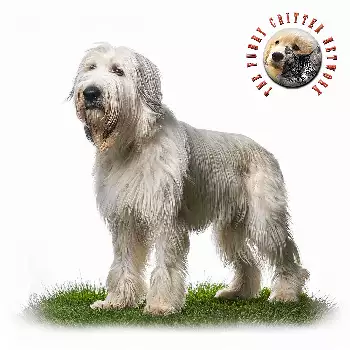
The Ovcharka's coat is one of its defining characteristics and exists in two distinct varieties depending on regional origin. The long-coated type - most associated with the Georgian mountain regions - has a mane-like ruff around the neck and chest, feathering along the backs of the legs, and a full plume of a tail. The shorter-coated steppe type is still double-layered and weather-resistant but presents as a cleaner, less dramatic silhouette. Both coats serve the same function: insulation from cold and some protection from physical contact. Colors range across a wide spectrum including various shades of gray, fawn, cream, white, brindle, and piebald combinations. Solid black exists but is less common.

In motion, the Ovcharka moves with a surprisingly easy, ground-covering gait for its size. It's not a flashy mover but an efficient one - the dog was built to patrol territory all night and still have reserves left. At rest, there's a settled heaviness to the way these dogs carry themselves, like a boulder that happens to breathe. That stillness is part of their presence and part of what makes them so effective as deterrents before they ever have to act.

Males are meaningfully larger than females in every dimension - taller, heavier, broader-headed. Both sexes carry the same fundamental type, but a large male next to an average female of the breed can look like two different animals to the uninitiated. Sexual dimorphism is pronounced and intentional in the breed standard.

The overall impression of the Caucasian Ovcharka is one of density and substance - nothing about this dog reads as refined or elegant in the show-dog sense. What it communicates instead is raw capability. Every physical element - the thick neck, the wide skull, the heavily boned legs, the coat built for weather - points to a dog that was designed to work under genuinely hard conditions over long periods. That functionality is part of its appeal to the people who are genuinely drawn to this breed.

Affectionate With Family
The Ovcharka forms powerful bonds with its own people and can be deeply devoted to its household. That warmth is reserved entirely for the inner circle - strangers are a different matter entirely.
Good With Young Children
This is not a breed suited to homes with small children. Its sheer size and guardian instincts make early, careful supervision essential, and most breeders recommend waiting until children are older.
Good With Other Dogs
Strong territorial instincts and same-sex aggression are well-documented in the breed. Multi-dog households require careful management and very deliberate socialization from puppyhood.
Shedding Level
The Ovcharka produces a significant seasonal shed - the coat blows out once annually in a heavy wave. Between those events, regular brushing keeps the fur manageable.
Coat Grooming Frequency
Twice-weekly brushing handles routine maintenance for the long-coated variety. During the annual coat blow, more frequent grooming - and a warm bath to loosen the undercoat - helps manage the volume.
Drooling Level
Drooling is minimal for a dog of this size, which is a modest upside for an otherwise high-maintenance companion.
Coat Type
The Ovcharka comes in two coat varieties - a long, flowing mountain-type coat and a shorter steppe-type coat. Both are double-layered and built for harsh weather.
Openness To Strangers
Suspicion of strangers is deeply embedded in this breed's purpose. These dogs were bred to identify threats independently, and they do not warm up quickly. Proper socialization makes this manageable, not absent.
Playfulness Level
Within the family, the Ovcharka can show a playful side, particularly in adolescence. As they mature into their guardian role, that playfulness becomes more selective and deliberate.
Watchdog/Protective Nature
Protective drive is this breed's core purpose, not a bonus trait. The Ovcharka will act on perceived threats without waiting for direction - that independence is by design.
Adaptability Level
This is not a breed that adjusts easily to apartment living, dense neighborhoods, or chaotic households. Space, routine, and a confident owner are the foundation this dog needs to thrive.
Trainability Level
The Ovcharka is intelligent but highly independent - it was built to make its own decisions in the field. Experienced, patient handling with consistent structure gets results; heavy-handed or inconsistent approaches do not.

Caucasian Ovcharka History & Development

The Caucasian Ovcharka's history is not the history of a breed club's breeding program - it's the history of mountains. These dogs existed in the Caucasus range, the dramatic spine of land running between the Black and Caspian Seas, long before anyone was writing breed standards. Shepherds in what are now Georgia, Armenia, Azerbaijan, Dagestan, and Chechnya relied on large, fierce guardian dogs to protect their flocks from wolves and bears, and those dogs were selected over centuries for the traits that made them effective: size, courage, territorial instinct, and the judgment to act independently when the shepherd wasn't watching.

The name Caucasian Ovcharka is Russian in origin, reflecting the Soviet Union's codification of this regional working dog into a formal breed type. Beginning around the 1920s, Soviet cynologists began standardizing dogs from across the Caucasus region, selecting for the most impressive specimens and establishing breeding programs. The Soviet military and prison system were significant early drivers of the breed's formal development - Ovcharkas were used extensively as border patrol dogs and guard dogs in correctional facilities, which shaped the selection pressure toward maximum territorial intensity. Many of the most extreme guardian traits documented in modern Ovcharkas trace directly to this period of working-dog selection under demanding conditions.

After the Soviet Union's collapse, the breed's population fragmented somewhat along geographic lines, with Russian, Georgian, and other regional breeders maintaining distinct lines with their own emphases. Georgian breeders in particular have been vocal about preserving the larger, longer-coated mountain type that they consider the authentic expression of the breed. This regional identity debate continues in dog shows and breeding circles today.

The Ovcharka reached Western Europe and North America in limited numbers through the latter decades of the twentieth century, largely through enthusiasts who sought out working guardian breeds with deep ancestral histories. The Caucasian Ovcharka Club of America was established to support owners and breeders navigating this uncommon breed in a North American context very different from its origins. The AKC began recognizing the Caucasian Shepherd Dog through its Foundation Stock Service, using the English translation of the name while the dog's core community has largely retained the Russian designation.

The name Caucasian Ovcharka is more than a translation artifact - it carries the weight of the working context in which this dog evolved. When people search for this breed by its Russian name, they're often connecting to sources closer to the breed's actual working culture, where the dog's capabilities and requirements are not romanticized.

Today the Ovcharka remains uncommon in Western countries relative to its recognition, which is arguably appropriate given how demanding the breed is. The dogs that perform best in North American homes typically come from lines with documented working history and temperament evaluation, not simply impressive size. Breeders with real commitment to the breed spend years understanding what the original working function required and selecting for the stable judgment that made these dogs trustworthy guardians in the first place, not just the dramatic appearance.

Caucasian Ovcharka Temperament & Personality

Anyone who tells you the Caucasian Ovcharka is just a big fluffy dog hasn't spent time with one. This is a serious guardian with a serious job baked into its genetics, and understanding that from the start is the only way to have a good experience owning one. The breed is not aggressive by nature - that distinction matters. It is territorial by nature, and territory is the lens through which it interprets every interaction with the world.

Within the family unit, the Ovcharka can be genuinely warm. These dogs form strong attachments and are known to be devoted to their people in ways that surprise owners who expected only intensity. They will seek out contact, follow family members through the house, and demonstrate affection on their own terms. That warmth is specifically and exclusively for the inner circle. Step outside that circle as a visitor or stranger, and the dog's assessment changes immediately. The Ovcharka is not suspicious in the anxious, yappy way of smaller dogs - it evaluates calmly and decides. That calm makes it more unsettling, not less.

Strangers on the property trigger a guardian response that is proportional to perceived threat level. A stranger who respects the dog's space and lets the dog approach on its own terms may eventually receive a neutral assessment. A stranger who moves quickly, approaches directly, or ignores the dog's early signals will encounter a different situation entirely. This is not a breed that gives many warnings before acting. Early and extensive socialization - real socialization, with a wide variety of people and situations - is the difference between a manageable guardian and an unmanageable liability.

Same-sex aggression is well-documented and present in many individuals, particularly males. Multi-dog households require thoughtful planning and consistent management. Interactions with dogs outside the household need supervision indefinitely - the Ovcharka's territorial drive doesn't distinguish between canine and human intruders by default. Prey drive is present and can be activated by small animals that run. Homes with cats or small pets require careful introduction and ongoing management.

Boredom and lack of clear leadership produce a different kind of problem. An Ovcharka that doesn't understand its role in the household, or that doesn't have a confident owner willing to set and maintain structure, becomes increasingly self-directed in ways that are not safe. These dogs are highly intelligent and will fill a leadership vacuum. They need to know what their job is and they need someone they respect enough to defer to. That combination of intelligence, independence, and physical capability means the stakes of getting it right are higher than with most breeds. Experienced dog owners who have handled guardian or working breeds are the right match. First-time dog owners should look elsewhere.

The flip side of this intensity is real. An Ovcharka with the right owner, the right structure, and the right working outlet is a genuinely impressive companion - steady, devoted, and providing a quality of presence that more bidable breeds simply don't offer. People who are suited to this breed tend to understand that the challenge is the point. It's a relationship built on mutual respect rather than compliance, and for the right person, there's nothing quite like it.

Caucasian Ovcharka Family Life & Living Requirements

If you're picturing this dog in a city apartment, stop there. The Caucasian Ovcharka needs space - not as a preference but as a functional requirement for its mental and physical wellbeing. A yard is the baseline, and a securely fenced yard at that. This is a dog that can clear a four-foot fence without much effort, and its territorial instinct means it will patrol the perimeter of whatever space it has. Fencing needs to be solid, tall, and well-maintained.

The breed is not suited to homes with young children, and most breeders are direct about this. The combination of the dog's size, its protective instincts, and its independent judgment makes interactions with small children inherently unpredictable. An Ovcharka that's startled by a child's sudden movement isn't acting out of malice - it's acting out of reflex. The physical consequences of that reflex are not trivial when the dog weighs over 100 pounds. Older children who understand how to behave around dogs and who grow up with the dog from puppyhood have better outcomes, but even then, supervision is a constant.

The Ovcharka is naturally suited to cooler climates. The breed's dense double coat provides excellent insulation in cold weather, and these dogs do well in northern regions where that coat has real utility. Hot and humid climates require careful management - shade, fresh water, limited exercise during the hottest parts of the day, and close monitoring for signs of heat stress. The coat may need more frequent grooming in warm climates to manage the insulating effect.

This is not a breed that tolerates being left alone for long periods and then expected to behave. Social isolation without adequate mental engagement produces an Ovcharka that redirects its energy in destructive or aggressive ways. Regular, meaningful interaction with the family - combined with a job or clear role to play - keeps these dogs settled. Some owners use structured property guarding as the outlet, others use formal working-dog activities, but the dog needs purpose beyond walking laps around a yard.

Owners who do best with this breed tend to describe their household as one with clear, consistent rules and a calm, confident tone. Chaotic or unpredictable home environments are genuinely harder for this dog than quiet, structured ones. The Ovcharka notices everything and is constantly assessing - a settled household gives it fewer reasons to stay on alert.

Caucasian Ovcharka Training & Exercise Needs

Training a Caucasian Ovcharka requires a specific mindset that doesn't translate directly from experience with more biddable breeds. This dog is not going to execute commands because it wants to please you - it will comply when it respects you and when the request makes sense within its understanding of the world. That sounds philosophical until you're standing in a field with a 150-pound dog that has decided your cue is optional. Experienced handlers understand this distinction from day one.

The foundation of training has to be laid in puppyhood, and it has to be consistent from the first day the dog comes home. Ovcharka puppies are manageable - the adults are not if the groundwork isn't there. Basic obedience with a firm, calm, non-confrontational approach works better than dominance-based methods, which tend to produce a dog that is either shut down or escalating. Positive reinforcement paired with clear structure and genuine follow-through is the effective combination. The key word is follow-through: this breed will test whether "no" means no, and it remembers what it finds out.

Socialization is not optional - it's a core component of responsible Ovcharka ownership. The puppy needs regular exposure to people, places, sounds, vehicles, and other animals during the critical developmental window. Not overwhelming flood exposure, but steady, calm, positive encounters that build a framework for how to assess new situations. An Ovcharka that hasn't been socialized doesn't become friendly - it becomes suspicious of everything, and that generalized suspicion is genuinely dangerous in a dog of this size.

Exercise needs are moderate relative to the dog's size. This is not a high-energy breed by working-dog standards - it was built for sustained vigilance over long periods, not sprint activity. Daily walks combined with access to a yard where the dog can move at its own pace are usually adequate. Mental engagement matters as much as physical exercise for this breed; a bored Ovcharka that's physically tired but mentally unstimulated is still a problem. Puppies and adolescents need controlled exercise to protect developing joints - avoid high-impact activities like long runs or jumping until the dog is fully mature, which for giant breeds may not be until 18 to 24 months. Joint health in adulthood depends significantly on how the growing skeleton was managed early on.

Caucasian Ovcharka Health Concerns

The Caucasian Ovcharka is generally considered a hardy breed, but giant-breed health realities apply here just as they do to other dogs of this size. Hip dysplasia is the primary documented concern - the abnormal development of the hip joint that leads to degenerative joint disease over time. In a dog of this weight, compromised hips become a serious quality-of-life issue. Purchasing from breeders who provide OFA hip evaluations for both parents reduces but does not eliminate the risk. Elbow dysplasia is also documented and follows similar patterns.

The AKC's recommended health testing protocol for breeders includes hip evaluation, elbow evaluation, and ophthalmologist evaluation. There are no widely established DNA tests specific to the breed at this time. Veterinary handling requires some advance thought - these dogs can be difficult to restrain if they haven't been conditioned to medical handling from puppyhood. That conditioning is not optional; it's safety-critical for both the dog and the veterinary team. Starting handling exercises early and making routine vet visits low-stress experiences significantly reduces risk for everyone involved as the dog grows into its full adult size and strength.

Common Health Issues

  • Hip dysplasia: Abnormal development of the hip joint documented in the breed - Leading to degenerative joint disease and pain over time. A dog of this weight with compromised hips faces serious mobility challenges in middle and senior years.
  • Elbow dysplasia: Developmental abnormalities affecting the elbow joint - Causing lameness and pain, particularly during and after the rapid growth phase of puppyhood.
  • Cataracts: Clouding of the eye lens documented in the breed - Progressing in severity and potentially affecting vision if untreated.
  • Entropion: Inward rolling of the eyelid that causes eyelash contact with the cornea. Can cause chronic irritation and corneal damage - Surgical correction is effective when performed early.
  • Gastric dilatation-volvulus - GDV/bloat, : A life-threatening emergency in which the stomach fills with gas and rotates. The Ovcharka's deep chest puts it at elevated risk. Requires immediate veterinary intervention.
  • Obesity: Overweight Ovcharkas face compounded joint stress - Increased GDV risk, and shortened lifespan. Weight management through measured feeding and regular exercise is an active health responsibility.

Preventive Care & Health Monitoring

  • OFA hip evaluation: Both breeding-stock parents should have documented OFA hip evaluations - Ask to see the certificates before committing to a puppy.
  • OFA elbow evaluation: Elbow evaluations should accompany hip evaluations in any responsible breeding program for this breed. - OFA elbow evaluation: Elbow evaluations should accompany hip evaluations in any responsible breeding program for this breed.
  • Ophthalmologist eye clearance: Annual eye exams by a board-certified veterinary ophthalmologist should be standard for breeding stock to screen for cataracts and entropion. - Ophthalmologist eye clearance: Annual eye exams by a board-certified veterinary ophthalmologist should be standard for breeding stock to screen for cataracts and entropion.
  • Controlled growth nutrition: Giant-breed puppy food formulated for slow - Controlled development helps protect joints during the critical growth phase. Avoid overfeeding during puppyhood.
  • GDV prevention practices: Feed two or three smaller meals rather than one large feeding - Limit intense exercise for at least an hour before and after meals. Know the warning signs of bloat and have your emergency vet's number accessible.
  • Dental care routine: Regular tooth brushing or proven dental chews - Combined with periodic professional dental cleanings, supports systemic health and reduces disease risk associated with chronic dental infection.

Caucasian Ovcharka Grooming & Maintenance

Grooming requirements vary somewhat between the two coat varieties, but neither is a low-maintenance choice. The long-coated Ovcharka needs thorough brushing twice a week under normal conditions to prevent the dense undercoat from matting. Pay particular attention to the areas prone to tangling - behind the ears, in the "armpits," and along the backs of the legs where friction creates mats quickly if left unattended. A slicker brush and a wide-toothed comb are the core tools.

Once a year, the Ovcharka goes through a dramatic seasonal shed - the full undercoat releases in a heavy, weeks-long event that generates an impressive volume of fur. During this time, the routine brushing schedule needs to increase significantly. A warm bath helps loosen the dead coat and accelerates the process; follow it with thorough blow-drying and a full brush-out while the coat is still accessible. This is a multi-session project, not a one-afternoon job. If you're not prepared to commit to this annually, a professional groomer experienced with heavy-coated giant breeds is a worthwhile investment.

The rest of the grooming routine is straightforward but needs consistent attention. Nails should be trimmed every three to four weeks - long nails on a dog of this weight affect gait and joint alignment over time. Ear cleaning is routine maintenance that prevents buildup in dogs whose ear canals can trap debris. Dental care is genuinely important; dental disease has been linked to systemic health issues in this breed, and regular brushing or dental chews are part of the long-term care picture. Start all grooming handling in puppyhood - an Ovcharka that tolerates nail trimming and ear cleaning as a puppy will be manageable as an adult. One that doesn't is a significant challenge.

The shorter-coated steppe variety requires less grooming time per session but still benefits from regular brushing to manage undercoat shedding and keep the skin healthy. Both varieties share the same seasonal blow-out pattern; the volume is just somewhat less dramatic in the short coat. Regardless of coat type, the Ovcharka's size means grooming is a physical undertaking - a cooperative dog makes it manageable, a resistant one makes it genuinely difficult. That's one more reason to start early and make grooming a neutral, routine experience from day one.