Cane da Pastore Bergamasco

Bergamasco Sheepdog

Quick Facts

🐕 Breed Group
Herding Group
📏 Size Category
Medium to Large
📏 Height
Males: 23.5 inches, Females: 22 inches
⚖️ Weight
Males: 70-84 pounds, Females: 57-71 pounds
⏱️ Life Expectancy
13-15 years
🧣 Coat Type
Unique three-layer felted coat forming flat mats or flocks
🎨 Coat Colors
Gray (all shades including merle gray), black, and silver
😀 Temperament
Patient, calm, intelligent, devoted
🏃 Exercise Needs
Moderate - 45-60 minutes daily
🎓 Training Difficulty
Moderate - highly intelligent but independently minded
👶 Good with Children
Excellent - gentle and patient with children
🐾 Good with Other Pets
Generally good - calm and non-aggressive with other animals

Other Names & Breed Recognition

Cane da Pastore Bergamasco is the breed's complete Italian formal name, used in FCI registration and in Italian breed documentation. Translated literally, it means Bergamo Shepherd Dog - a reference to the Bergamo region of the Italian Alps where the breed was developed over many centuries working alongside shepherds in the high mountain pastures. The name is the most precise identifier for the breed in its country of origin and in FCI-affiliated international contexts.

In everyday English usage, the breed is almost universally known as the Bergamasco Sheepdog or simply the Bergamasco. The AKC uses Bergamasco Sheepdog as the official registered name following the breed's admission to the Herding Group in 2015. The Kennel Club in the United Kingdom places the breed in its Pastoral Group under the same English name. The FCI standard uses the Italian full name, Cane da Pastore Bergamasco, as the primary designation.

Some historical literature and older European breed texts refer to the dog as the Bergamese Shepherd or Bergamasker, the latter reflecting the German-language influence on European cynological writing in the 19th and early 20th centuries. These names are rarely encountered in contemporary contexts but appear in older breed histories. The breed's coat is so distinctive that early descriptions of the dog often focused on it almost to the exclusion of everything else, producing informal references that described the coat rather than the breed's name.

The name Bergamasco derives directly from Bergamo, the province in the Lombardy region of northern Italy. This is not an arbitrary geographic attribution - the breed genuinely developed in and around Bergamo over a period of time that some historians trace back more than two thousand years. The region's alpine terrain, its wool industry, and the specific demands of shepherding in high mountain pastures all influenced the dog that carries Bergamo's name today. When you use the full Italian name Cane da Pastore Bergamasco, you are invoking that specific geography and that specific working tradition in a single phrase. For people who encountered this breed under its Italian name and are trying to learn more, that name is the right place to begin.

Today, the Bergamasco remains rare worldwide, with a population counted in the low thousands. Its small numbers make responsible breeding and careful health documentation particularly important, and organizations in multiple countries work to support those efforts under the breed's various names.

Cane da Pastore Bergamasco Organizations & Standards

The Federation Cynologique Internationale holds the Cane da Pastore Bergamasco under Standard No. 194, placing it within Group 1 (Sheepdogs and Cattle Dogs), Section 1 (Sheepdogs). This classification positions the Bergamasco correctly within the broader herding dog tradition of Europe, alongside other ancient shepherd breeds of the continent. FCI recognition has been in place for many decades, establishing the framework for breed conformation evaluation across the many countries that use the FCI system.

The FCI standard describes a medium to large herding dog with a strong, rustic build suited to mountain terrain. Males are specified at approximately 23.5 inches at the withers with a weight between 70 and 84 pounds; females are slightly smaller at 22 inches and 57 to 71 pounds. The standard places considerable emphasis on the coat, which is one of the breed's defining characteristics and is examined in detail as part of breed evaluation. The coat is neither simply long nor simply matted - it is a structurally specific formation of three distinct fiber types that has no parallel in any other breed.

In the United States, the AKC admitted the Bergamasco Sheepdog to the Herding Group in 2015 after a period in the Foundation Stock Service. The AKC standard mirrors the FCI's physical requirements and similarly emphasizes the coat's unique structure and the breed's calm, patient, intelligent temperament. The Bergamasco Sheepdog Club of America (BSCA) serves as the AKC parent club and is involved in health tracking, breeder guidance, and breed education.

The National Bergamasco Sheepdog Alliance also plays an active role in supporting breeders and owners in North America, providing health guidance and connecting prospective owners with responsible breeders. Recommended health checks before purchasing a puppy include OFA certification for hip dysplasia clearance in both parents, a recent examination by a certified veterinary ophthalmologist with normal results, and a heart check for murmurs after four months of age. These represent the primary areas where the breed has documented health concerns.

The United Kennel Club places the Bergamasco in its Herding Dog Group. In the United Kingdom, The Kennel Club classifies it in the Pastoral Group. Across all registries, the breed is consistently recognized as a capable herding dog with a distinctive and ancient heritage, evaluated against standards that reflect its working origins in the Italian Alps. The breed's rarity means that breed club membership and active involvement in the community are particularly valuable for new owners navigating the limited breeder network.

Kennel Club Recognition

  • American Kennel Club (AKC): Recognized in 2015, Herding Group
  • United Kennel Club (UKC): Recognized, Herding Dog Group
  • FCI: Recognized, Group 1 - Sheepdogs and Cattle Dogs
  • The Kennel Club (UK): Recognized, Pastoral Group

Cane da Pastore Bergamasco Physical Description

The Cane da Pastore Bergamasco presents an immediately striking appearance - not because of dramatic size or exaggerated features, but because of its coat. No other breed in the world develops a coat quite like the Bergamasco's, and understanding that coat is central to understanding the dog as a whole.

Beneath the coat is a substantial, well-balanced herding dog of medium to large size. The body is slightly longer than it is tall, with a solid, well-muscled frame designed for endurance in demanding mountain terrain. Males typically stand around 23.5 inches at the withers and weigh between 70 and 84 pounds. Females are somewhat smaller, around 22 inches and 57 to 71 pounds. The overall build is rustic and functional - not refined or elegant, but sturdy and capable.

The head is broad and somewhat rounded, with a muzzle that is equal in length to the skull. The stop is well-defined but not abrupt. The nose is large and always black. The eyes are large, oval, and typically dark chestnut in color, set at a slightly oblique angle that gives the dog a soft, thoughtful expression. The ears are semi-drooping, thin, and covered with soft, wavy hair that eventually integrates into the developing coat flocks. The teeth meet in a scissors bite.

The neck is strong and slightly arched, connecting smoothly to well-laid-back shoulders and a straight, level topline. The chest is deep and wide, providing good heart and lung capacity for a working dog. The tail is thick at the base and carried in a slight upward curve when the dog is active, drooping when at rest.

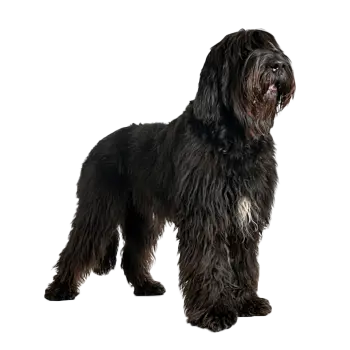
The coat is the defining feature of the Cane da Pastore Bergamasco and requires its own explanation. Three distinct fiber types are present: a fine, oily inner layer called the dog hair; a coarser, longer outer layer called the goat hair; and a woolly, crimped intermediate layer. These three types tangle together rather than staying separate, creating flat, rope-like mats or flocks that grow from the skin surface outward. This felting process begins around one year of age and develops progressively until the dog is around five to six years old, when the coat reaches full coverage.

The flock coat is not a grooming failure or a neglected coat. It is the correct coat for this breed, developed over centuries to protect the dog in alpine conditions. Once fully formed, the flocks reach the ground and cover the entire body except the face and the lower legs. Coat color ranges through all shades of gray, including the distinctive merle-pattern gray, as well as black. A uniform black coat is accepted, and dogs may have various shades of gray from pale silver to coal. White markings are permissible but should be limited.

Movement is free and elastic, with a characteristic rolling quality produced by the weighted coat. Despite the coat's considerable bulk in an adult, the dog beneath moves with the ease and endurance that alpine herding demanded.

The overall impression the Cane da Pastore Bergamasco creates is one of quiet substance. It is not a dramatic dog in the way of the Molosser breeds or the sleek breeds developed for speed. It is a dog that has been doing the same essential job for a very long time, and its body reflects that continuity. There is nothing wasted in the structure of the Bergamasco - every feature serves a purpose that traces back to mountain pastures and alpine winters. People who encounter the breed for the first time are often struck by both the coat and by the calm, intelligent expression looking out from beneath it.

Affectionate With Family
The Cane da Pastore Bergamasco is a profoundly devoted family dog. These are loyal, attentive companions who thrive on close contact with their people and do not fare well when isolated.
Good With Young Children
Patient, calm, and gentle, the Bergamasco is one of the better large herding breeds for families with children. Their even temperament and lack of aggression make them reliable companions for kids of all ages.
Good With Other Dogs
The Cane da Pastore Bergamasco generally coexists well with other dogs. Their calm, non-dominant nature means inter-dog conflict is uncommon in well-socialized individuals.
Shedding Level
The Bergamasco is a non-shedding breed. The unique three-layer coat does not shed in the conventional sense, making it a practical choice for owners concerned about loose hair in the home.
Coat Grooming Frequency
Once the coat's flocks are fully formed, maintenance drops significantly. The critical period is the first two years, when the coat must be actively separated and managed to develop correctly.
Drooling Level
Drooling is not a characteristic of this breed. The Cane da Pastore Bergamasco has a relatively tight lip line and is not prone to the drooling associated with heavier-jowled breeds.
Coat Type
The Bergamasco coat is unlike any other in the dog world. Three distinct hair types - dog, goat, and wool - felt together over time into flat, rope-like mats that cover the body from shoulder to tail.
Openness To Strangers
The Cane da Pastore Bergamasco is calm with strangers once assured of their intentions, though it is not immediately effusive. A brief reserve gives way to friendly acceptance in well-socialized dogs.
Playfulness Level
These dogs enjoy interactive play and have a genuine sense of humor that surfaces with trusted people. They are not relentlessly energetic, but they appreciate engagement and activity.
Watchdog/Protective Nature
The Cane da Pastore Bergamasco is an alert watchdog that will announce the presence of strangers. It is not an aggressive guarder but maintains a calm, watchful awareness of its environment.
Adaptability Level
With adequate daily exercise and indoor access, the Bergamasco adapts reasonably well to varied living situations. It does not thrive in isolation but can manage urban environments given the right setup.
Trainability Level
The Cane da Pastore Bergamasco is highly intelligent and genuinely willing to cooperate, though its independent judgment means training works best when the dog understands the purpose rather than simply the command.

Cane da Pastore Bergamasco History & Development

The history of the Cane da Pastore Bergamasco is a story of mountains, sheep, and extraordinary longevity. This is one of the oldest herding breeds in Europe, with origins that researchers have traced back at least two thousand years, and possibly much longer. The breed developed in the high pastures of the Italian Alps - specifically in the area around Bergamo in the Lombardy region - where it worked alongside shepherds managing flocks of sheep in terrain that was demanding, remote, and exposed to extreme weather.

The Bergamasco coat, the breed's most distinctive feature, was not developed for aesthetics. It was developed for function. The flocked coat provided protection from the cold and wet of alpine winters, from the sun at high altitude, and from the teeth and claws of wolves and other predators that threatened both the flock and the dog. The coat was, quite literally, a tool of survival, and the shepherds who developed the breed selected for it as carefully as they selected for intelligence and working ability.

The name Cane da Pastore Bergamasco embeds this history clearly. Cane da Pastore means shepherd's dog in Italian - not a decorative or companionate function, but the specific role of a working partner to the pastori who moved flocks across the Alpine transhumance routes between summer and winter pastures. Bergamasco identifies the specific geographic region of that work. The name is a record of the breed's purpose and place of origin preserved in language.

The breed nearly vanished after World War II. The wool industry that had sustained the shepherding economy of the Italian Alps collapsed, the transhumance routes became economically unviable, and the specific working function that had made the Cane da Pastore Bergamasco essential faded along with them. By the 1960s, the breed was critically endangered, with only a handful of individuals remaining.

The revival of the Cane da Pastore Bergamasco was led primarily by Dr. Maria Andreoli, an Italian geneticist who recognized the breed's peril and committed herself to its preservation. She located surviving dogs, documented the breed's characteristics, established a structured breeding program, and worked to raise awareness both in Italy and internationally. Her efforts created the foundation for the modern Bergamasco population. FCI recognition under the full Italian name Cane da Pastore Bergamasco was established, and international clubs in the United States, the United Kingdom, and other countries formed to support the breed's expansion beyond Italy.

AKC recognition in 2015 brought the breed to the attention of American dog enthusiasts in a formal way, though the population remains small. The Bergamasco is genuinely rare, and that rarity is part of what makes the community surrounding it so dedicated and knowledgeable. Those who seek out the Cane da Pastore Bergamasco today are typically drawn by its unique coat, its ancient lineage, and its calm, thoughtful temperament - qualities that have remained consistent through two thousand years of careful, purposeful selection. The breed's rarity adds to rather than detracts from its appeal for people who want a dog with genuine depth of history and character.

Cane da Pastore Bergamasco Temperament & Personality

The Cane da Pastore Bergamasco carries a temperament that reflects its working heritage in specific and traceable ways. The shepherds who developed this breed in the Italian Alps did not want a dog that required constant direction. They wanted a partner - a dog intelligent enough to assess situations independently, calm enough to work with a flock without introducing panic, and devoted enough to remain reliably with its shepherd through seasons of demanding outdoor work. Those qualities are still present in the modern Bergamasco.

This breed's intelligence is of the deliberate, observational variety. The Bergamasco watches its environment carefully, notices patterns, and responds to situations with a considered quality that can initially seem like slowness but is actually thoughtfulness. These dogs learn quickly, retain what they learn reliably, and apply that knowledge with judgment rather than mechanical compliance. The shepherds who relied on them valued that quality above almost anything else.

With family, the Cane da Pastore Bergamasco is deeply devoted and demonstrably warm. These are not standoffish dogs within their trusted circle. They follow their people around the house, settle close when the family is gathered, and show genuine investment in the emotional tenor of the household. They are notably good with children - patient, calm, and disinclined to the nervous reactivity that characterizes some other herding breeds. The combination of good size, steady temperament, and low aggression makes the Bergamasco one of the better family herding dogs available.

With strangers, the Bergamasco is calm rather than suspicious. A brief period of assessment gives way to a friendly, relaxed reception in well-socialized dogs. This is not a breed that greets every visitor with alarm or that requires elaborate management when guests arrive. That calm is one of the breed's most appealing qualities for people who want a dog that is functional in a normal household.

The breed's herding instincts are present but moderate compared to some other herding breeds. The Bergamasco was developed to work at the pace of a moving flock over long distances rather than in the tight, intense bursts associated with tending breeds. That translates in the home to a dog that is active and alert but not relentlessly high-energy. Daily exercise satisfies the breed, and a tired Bergamasco is a wonderfully settled household companion.

When under-stimulated or left alone for extended periods without interaction, the Bergamasco can become anxious or develop unwanted behaviors. This is a breed that was developed to work in partnership, not in isolation. Owners who provide consistent companionship, daily exercise, and appropriate mental engagement will find the Bergamasco an exceptionally stable and rewarding dog.

One quality that experienced Bergamasco owners often mention is the breed's capacity to read human emotion. These dogs are perceptive in a way that seems connected to their long history working closely with shepherds across long, demanding days. They notice when something is off in the household and respond accordingly. That attentiveness is one of the breed's quieter pleasures, and it makes the Bergamasco a genuinely companionable presence in a way that breeds with less herding intelligence sometimes do not match.

Cane da Pastore Bergamasco Family Life & Living Requirements

The Cane da Pastore Bergamasco is genuinely one of the better herding breeds for family life. Its combination of medium-large size, calm temperament, patience with children, and low-aggression personality profile makes it well-suited to active households that want a working-type dog without the intense management demands of some other herding breeds.

Children and Bergamascos typically get along well when the dog has been properly socialized and the children have been taught to interact respectfully with large dogs. The breed's natural patience and its non-reactive temperament create good conditions for a positive relationship. Unlike some herding breeds that may attempt to herd children or that are easily overwhelmed by chaotic household energy, the Bergamasco tends to settle into family dynamics with relatively little friction.

The breed requires close indoor access to its family. This is not a dog that does well kenneled outside or left in a yard for long stretches. The Cane da Pastore Bergamasco was developed to live and work alongside its shepherd, and the social bond that working relationship created is still part of the breed's psychology. Isolation produces anxiety. Companionship produces a calm, content, and functional family dog.

Housing flexibility is reasonable. A home with outdoor access and a securely fenced yard is ideal, but the breed can adapt to urban environments with committed daily exercise and access to outdoor spaces for exploration and decompression. One practical consideration for apartment or urban dwellers is the coat's tendency to carry debris - leaves, twigs, burrs, and plant material all adhere readily to the flocked coat. Regular checks and brief outdoor coat inspections become routine.

Exercise needs are moderate by working dog standards. Daily walks of 45 to 60 minutes, supplemented by off-leash time to explore and move freely, generally satisfies the Bergamasco. The breed does not require the relentless exercise demands of some other herding dogs, which makes it more accessible to active families who cannot dedicate hours per day to exercise. Mental stimulation - training sessions, puzzle work, nose work - supplements physical exercise and keeps the breed's considerable intelligence engaged.

Prospective owners should understand what the Bergamasco's coat demands before acquiring the dog. The flocked coat carries outdoor debris indoors readily, requires a specific bathing and drying routine that takes significantly longer than with smooth-coated breeds, and is unlike any other grooming commitment in the dog world. That coat is part of what makes the Bergamasco extraordinary, and being prepared for it is part of being a good Bergamasco owner.

Cane da Pastore Bergamasco Training & Exercise Needs

Training the Cane da Pastore Bergamasco is a cooperative rather than directive experience. The breed's shepherding origins produced a dog that was selected specifically for independent judgment - dogs that could make good decisions without being told every moment what to do. That quality persists in the modern Bergamasco and shapes how training works best with this breed.

Positive reinforcement is the most effective approach. The Bergamasco responds readily to training when it understands the purpose behind the request and when the handler's communication is clear and consistent. Harsh corrections or overly mechanical repetition are counterproductive. This is a dog that thinks about what it is being asked and why. Training methods that engage that thinking quality work far better than those that attempt to suppress it.

Basic obedience - sit, stay, come, heel, down, leave it - is genuinely important for a dog of this size and with this level of independence. A Bergamasco that does not come reliably when called and that does not walk calmly on leash is harder to manage safely, particularly given the breed's moderate size and the physical leverage it can apply when it decides to go somewhere different than planned. These foundations should be established in puppyhood and maintained consistently.

Socialization is important but somewhat less intensive than for more guardian-oriented breeds. The Bergamasco's natural temperament is calm and non-reactive, which gives it good baseline sociability. That said, puppies that are exposed to varied people, environments, sounds, and situations during the critical period develop into more confident, adaptable adults. The goal is reliability across a wide range of circumstances.

Exercise needs are moderate and manageable. Plan for 45 to 60 minutes of active daily activity - brisk walks, off-leash exploration, structured play, or other activities that give the dog purposeful movement. The Bergamasco does not require the hours of intense exercise that some working breeds demand, but consistent daily activity is important for both physical health and behavioral stability. Dogs that receive regular exercise and adequate mental engagement are noticeably calmer and more pleasant to live with than those that are under-stimulated.

The breed's independence, which was such a valued working quality in the Alps, occasionally surfaces in training as selective compliance. The Bergamasco is not defiant - it is evaluating. Keeping sessions varied, rewarding generously for genuine engagement, and maintaining a patient rather than repetitive approach tends to produce the best outcomes with this thoughtful and capable breed.

Cane da Pastore Bergamasco Health Concerns

The Cane da Pastore Bergamasco is a notably robust breed with a documented lifespan of 13 to 15 years - exceptional for a dog of its size. The AKC has described the breed as robustly healthy, and the breed's limited gene pool has not produced the concentrated health problems seen in some more heavily bred popular breeds. That said, prospective owners should understand the documented health concerns that do exist.

Gastric dilatation-volvulus (bloat) risk is elevated in breeds of this size and build. Deep-chested dogs of the Bergamasco's proportions carry a higher baseline risk. Feeding twice daily, avoiding vigorous exercise immediately around mealtimes, and discussing prophylactic gastropexy with your veterinarian are all practical preventive measures. Skin health under the flocked coat requires monitoring; trapped moisture can create conditions favorable to bacterial and yeast overgrowth if the coat is not properly maintained and dried after bathing. Regularly parting the flocks to check the skin beneath catches developing problems before they become significant. This is a simple habit that experienced Bergamasco owners build into their routine from early on.

Common Health Issues

  • Hip dysplasia: Documented in the breed across all lines. Abnormal hip joint development that can progress to arthritis and lameness. OFA certification or PennHIP evaluation for both parents and ideally grandparents is recommended before purchasing a puppy - Given the breed's small gene pool.
  • Progressive retinal atrophy and cataracts: Eye conditions that can affect vision - A current CAER examination by a board-certified veterinary ophthalmologist is recommended for breeding animals. Buyers should ask to see recent eye exam documentation for both parents.
  • Degenerative myelopathy - DM, gene carriers: Carrier status for the DM mutation has been documented in Bergamasco breed lines. A DNA test is available. Carriers are not expected to develop the disease, but breeding two carriers together risks producing affected offspring. Responsible breeders test and pair animals to avoid this.
  • Gastric dilatation-volvulus - Bloat, : Elevated risk in medium-large, deep-chested breeds like the Bergamasco. A life-threatening emergency requiring immediate veterinary care. Preventive feeding practices and discussion of prophylactic gastropexy with your veterinarian are recommended.
  • Skin infections under the coat: The flocked coat can trap moisture and debris - Creating conditions favorable to bacterial or yeast overgrowth if not properly maintained. Thorough drying after bathing and regular coat inspection reduce this risk considerably.

Preventive Care & Health Monitoring

  • OFA hip evaluation or PennHIP: Recommended for all breeding dogs. The National Bergamasco Sheepdog Alliance advises verifying both parents' and ideally grandparents' hip certifications before purchasing a puppy - Given the breed's limited gene pool.
  • CAER ophthalmologist examination: A current eye exam by a board-certified veterinary ophthalmologist with normal results is recommended for breeding animals - Ask to see recent documentation when evaluating a puppy.
  • Heart murmur evaluation: A cardiac check after four months of age is part of the recommended pre-breeding health screening for this breed - Ask breeders whether this has been completed for both parents.
  • Degenerative myelopathy DNA test: A DNA test for the DM mutation is available and can identify carriers within breeding programs - Responsible breeders use this information to make pairing decisions that avoid producing affected offspring.
  • Proper coat drying after bathing: Thorough drying after every bath is essential to prevent moisture-related skin infections under the flocked coat - High-velocity fan drying is the method most commonly used by experienced Bergamasco owners and breeders.

Cane da Pastore Bergamasco Grooming & Maintenance

Grooming the Cane da Pastore Bergamasco is unlike grooming any other breed. The initial learning curve is steeper than most owners expect, but the long-term maintenance commitment is actually lower than many people assume based on the coat's dramatic appearance.

The coat development period - roughly from one year of age to five or six years - is when most of the active work occurs. As the three coat layers (dog hair, goat hair, and wool) begin to tangle and felt together, the owner's job is to separate the forming mats into individual flocks rather than allowing the entire coat to mat together into a single sheet. This separation is done by hand, pulling the forming mats apart into flat, individual rope-like sections that will eventually become the adult flocks. A breeder's guidance during this period is genuinely valuable and not something to skip. Doing it wrong produces a coat that is difficult or impossible to correct without a complete clip-off.

Once the flocks are correctly formed, the ongoing maintenance commitment drops significantly. Brushing is not part of the routine - the flocked coat does not require it and regular brushing would actually disrupt the flock structure. Occasional inspection for debris trapped in the flocks is part of the routine, particularly in dogs that spend time outdoors in vegetation.

Bathing is the main grooming commitment for the adult Bergamasco. The coat should be bathed a few times per year, or as needed when the dog becomes dirty. The significant challenge is drying. The dense, layered flocks hold moisture for extended periods, and a Bergamasco that is not thoroughly dried after bathing can develop mildew in the coat and skin irritation underneath. A high-velocity fan dryer is the tool most breeders use. Plan for drying time to take substantially longer than the bath itself.

Ear care, nail trimming, and dental hygiene complete the maintenance routine. The pendulous ears should be checked weekly for signs of infection. Nails need trimming every three to four weeks. Dental brushing several times weekly reduces tartar and the risk of periodontal disease.