Cairn

Cairn Terrier

Quick Facts

🐕 Breed Group
Terrier Group
📏 Size Category
Small
📏 Height
Males: 10 inches, Females: 9.5 inches
⚖️ Weight
Males: 14 lbs, Females: 13 lbs
⏱️ Life Expectancy
13-16 years
🧣 Coat Type
Double coat - harsh wiry outer, soft dense undercoat
🎨 Coat Colors
Cream, wheaten, red, sandy, grey, brindle
😀 Temperament
Alert, curious, independent, cheerful, loyal
🏃 Exercise Needs
Moderate
🎓 Training Difficulty
Moderate - bright but independent
👶 Good with Children
Yes, sturdy enough to handle kids
🐾 Good with Other Pets
Generally good with dogs, prey drive toward small animals

Other Names & Breed Recognition

People who love this breed often just call it the Cairn - dropping the terrier designation entirely in the same casual way that Labrador owners say Lab or Golden Retriever owners say Golden. The shorthand works because the name itself is distinctive enough to be unambiguous. You say Cairn and anyone who knows dogs knows what you mean.

The full name is the Cairn Terrier, derived from the cairns - the stacked stone monuments and rock piles that dot the Scottish Highland landscape. These structures, used as trail markers, burial mounds, and boundary indicators for centuries, also happened to shelter the foxes, otters, and other small vermin that Highland farmers needed to control. The dogs bred to bolt these animals from the rocks took their name from the landscape feature that defined their working environment. So when you say Cairn, you are invoking Scottish Highland topography, working history, and a centuries-old relationship between farmers and a particularly capable small dog all at once.

In Scotland, before registries formalized the naming, dogs now recognized as distinct breeds were often grouped loosely under the category of Highland terriers or Scotch terriers. The process of separating the Cairn Terrier from what would become the Scottish Terrier and the West Highland White Terrier took place gradually through the late 19th and early 20th centuries. Some breeders resisted the separation, and the resulting territorial debates among early fanciers were quite heated. The Cairn Terrier found its specific identity and AKC recognition in 1913.

The nickname Cairn stuck in part because of the breed's fame following the 1939 film The Wizard of Oz, where a Cairn named Terry played Dorothy's dog Toto. The film introduced the breed to a global audience, and the name became household currency. Today, decades on from that cultural moment, the Cairn Terrier remains one of the most recognized of the Scottish terrier breeds, and the single-word shorthand is fully understood anywhere dogs are discussed.

The nickname is also practical in daily use. Cairn Terrier owners regularly encounter the need to explain or describe their dog in casual conversation, and the single word Cairn carries the full identity without requiring the longer explanation that less familiar breed names often demand. It is the kind of name that feels comfortable in the mouth, used with the easy familiarity of long acquaintance.

Cairn Organizations & Standards

The Cairn Terrier Club of America is the AKC parent club for the breed and the source of breed standards, health testing guidelines, and breeder referrals in the United States. The CTCA works closely with its associated health foundation to fund research and maintain health testing protocols relevant to the breed. The Kennel Club in the United Kingdom recognizes the breed in its Terrier group, as does the FCI under Group 3, Section 2 among small-sized terriers. The Canadian Kennel Club recognizes the breed in its Terrier group as well.

The AKC breed standard describes the Cairn as a short-legged, strongly built terrier with a level back, a broad head with a decided stop, and small, erect ears that should not be over-large or rounded at the tip. The expression is typically described as foxy - alert, sharp, and characterful. The coat is double, with an outer layer that is harsh, dense, and weather-resistant and an inner layer that is soft and close. Colors range from cream and wheaten through sandy, red, and grey to brindle in various combinations; white and black and tan are not acceptable under the standard. Males weigh approximately 14 pounds and stand 10 inches; females are slightly lighter at 13 pounds and 9.5 inches.

Health testing guidelines from the CTCA address specific conditions documented in the breed. The recommended testing protocol includes a DNA test for pyruvate kinase deficiency, bile acid testing for liver shunt screening (recommended for all puppies at 12 to 16 weeks as well as adults prior to breeding), ophthalmology examination by a veterinary ophthalmologist for ocular melanosis screening, cardiac evaluation, patellar luxation evaluation, and a DNA test for globoid cell leukodystrophy. The CTCA has invested significantly in research into conditions specific to this breed, and the testing protocol reflects that investment.

Breeder referrals through the CTCA website connect prospective owners with members who have agreed to follow the club's code of ethics and health testing requirements. The Foundation of the Cairn Terrier Club of America separately funds health research and maintains educational resources for owners at cairnterrierhealth.org. Together these organizations represent a well-developed support infrastructure for a breed whose owners tend to be deeply engaged with its welfare.

The CTCA also maintains a breeder code of ethics that participating breeders agree to uphold, covering health testing, honest representation of breeding stock, support for puppy buyers, and the commitment to take back any dog bred by them that the owner can no longer keep. This network of commitments represents the infrastructure that separates conscientious breeding from purely commercial production, and for buyers who use the parent club as a starting point, it provides meaningful assurance about the practices behind the puppies they are considering.

Kennel Club Recognition

  • American Kennel Club (AKC): Recognized in 1913, Terrier Group
  • United Kennel Club (UKC): Recognized, Terrier Group
  • Canadian Kennel Club (CKC): Recognized, Terriers
  • FCI: Recognized, Group 3 - Terriers
  • The Kennel Club (UK): Recognized, Terrier

Cairn Physical Description

The Cairn is a compact, sturdy little dog that manages to look simultaneously tough and completely approachable. This is not a delicate terrier; it is a working dog in a small package, built to scramble over rocks, pursue prey into burrows, and survive Scottish weather without complaint. The overall impression is of solid, well-balanced construction - no exaggeration anywhere, nothing fragile, nothing overdone.

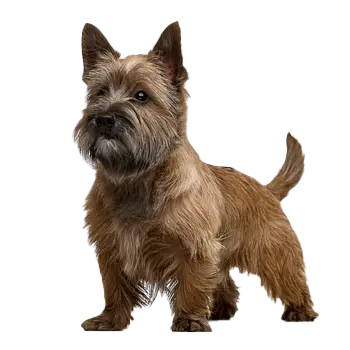
The head is broad and well-covered in shaggy hair that creates a rounded, almost untrimmed appearance consistent with the breed's natural look. The skull is broad with a well-defined stop between the eyes. The muzzle is strong and well-developed, not snippy. The small, erect ears sit wide apart on the skull, pointed and neat, carrying the shaggy coat but not overwhelmed by it. The eyes are set wide apart and deep, dark hazel in color with a dark surround that emphasizes the keen, foxy expression the standard describes. That expression - inquisitive, alert, ready - is one of the most characteristic things about this breed.

The neck is moderately long, the back level and strong over a short, compact body. The chest reaches to elbow level and is well-developed without being barrel-shaped. The body proportions are slightly longer than tall, which together with the short legs gives the characteristic low-slung silhouette. The tail is short, well-covered with hair, carried erect but never over the back in a tight curl.

The legs are short, strong, and covered with shaggy coat. The forefeet are larger than the hind, with thicker pads and stronger construction reflecting the working purpose - these feet were meant to dig. The hindquarters are strong and muscular with well-developed second thighs. The gait is free and springy with a level topline, covering ground efficiently in a way that reflects the breed's working purpose.

The coat is one of the defining features of the breed. The outer coat is hard, harsh to the touch, and dense, not silky or wavy. It lies naturally without any particular tendency to mat in well-conditioned coats. The undercoat is short, soft, and close - a genuine insulating layer that made this dog functional in cold, wet Highland conditions. Color variety is one of the pleasant characteristics of the breed: creams, wheatens, reds, greys, and brindle patterns in multiple combinations give the Cairn an appealing visual diversity that does not occur in many single-colored terrier breeds. The coat may change shade as the dog matures, and puppies often differ noticeably from their eventual adult color.

Size is deliberately kept modest: 14 pounds and 10 inches for a male, 13 pounds and 9.5 inches for a female. This is a dog that fits in most households, travels easily, and manages stairs and furniture without the accommodation required for larger breeds, while still being sturdy enough to keep up with an active family.

The expression the standard calls foxy is worth dwelling on because it captures something genuine. When you look a well-bred Cairn in the face, you see an animal that is paying full attention. The eyes are bright and ready, the ears are tracking, and the overall quality of the face suggests an animal actively processing its environment. That engaged quality - present, attentive, interested - is as much a breed characteristic as any measurement in the standard, and a Cairn without it fails to capture what this dog actually is. The physical description is not merely an inventory of parts; it is the material expression of a character that was shaped by centuries of work in demanding terrain. That engaged quality - present, attentive, and ready to act - is what makes the Cairn's face so consistently compelling to the people who love the breed.

Affectionate With Family
A Cairn wraps itself around its family completely - alert to everyone's moods, present in every room, and genuinely delighted to spend time with the people it loves.
Good With Young Children
Sturdy, playful, and good-humored, the Cairn handles the energy and unpredictability of children better than many small breeds. They are not fragile dogs and they enjoy a romp.
Good With Other Dogs
Generally sociable with other dogs, though the terrier's confident personality means it rarely backs down from a challenge. Proper introductions and early socialization produce the best multi-dog outcomes.
Shedding Level
The double coat sheds moderately rather than heavily, and much of the dead coat stays trapped in the outer layer until brushed out. Regular grooming manages shedding effectively.
Coat Grooming Frequency
The wiry coat benefits from regular brushing and periodic hand-stripping to maintain correct harsh texture. Owners who clip rather than strip will find the coat softens over time.
Drooling Level
Not a drooler. The Cairn's tight, dry muzzle means this is not a consideration in choosing whether the breed fits your household.
Coat Type
A double coat with a harsh, weather-resistant outer layer over a dense soft undercoat. This combination made the breed functional in Scotland's rugged climate and still provides good protection today.
Openness To Strangers
Curious rather than suspicious, a Cairn will check out new people with interest. They warm up quickly and are generally friendly, though some individuals are more reserved than others.
Playfulness Level
One of the most playful small breeds available. The Cairn's energy and humor never really disappear with age - these dogs remain game for fun well into their senior years.
Watchdog/Protective Nature
Alert and quick to announce anything unusual, the Cairn makes a reliable watchdog despite its small size. The bark is confident and carries well.
Adaptability Level
Highly adaptable to different living situations. The Cairn does well in apartments, houses, and rural settings alike, provided its exercise and companionship needs are met.
Trainability Level
Bright and eager to engage, a Cairn learns quickly when training is kept positive and interesting. The independence that makes them charming also means they evaluate instructions rather than automatically following them.

Cairn History & Development

The name Cairn Terrier describes both a working function and a landscape. In Scotland, a cairn is a heap of rough stones - a marker, a monument, a boundary indicator. These stone structures also happened to provide ideal habitat for the small animals that Highland farmers needed to control: foxes that took poultry, otters that raided fish traps, rats that depleted grain stores, and other vermin that competed with or preyed on farm livestock. The dogs bred to bolt these animals from the rocks were named for the landscape feature that defined their work, and the name stuck.

Before formal registries organized dog breeds into distinct categories, the various small terriers of the Scottish Highlands were often grouped loosely as Highland terriers or Scotch terriers. The dogs that would eventually be recognized as the Cairn Terrier, the Scottish Terrier, and the West Highland White Terrier shared significant overlap in the early years of organized dog shows, and the process of differentiating them involved considerable debate among breeders who had strong opinions about which type represented the authentic original. The Cairn Terrier Club was established in 1910, and AKC recognition followed in 1913.

The breed's history on the Isle of Skye in the Inner Hebrides is particularly documented, with references to small terriers working alongside the MacLeod clan in the 17th century and continuing through the period when the breed's formal history began to be recorded. The Skye connection is interesting because Skye Terriers were a separate and sometimes competing breed claim, and the early Cairn breeders worked to establish clear distinctions.

The cultural moment that defined the breed's popular recognition was the 1939 film The Wizard of Oz. Terry, a Cairn Terrier bitch, played Toto alongside Judy Garland, and the film's global reach introduced the breed to an audience that stretched far beyond terrier enthusiasts. The AKC registration numbers for the breed increased substantially following the film's release, a pattern familiar in other breeds that achieve cinematic fame.

Today the Cairn Terrier maintains healthy popularity without the boom-and-bust cycles that affect breeds driven purely by celebrity or fashion. The dedicated ownership community, active parent club, and the breed's genuine suitability as a companion for a wide range of households have sustained it as a consistently well-regarded choice for people who want a small terrier with character.

The Isle of Skye connection also explains some of the confusion in early breed history between the Cairn Terrier and the Skye Terrier, which is a different and much longer-coated breed. Early fanciers sometimes used place names loosely in describing their dogs, and the records from before formal registration are not always precise. What can be said with confidence is that the type of small, double-coated, earth-working terrier represented by today's Cairn has been documented in the Scottish Highlands for at least three centuries, and that the formal breed identity organized around this type has been consistent since 1910. What can also be said is that the breed community's active health research and strong parent club reflect the same investment in a reliable working type that motivated the original Highland farmers who developed these dogs - the form of that investment has changed, but the underlying commitment to the breed's integrity has not.

Cairn Temperament & Personality

If you want a small dog that acts like a big dog, the Cairn is a strong candidate. This breed has no particular awareness of its own size relative to the world, and it applies the same confident, curious energy to a 200-pound mastiff it has just met as to a chipmunk under the deck. That fearlessness was bred in on the rocky hillsides of the Scottish Highlands and it has not diminished in the centuries since. You will need to manage it, but you will also enjoy it immensely.

The Cairn is curious about everything. This is a dog that needs to investigate the interesting smell, look behind the door, check what just moved in the grass, and examine the new object you brought into the house. That curiosity is part of what makes them entertaining companions - they are interested in the world and they want to share their discoveries with you. It also means an unsupervised Cairn can find its way into situations its owner would have preferred to prevent.

With family the Cairn is warm, demonstrably affectionate, and deeply loyal. These dogs track their people through the house, want to be in the same room, and express strong preferences about sleeping arrangements that usually end up in the family's favor. They form close bonds across household members but often have a special person whose moods and schedules they monitor with particular attention.

The independent streak is real and requires honest acknowledgment. The Cairn will hear your command, weigh it against whatever else is going on, and decide whether compliance serves its interests at this particular moment. This is not defiance in any mean-spirited sense; it is the self-directedness of a dog that was bred to make decisions in terrain where waiting for instructions from a handler was not practical. Training works best when it makes compliance the obviously attractive option rather than relying on authority alone.

Digging and chasing are hardwired drives that no amount of training fully eliminates. A garden with the Cairn has a different relationship to flower beds and lawn edges than a garden without one. These dogs dig because they were bred to dig - their feet are built for it and the impulse comes from deep in their genetic makeup. Providing sanctioned outlets for digging and managing access to priority landscaping produces better outcomes than trying to extinguish the behavior entirely.

The Cairn's cheerfulness is one of its most valued qualities. These dogs are happy. They bring an upbeat, engaged energy to daily life that is genuinely mood-lifting for the people around them, and they maintain that quality well into old age. A Cairn at twelve is often indistinguishable in energy and enthusiasm from one at three.

Socialization requirements for the Cairn deserve specific mention. These dogs benefit enormously from broad exposure during the first four to five months of life - different people, different environments, different sounds, different animals. A Cairn that was well-socialized as a puppy carries that investment forward for its entire life in the form of a calmer, more adaptable adult. The breed's natural confidence means it handles new situations reasonably well even without extensive early socialization, but the ceiling on that adaptability is considerably higher for dogs that had rich early experiences.

Cairn Family Life & Living Requirements

The Cairn fits comfortably into most living situations, which is part of what has kept it consistently popular across diverse owner demographics. Apartments, suburban houses, and farm settings all suit this breed provided the basics are covered: daily exercise, companionship, mental engagement, and secure containment. The small size is genuinely practical for apartment dwellers, and the moderate exercise needs do not require a large property.

With children the Cairn performs exceptionally well for a small breed. The stocky, well-muscled build means the dog is not easily injured by clumsy handling, and the breed's good humor and playfulness align naturally with children's energy. Early socialization that includes exposure to children's unpredictable movements and sounds produces a dog that genuinely enjoys the dynamic energy of a family with kids. Respect for the dog's space and basic bite-prevention education remain important regardless of breed, but the Cairn is a genuinely good family dog rather than merely a tolerated one.

Containment deserves serious attention. The Cairn is a digger, and a standard fence without a digger deterrent along the base is an invitation the dog will eventually accept. Digging under the fence is a real behavior pattern in this breed, not a remote theoretical risk. Additionally, the prey drive that activates on any small, fast-moving creature passing within sight can send a Cairn over or through inadequate fencing in moments of high excitement. A secure yard is a genuine requirement.

This breed does not do well with extended solitude. Cairns are people-oriented dogs that expect company as part of their daily experience, and a dog left alone for long hours regularly will develop the behavioral outlets - nuisance barking, destructive chewing, excessive digging - that characterize an understimulated social animal. If your schedule involves long daily absences, planning for dog walkers, doggy daycare, or another canine companion is a reasonable and responsible step.

One advantage the Cairn offers families with varying daily schedules is the breed's genuine adaptability to pace. On busy days when the walk is shorter or the play session is briefer, the Cairn adjusts with reasonable good humor. On days when more time is available, the dog is a cheerful and engaged companion for extended outings. This flexibility, combined with the breed's manageable size and moderate exercise needs, makes the Cairn one of the more practically suitable terrier choices for households that cannot guarantee a perfectly consistent daily routine. This flexibility makes the Cairn a reliably pleasant houseguest in the broadest sense - it goes along with the family's life rather than demanding the family's life reorganize around it.

Cairn Training & Exercise Needs

Training a Cairn works best when you approach it as a negotiation rather than a directive. These dogs are smart enough to understand what you want, experienced enough in their own judgment to evaluate whether they want to do it, and playful enough that they will engage enthusiastically if you make training fun. The owners who get the best results with Cairns are those who find the combination of clarity, consistency, and genuine entertainment that keeps the dog's interest engaged.

Positive reinforcement with high-value food rewards is the foundation. The Cairn is genuinely food motivated, and a dog that associates coming to you with good things happening will cooperate much more reliably than one trained through corrections. Short sessions with clear criteria and prompt rewards build the association between behavior and reward quickly. Once a behavior is reliably on cue, gradually fading the treats while maintaining the behavior through variable reward schedules keeps the dog working without requiring a treat for every repetition.

The areas that require specific training attention are recall and digging, both driven by the same underlying terrier instincts. Recall training should begin in low-distraction environments and be raised in difficulty very gradually, never expecting a Cairn to be reliable in high-arousal situations without having put in substantial training time specifically at that difficulty level. Coming when called should be the most rewarding thing that can happen to the dog, consistently, or the dog will continue to weigh its options. Digging management involves both providing sanctioned dig spots and making restricted areas less appealing through barriers or deterrents.

Exercise needs are moderate. A Cairn is not a dog that requires marathon runs or extensive territory, but it needs daily opportunity to move, explore, sniff, and discharge energy. Two twenty-minute outings with genuine sniffing opportunities and occasional off-leash play in a secure space satisfies most Cairns. The mental component of exercise - the opportunity to problem-solve, investigate, and engage the terrier brain - is at least as important as the physical component. A Cairn that has sniffed its way through a new environment will be calmer and more settled than one that has only walked on leash around the same familiar block.

One aspect of the Cairn's training that owners sometimes overlook is the value of nose work and scent-based activities. These dogs have strong scenting ability and using it constructively - through formal nose work classes, treat searches around the house, or tracking on leash - provides the kind of deep mental satisfaction that general obedience work alone does not always achieve. A Cairn that has spent thirty minutes working a scent puzzle is genuinely tired in a way that a thirty-minute walk may not produce.

Cairn Health Concerns

The Cairn Terrier is a basically healthy breed with an enviable lifespan of 13 to 16 years, and the Cairn Terrier Club of America's health foundation is one of the more active and research-oriented in the terrier world. That said, several specific conditions are documented in the breed, and responsible breeders test for the ones that have available screening tools.

Regular veterinary wellness examinations at least annually - and twice yearly for dogs over seven - provide the baseline monitoring that catches developing conditions before they become crises. The Cairn's long lifespan means these dogs are with you for a considerable time, and the investment in consistent preventive care throughout that life pays dividends in both quality of life and reduced emergency intervention.

Common Health Issues

  • Ocular melanosis: A condition essentially specific to Cairn Terriers in which pigmented cells accumulate in the anterior chamber of the eye - Potentially causing secondary glaucoma and vision loss. Annual ophthalmology examination is the primary screening tool.
  • Craniomandibular osteopathy: Abnormal bone growth along the jaw and skull in puppies 3 to 8 months old - Causing pain and difficulty eating. Most cases resolve at skeletal maturity but severe cases can have lasting effects. DNA test available.
  • Portosystemic liver shunt: Abnormal vascular connection bypasses the liver - Preventing toxin filtration. Documented above average incidence in Cairns. Bile acid testing at 12 to 16 weeks screens puppies before placement.
  • Pyruvate kinase deficiency: Genetic enzyme defect in red blood cells causing hemolytic anemia - DNA test identifies affected and carrier dogs. Affected dogs typically do not survive past four years.
  • Hypothyroidism: Reduced thyroid hormone output causing weight gain - Lethargy, and coat changes. Documented at above-average rates in the breed. Annual thyroid panel recommended for older dogs and all breeding stock.
  • Patellar luxation: The kneecap slips out of its groove - Causing intermittent hind limb lameness. Higher incidence than average for small breeds.

Preventive Care & Health Monitoring

  • DNA testing for PK deficiency and CMO before breeding: Both conditions have DNA tests that allow breeders to avoid producing affected puppies - Buyers should ask for test results on both parents.
  • Bile acid testing at 12 to 16 weeks: Screens puppies for portosystemic liver shunt before placement - The CTCA recommends this as a standard screening for all Cairn puppies.
  • Annual ophthalmology exam from age 2: Ocular melanosis is detectable only through examination - Starting annual exams at two years and continuing through the dog's life is the current recommendation.
  • Cardiac evaluation and patellar assessment for breeding stock: Both are part of the CTCA health testing protocol and provide baseline information for breeding decisions. - Cardiac evaluation and patellar assessment for breeding stock: Both are part of the CTCA health testing protocol and provide baseline information for breeding decisions.
  • Regular dental care: Daily tooth brushing plus periodic professional cleanings addresses the above-average dental disease risk documented in this breed. - Regular dental care: Daily tooth brushing plus periodic professional cleanings addresses the above-average dental disease risk documented in this breed.

Cairn Grooming & Maintenance

The Cairn's double coat is hardy, naturally weather-resistant, and designed to look somewhat casual and ungroomed - which is fortunate, because the breed's active lifestyle means it regularly looks like it has been doing something interesting. Regular maintenance keeps the coat healthy and functional without requiring the elaborate grooming that some terrier breeds demand.

For owners who want to maintain correct harsh coat texture, hand-stripping twice a year - pulling out the dead outer coat by hand rather than cutting it - is the traditional approach. Hand-stripping preserves the harsh guard hair texture that is characteristic of the breed and keeps the color true. Owners who prefer convenience often clip the coat instead, which is perfectly acceptable for a companion dog but does result in the coat softening and sometimes changing shade over time as the clipped coat grows in with a different texture.

Between strippings or trimmings, brushing two to three times weekly prevents mats from forming in the soft undercoat and removes debris picked up in outdoor exploration. Cairns that spend time in brushy areas may need checking more often for plant material and burrs caught in the outer coat. Bathing every four to six weeks, or when the dog has made itself genuinely dirty, is sufficient.

Nails should be trimmed every three to four weeks. Ear cleaning every couple of weeks, along with checking the ear canals for redness or odor that might indicate early infection, is good routine practice. Dental care is genuinely important for this breed - daily brushing is ideal, and at minimum several times per week, to counter the above-average tendency toward dental disease. The Cairn's good humor extends to grooming sessions when they are started in puppyhood, and a dog that has always been handled for nail trims, ear cleaning, and brushing treats these as normal parts of life rather than ordeals.

The casual, somewhat rough appearance of the well-groomed Cairn is part of its character. This is not a breed meant to look polished or coifed - it is a working terrier whose appearance should suggest it has been doing useful things outdoors. Owners who accept and appreciate that aesthetic find the grooming requirements straightforward and the results charming. The Cairn that looks like it just came back from an adventure probably did.