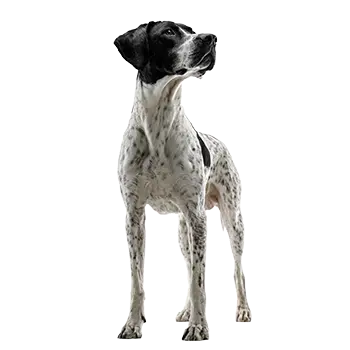
The Braque d'Auvergne presents a picture of strength balanced with refinement, a medium to large pointing dog built for endurance rather than speed. The body is essentially square in proportion, with the length from the point of the shoulder to the point of the buttock approximately equal to the height at the withers. Males typically weigh between 55 and 66 pounds, while females range from 44 to 55 pounds. The overall impression should be of a robust, strongly boned dog without heaviness, possessing the lightness of construction and harmonious proportions that distinguish the braque type from heavier continental breeds. The chest is deep rather than wide, reaching to the elbow, with oval-shaped ribs that provide ample lung capacity for sustained work. The withers are high and well defined, the back is short and straight, and the loin is short and wide, particularly in females.
The head is one of the breed's most distinctive features, long and proportional to the body with a nearly oval skull when viewed from above. The lines of the skull and muzzle are slightly divergent, a characteristic braque trait that distinguishes it from breeds with parallel head planes. The stop is moderate but clearly defined, and the occipital protuberance is only slightly prominent. The muzzle is approximately equal in length to the skull, level in profile, with pendulous lips that overlap to form a square end when viewed from the front. The nose is always black, broad, and shiny with well-opened nostrils. The eyes are relatively large, oval, and dark hazel in color, set well into the orbit and giving an expression that breed enthusiasts describe as candid and kind. The ears are set low and well back on the skull, long and supple with rounded tips and a slight inward fold, reaching nearly to the nose when pulled forward.
The coat is one of the Braque d'Auvergne's most immediately recognizable features. Short, glossy, and slightly softer than the coats of many other pointer breeds, it displays a pattern of black on white that creates a striking visual effect. Two recognized coat patterns exist within the breed. The more common type features a predominantly white body with black ticking that gives a blue or blue-grey impression from a distance, paired with a solidly black head and ears. The rarer charbonne type reverses this emphasis, presenting a predominantly black body with white ticking. In both types, a white blaze extending from the muzzle up to the skull is preferred, and the head and ears are primarily black. The distinction between these two coat patterns is a matter of individual variation rather than a division within the breed, and both are considered equally correct under all breed standards.
The limbs are strong and straight with substantial bone, the forequarters featuring well-angulated shoulders that permit free movement and elbows held close to the body. The hindquarters are strongly muscled with well-defined hock joints and short, strong rear pasterns. Feet are oval in shape with deep, hard pads, tightly knit toes, and strong short nails. The tail is set on as a continuation of the gently sloping croup and was traditionally docked to a length of 15 to 20 centimeters. In countries where docking is prohibited, the natural tail reaches to the point of the hock without extending beyond it and is carried horizontally or slightly above the topline during work. Movement is of moderate amplitude but with a sustained rhythm that produces the breed's notable endurance, with the habitual hunting gait being a steady gallop that is regular and slightly rocking.
Affectionate With Family
★★★★★
The Braque d'Auvergne forms exceptionally deep bonds with its family and is known for its almost constant desire to be in physical contact with its people. This is a breed that was developed to hunt in close partnership with a single handler, and that closeness translates directly into home life. Separation anxiety is a genuine concern with this breed because it simply does not tolerate being away from its household for extended periods. Owners frequently describe the Braque d'Auvergne as a shadow dog that follows them from room to room and settles only when it can see or touch its favorite person.
Good With Young Children
★★★★☆
The Braque d'Auvergne is remarkably gentle and patient with children of all ages, displaying a soft mouth and a careful awareness of its own size around smaller family members. Its sensitive nature means it rarely responds to accidental rough handling with anything more than a quiet retreat. Families with young children will find this breed to be tolerant and protective, often positioning itself near toddlers as a calm guardian. The only caution is the breed's enthusiastic greeting style during its prolonged puppyhood, when its size and exuberance can accidentally knock small children over.
Good With Other Dogs
★★★★☆
Bred to work alongside other gundogs in the field, the Braque d'Auvergne is generally sociable and cooperative with other dogs. It lacks the competitive edge seen in many terrier or guarding breeds and tends to defer rather than escalate during canine disagreements. Multi-dog households that include another sporting breed will typically find the Braque d'Auvergne integrates smoothly. Same-sex aggression is uncommon, and this breed often seeks out canine companionship when its human family is unavailable, making it a good candidate for homes that already have a resident dog.
Shedding Level
★★★☆☆
The short, glossy coat sheds at a moderate rate year-round, with noticeable increases during the spring and autumn seasonal transitions. While the shedding is not excessive compared to double-coated breeds, owners will find loose black and white hairs on furniture and clothing if brushing is neglected. The short length of the individual hairs means they embed in upholstery somewhat stubbornly, so regular brushing two to three times per week during heavy shedding periods helps keep the situation manageable. Outside of seasonal coat changes, a weekly brushing session is generally sufficient to control loose hair.
Coat Grooming Frequency
★★☆☆☆
One of the Braque d'Auvergne's most practical qualities is its low-maintenance coat. The short, smooth hair requires only weekly brushing with a bristle brush or grooming mitt to remove dead hair and distribute natural oils. There is no need for professional grooming, hand-stripping, or clipping. Bathing is only necessary when the dog has gotten into something particularly messy or odorous, and even then, the coat's natural dirt resistance means it dries quickly and cleans up easily. The primary grooming attention should go to the ears, which are long and pendulous and require weekly cleaning to prevent infections.
Drooling Level
★★☆☆☆
The Braque d'Auvergne has pendulous lips that can produce some drool, particularly after drinking or during periods of excitement and anticipation around food. However, this is not a heavy drooling breed in the way that mastiffs or bloodhounds are. Most owners will notice occasional strings of saliva rather than a constant flow. Keeping a towel near the water bowl handles most situations. The breed does tend to be messier drinkers than tight-lipped breeds, and some individuals will trail water across the floor after a long drink.
Coat Type
★★☆☆☆
The single coat is short, glossy, and slightly softer than the coats of many other pointer breeds. It lies flat against the body and provides reasonable weather protection without the bulk of a double coat. The characteristic black and white coloring with ticking or roaning creates the distinctive blue impression that is a hallmark of the breed. The skin beneath is fine and supple, fitting closely to the body without excessive looseness. This coat type is well suited to active field work, drying quickly after water retrieves and resisting the accumulation of burrs and debris in moderate cover.
Openness To Strangers
★★★☆☆
The Braque d'Auvergne is neither excessively outgoing nor particularly reserved with unfamiliar people. It tends to approach strangers with a calm curiosity rather than immediate enthusiasm or suspicion. Initial meetings may involve a brief period of observation before the dog warms up and begins soliciting attention. This moderate approach to strangers makes the breed a poor choice as a guard dog but an excellent companion in social situations once introductions have been made. Proper socialization during puppyhood helps ensure the breed's natural balance does not tip toward timidity.
Playfulness Level
★★★★☆
The Braque d'Auvergne retains a puppy-like playfulness well into adulthood, and the breed is notably slow to mature both physically and mentally. Games of fetch, tug, and chase are enthusiastically received, and the breed's retrieving instinct means it will happily carry toys, sticks, and anything else it can fit in its soft mouth. Interactive play that mimics hunting behaviors such as searching, pointing, and retrieving provides the best mental and physical outlet. The breed's playful nature extends to its interactions with children, making it a willing and energetic play partner for active families.
Watchdog/Protective Nature
★★☆☆☆
The Braque d'Auvergne was bred for cooperation and gentleness, not territorial defense, and this shows in its limited watchdog instincts. While it may bark at unusual sounds or the arrival of visitors, it is far more likely to greet an intruder with a wagging tail and a toy offering than any display of aggression. This breed lacks the protective drive seen in guardian breeds and should not be relied upon for home security. Its value lies entirely in companionship and field work rather than deterrence or defense.
Adaptability Level
★★★☆☆
The Braque d'Auvergne can adapt to various living situations provided its substantial exercise needs are met consistently. It is not an ideal apartment dog due to its size and energy level, but it can manage in a home without a large yard if given two or more hours of vigorous daily exercise. The breed's sensitivity means it does not handle environmental changes, household upheaval, or schedule disruptions as easily as more stoic breeds. It thrives on routine and consistency, and sudden changes in its living situation or family structure can trigger anxiety. Rural or suburban homes with access to safe running areas represent the best fit.
Trainability Level
★★★★☆
The Braque d'Auvergne is highly trainable, combining natural intelligence with a genuine desire to please its handler. It responds exceptionally well to positive reinforcement methods and wilts under harsh corrections or heavy-handed training approaches. The breed's sensitivity is both its greatest training asset and its primary challenge, as it reads handler emotions with remarkable accuracy and can shut down if it senses frustration or impatience. Patient, consistent training with clear communication produces outstanding results, and the breed's natural hunting instincts mean that field training progresses quickly once foundational obedience is established.