Borzaya Sobaka

Borzoi

Quick Facts

πŸ• Breed Group
Hound Group (AKC); FCI Group 10 - Sighthounds
πŸ“ Size Category
Large to Giant
πŸ“ Height
Males: 28 inches minimum (typically 28-32 inches), Females: 26 inches minimum (typically 26-30 inches)
βš–οΈ Weight
Males: 75-105 pounds, Females: 60-90 pounds
⏱️ Life Expectancy
9-14 years
🧣 Coat Type
Long, silky, flat to wavy or slightly curly; soft undercoat thickens in cold weather
🎨 Coat Colors
Any color or combination acceptable; most common are white, white with patches, cream, gold, red, brindle, black, sable
πŸ˜€ Temperament
Gentle, dignified, intelligent, independent, quiet, affectionate, reserved
πŸƒ Exercise Needs
Moderate to High - requires daily sprinting opportunities
πŸŽ“ Training Difficulty
Moderate to High - intelligent but independent; typical sighthound stubbornness
πŸ‘Ά Good with Children
Conditional - gentle but not tolerant of rough handling; best with older children
🐾 Good with Other Pets
Conditional - good with dogs of similar size; very high prey drive toward small animals

Other Names & Breed Recognition

Borzaya Sobaka is the Russian term from which the Borzoi derives its name. In the Russian language, "borzaya" means "fast" or "swift" and "sobaka" means "dog," making the literal translation simply "fast dog." This was the basic descriptive term that Russians used historically for all sighthound breeds, though in common usage the word "sobaka" was typically dropped, leaving just "borzaya" or its masculine form "borzoi" as the standard reference. The Russian naming system for sighthounds was built on descriptive terms rather than proper names: "psovaya" (from "psovina," meaning wavy or silky coat) distinguished the long-haired variety, "hortaya" meant shorthaired, "stepnaya" referred to the steppe type, and "krimskaya" identified the Crimean type. The full official Russian name for the breed known in English as the Borzoi is Russkaya Psovaya Borzaya, meaning "Russian long-haired sighthound."

The breed has carried several English names over its documented history. Until 1936, it was known in the United States and most English-speaking countries as the Russian Wolfhound, a name that directly referenced its primary historical function: coursing wolves on the vast Russian steppes. The name change to Borzoi reflected a broader international movement toward using native designations for breeds rather than descriptive English translations. The change also acknowledged that while wolf hunting defined the breed's historical purpose, modern dogs rarely if ever engage in such activities. The French designation Levrier Russe (Russian Greyhound) appears in some European literature, while the German names Barzaia and Russischer Windhund are used in German-speaking countries.

Other transliterations and informal names include Psowaya Barsaya, Sowaya Barzaya, and BarzoΓ―, reflecting various attempts to render Russian Cyrillic characters into Latin script across different languages and time periods. The Borzoi Club of America and the Borzoi Club UK both prefer "borzoi" as both the singular and plural form, though "borzois" is the more common plural in general English usage and the only plural cited in most dictionaries.

The breed is recognized by every major international kennel club. The American Kennel Club registered its first Borzoi, a dog named Princess Irma, in 1891, placing the breed in the Hound Group where it has remained. The FCI definitively accepted the Russkaya Psovaya Borzaya in 1956, classifying it in Group 10 (Sighthounds), Section 1 (Long-haired or Fringed Sighthounds). The Kennel Club in the United Kingdom places it in the Hound Group, and the Canadian Kennel Club likewise assigns it to the Hound Group. The UKC classifies the breed under Sighthounds and Pariah Dogs. Regardless of which name is encountered, whether Borzaya Sobaka, Borzoi, Russian Wolfhound, or Russkaya Psovaya Borzaya, the reference is to the same tall, elegant, silky-coated sighthound that was the pride of Russian aristocratic hunting for centuries.

Borzaya Sobaka Organizations & Standards

The Borzoi Club of America (BCOA), founded in 1903, serves as the AKC parent club for the breed in the United States. The BCOA maintains the official breed standard, coordinates health research through its health committee, publishes educational resources for owners and breeders, operates a breed rescue network, and hosts the national specialty show that draws Borzoi exhibitors from across the country. The club's Code of Ethics establishes expectations for responsible breeding, including health testing, honest disclosure of breed temperament and requirements, and lifetime responsibility for dogs produced. The BCOA publishes a quarterly magazine and maintains an active online presence that serves as a primary resource for breed information.

The AKC breed standard describes the Borzoi as possessing unmistakable elegance with flowing lines, graceful whether in motion or at rest. The standard emphasizes the importance of sound running structure combined with strong neck and jaws, reflecting the breed's original purpose of coursing and holding wolves. Males should present as masculine without coarseness, while females should appear feminine and refined. Males must stand at least 28 inches at the withers, with females at least 26 inches, though most dogs substantially exceed these minimums. Weight ranges from 75 to 105 pounds for males and 60 to 90 pounds for females. The standard specifies that the topcoat is long, silky, flat, wavy, or rather curly, with heavy feathering on the hindquarters and tail, and that any color or combination of colors is acceptable.

The FCI standard, published under the designation Russkaya Psovaya Borzaya (Standard Number 193), provides the most detailed description of the breed as maintained in its country of origin. The FCI standard specifies ideal heights of 75 to 85 centimeters for males and 68 to 78 centimeters for females, which aligns closely with the AKC minimums while establishing a more defined range. The FCI standard places particular emphasis on the breed's characteristic topline, which features a graceful arch over the loin that gives the Borzoi its distinctive profile in motion. Both standards agree that the breed should combine elegance with power, speed with endurance, and beauty with functional capability.

Health testing recommendations for the Borzoi vary by national kennel club but generally focus on cardiac screening, ophthalmologic examination, and thyroid evaluation. The BCOA health committee monitors breed health data and publishes recommendations for breeders. The breed's unique physiology as a sighthound, including its low body fat percentage, unusual drug metabolism, and naturally lower thyroid values, requires veterinary care informed by sighthound-specific knowledge. The BCOA provides resources for both owners and veterinarians to ensure that the breed's physiological differences are properly understood and accommodated.

Kennel Club Recognition

  • American Kennel Club (AKC): Recognized in 1891, Hound Group
  • United Kennel Club (UKC): Recognized, Sighthounds and Pariah Dogs
  • Canadian Kennel Club (CKC): Recognized, Hound Group
  • FCI: Recognized in 1956, Group 10 - Sighthounds
  • The Kennel Club (UK): Recognized, Hound

Borzaya Sobaka Physical Description

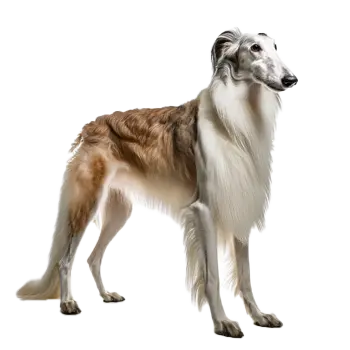
The Borzoi is one of the most visually striking breeds in existence, combining the extreme height of a giant breed with the lean, refined elegance of a coursing sighthound. The overall impression is of a tall, narrow dog of aristocratic bearing, with flowing lines and a graceful silhouette that has made it a perennial favorite of artists, photographers, and Art Nouveau designers. The body is slightly longer than tall, with a deep but narrow chest that provides ample room for the large heart and lungs needed for sustained high-speed pursuit. The back is arched over the loin in a distinctive curve that is characteristic of the breed and essential to its bounding, ground-covering gait. The ribcage is deep, reaching to the elbow, but relatively narrow when viewed from the front.

The head is one of the breed's most distinctive features: long, lean, and narrow, with a barely perceptible stop and a slightly Roman-nosed profile that tapers gracefully to the nose. The skull is so narrow that the breed's visual field exceeds 270 degrees, an adaptation for a dog that needed to spot and track fast-moving prey across open terrain. The eyes are large, dark, and almond-shaped, set obliquely and conveying an expression of soft intelligence and quiet alertness. The ears are small, fine, and carried folded back against the neck when the dog is relaxed, rising to a semi-erect position when alert. The jaws are long and powerful, capable of seizing and holding a wolf, with a full scissors bite.

The coat is the breed's crowning physical feature and the source of its Russian name "psovaya" (wavy or silky coated). The topcoat is long, silky, and either flat, wavy, or slightly curly, flowing freely from the body in a manner that lifts and ripples during movement. The coat is particularly profuse on the neck, where it forms an elegant frill, and on the hindquarters and tail, where heavy feathering creates a dramatic plume. The soft undercoat thickens in cold weather and sheds in warmer conditions, an adaptation to the extreme temperature variations of the Russian climate. Any color or combination of colors is acceptable in the breed standard, though the most common presentations are white, white with patches of any color, cream, gold, red, brindle, black, and sable.

Movement in the Borzoi is unique among domestic dogs, combining the bounding double-suspension gallop of a coursing sighthound with a smooth, flowing trot that covers ground effortlessly. At full gallop, the Borzoi is capable of speeds between 35 and 40 miles per hour, making it one of the fastest dog breeds in existence. The breed's distinctive arched topline flattens and extends during the gallop, functioning as a flexible spring that stores and releases energy with each stride. At a slower gait, the Borzoi moves with the light, elastic trot that the breed standard describes as springy and free. The tail is carried low in a graceful curve at rest and extends during high-speed movement to serve as a counterbalance during turns.

Affectionate With Family
The Borzaya Sobaka forms genuine and quiet attachments to its family, demonstrating affection through calm physical proximity and attentive presence rather than exuberant displays. The breed enjoys leaning against its people, resting its elegant head on a lap, and maintaining a composed closeness that reflects its aristocratic heritage. This affection is offered on the dog's own terms, and the breed values its personal space as much as it values companionship.
Good With Young Children
The Borzoi's gentle nature does not translate into tolerance for the rough, unpredictable handling that young children often deliver. The breed's tall, lean frame is vulnerable to injury from being climbed on or fallen against, and its sensitive temperament may produce anxiety or avoidance in response to loud, chaotic environments. Families with older children who understand gentle interaction will find a much better match, as the Borzoi can be a graceful and devoted companion for respectful young people.
Good With Other Dogs
The Borzoi generally coexists peacefully with other dogs, particularly those of similar size, and the breed's non-confrontational nature makes it less prone to dominance-related aggression than many breeds. However, the Borzoi's strong prey drive means that very small dogs may trigger chasing instincts, and the breed's sheer size and speed can inadvertently injure smaller housemates during play. Multi-Borzoi households are common among enthusiasts, and the breed's pack heritage supports comfortable cohabitation with its own kind.
Shedding Level
The long, silky coat sheds steadily year-round with a significant seasonal blowout, typically in spring, when the soft undercoat releases in substantial volumes. During this period, daily brushing is essential to manage the loose hair. The long, fine texture of the shed coat means it accumulates on furniture, clothing, and floors in conspicuous quantities that require regular attention.
Coat Grooming Frequency
The silky coat requires regular brushing two to three times per week to prevent tangles and mats, particularly in the longer feathering on the legs, chest, and tail. Despite its length and luxurious appearance, the Borzoi coat is relatively easy to maintain compared to breeds with softer, denser coats, as its silky texture resists matting more effectively. During seasonal shedding periods, daily grooming sessions become necessary.
Drooling Level
The Borzoi is a relatively clean-mouthed breed, though its deep, narrow muzzle can produce some drooling after drinking water or during periods of excitement or anticipation of food. The breed is not among the heavy droolers, but owners should expect occasional moisture around the muzzle, particularly after the dog drinks from a deep water bowl, where the long facial hair retains water.
Coat Type
The Borzoi carries a distinctive long, silky coat that is flat to wavy or slightly curly, with profuse feathering on the legs, chest, hindquarters, and tail that creates the breed's signature elegant silhouette. A soft, dense undercoat thickens during cold weather and sheds in warmer months. The coat's texture and distribution are unique among sighthounds, reflecting the breed's adaptation to the harsh Russian climate where it needed protection during winter wolf hunts.
Openness To Strangers
The Borzoi is naturally reserved and aloof with unfamiliar people, maintaining a dignified distance rather than approaching with open friendliness. This reserve is not fearful or aggressive but reflects the breed's independent, self-contained temperament. A well-socialized Borzoi will accept the presence of strangers without anxiety but will not actively seek their attention or approval. Visitors who approach quietly and allow the dog to initiate contact will find a more receptive response.
Playfulness Level
The Borzoi displays a selective playfulness that emerges in bursts of intense physical activity followed by extended periods of calm repose. The breed delights in sprinting at full speed across open ground, engaging in chase games with other sighthounds, and occasionally displaying a surprisingly silly streak at home. However, the Borzoi does not demand constant entertainment and is content to spend much of its day in elegant relaxation between these bursts of activity.
Watchdog/Protective Nature
The Borzoi was never bred for guard duty, and its temperament reflects this absence of protective selection. The breed may or may not alert to strangers at the door, and it lacks the territorial aggression or suspicion that defines effective watchdog breeds. The Borzoi's imposing size may provide some visual deterrence, but the dog's gentle, non-confrontational nature means it is unlikely to challenge an intruder with any conviction.
Adaptability Level
The Borzoi adapts reasonably well to various living situations provided it receives daily opportunities to sprint in a safely enclosed area. Despite its large size, the breed is calm and quiet indoors, often curling into surprisingly compact positions on furniture or dog beds. Apartment living is possible for owners committed to providing adequate outdoor exercise, though a home with access to a large, securely fenced area for off-leash running represents the ideal arrangement.
Trainability Level
The Borzoi is an intelligent dog that understands commands readily but applies a sighthound's independent judgment about whether compliance serves its interests at any given moment. The breed was developed to course game at high speed using its own initiative, not to wait for handler instruction, and that autonomous decision-making persists in the companion context. Positive reinforcement with patience and low-repetition training sessions produce the best results, while harsh methods or excessive drilling will cause the breed to shut down entirely.

Borzaya Sobaka History & Development

The Borzoi's history is inseparable from the Russian aristocracy that created, refined, and ultimately nearly destroyed it. The breed's origins lie in the 13th-century practice of wolf coursing on the vast Russian steppes, where mounted hunters used packs of swift, powerful sighthounds to pursue and bring down wolves that threatened livestock and settlements. The foundation stock for the modern Borzoi likely included Arabian sighthounds brought to Russia through trade and diplomatic exchange, crossed with native Russian dogs that provided the thick coat necessary for survival in the brutal Russian winters. By the 17th century, the breed had achieved recognizable type, and the first breed standard was recorded in 1650.

The golden age of the Borzoi coincided with the height of the Russian Empire. From the 17th through the early 20th century, the grand hunts of the Russian aristocracy represented some of the most elaborate sporting events in the world. A typical hunt involved hundreds of participants, dozens of Borzoi working in matched pairs or trios, and an entire entourage of attendants, horses, and support dogs. The Borzoi were expected to course wolves in open terrain, overtake them at speed, and hold them by the neck until the mounted hunters arrived to dispatch the quarry. This demanding work required extraordinary speed, courage, and jaw strength, and the Russian nobles bred for these qualities with obsessive dedication. Some estates maintained breeding programs with hundreds of Borzoi, and dogs were exchanged between noble families as diplomatic gifts.

The Russian Revolution of 1917 devastated the breed. Because the Borzoi was inextricably associated with the aristocracy, the revolutionary forces slaughtered many of the great kennel populations along with their noble owners. Entire bloodlines accumulated over centuries were destroyed within months. The breed survived the revolution primarily because European and American fanciers had acquired specimens before the upheaval. Queen Victoria received Borzoi as gifts from the Russian court in 1842, and the breed had been exhibited at European dog shows since the mid-19th century. The first Borzoi registered by the AKC, Princess Irma, arrived in the United States in 1889. These exported dogs, combined with small numbers that survived in Russia and were later bred by Soviet dog enthusiasts who convinced the government of the breed's value, formed the genetic foundation for the modern Borzoi.

The breed established itself firmly in the Western show ring and companion dog world during the 20th century, prized for precisely the qualities that had once made it a hunter: its extraordinary beauty, quiet dignity, and graceful movement. The Borzoi's association with elegance and aristocratic refinement made it a natural choice for artists, advertisers, and fashion designers, and its image became iconic in Art Deco and Art Nouveau design. Today the Borzoi serves primarily as a companion and show dog, though it retains its hunting capabilities and participates in lure coursing events that simulate the chase experience its ancestors were bred for.

Borzaya Sobaka Temperament & Personality

The Borzoi temperament is defined by a quiet dignity and self-contained independence that sets it apart from the more demonstrative and handler-oriented breeds. This is a dog that was bred to make high-speed decisions independently during the chase, and that autonomous temperament persists in the companion dog. The Borzoi does not look to its owner for constant guidance or approval; it processes its environment through its own judgment and acts accordingly. This independence is not defiance or aloofness in the negative sense, but rather the natural disposition of a breed that values its own assessment of situations and does not feel compelled to defer to human authority as a reflexive habit.

Gentleness is the quality that most consistently surprises people who encounter Borzoi for the first time. Despite the breed's size, its historical role as a wolf hunter, and its imposing physical presence, the Borzoi is one of the gentler large breeds in temperament. The breed is typically calm and quiet indoors, rarely destructive, and content to spend extended periods in relaxed repose on a comfortable surface. The Borzoi does not bark excessively, does not demand constant attention, and does not exhibit the nervous energy or restlessness that characterizes many high-drive breeds. This calm indoor demeanor is one of the breed's most appealing qualities for companion owners and is the primary reason that Borzoi can live successfully in urban environments despite their size.

Reserve toward strangers is a consistent temperament trait that should be distinguished from fearfulness or aggression. A well-socialized Borzoi will accept the presence of unfamiliar people without anxiety or hostility but will not approach them with the eager friendliness of a Labrador Retriever or Golden Retriever. The breed maintains its composure and distance, allowing strangers to enter its space on the dog's terms rather than rushing to greet them. This reserve reflects the breed's aristocratic heritage and its role as a companion to people who valued dignity and composure in their dogs as much as they valued it in themselves.

The Borzoi's prey drive is intense, deeply embedded, and must be respected by anyone who owns or handles the breed. The Borzoi was bred to sight, pursue, and seize fast-moving game at speeds exceeding 35 miles per hour, and this instinct does not switch off in a domestic setting. Small animals, including cats, small dogs, rabbits, and squirrels, may trigger an instantaneous chase response that overrides all training, all commands, and all good intentions. This prey drive is not aggression; it is instinct, and it cannot be trained away. Management through secure fencing, leash control, and careful introduction to household pets from puppyhood is the only reliable approach.

Borzaya Sobaka Family Life & Living Requirements

Living with a Borzoi requires understanding and accommodating the specific needs of a large, independent sighthound that combines periods of explosive physical activity with extended stretches of calm indoor companionship. The breed's size alone demands consideration: at 26 to 32 inches tall and weighing 60 to 105 pounds, the Borzoi occupies significant physical space and can inadvertently clear coffee tables, topple small children, and claim entire sofas simply by lying down. Despite this size, the Borzoi is often described as a "40-mile-per-hour couch potato," a characterization that accurately captures the breed's dual nature as both a supreme athlete and a supremely lazy housemate.

The most critical housing requirement is access to a safely enclosed area where the Borzoi can sprint at full speed. This is not optional. The breed's physical and psychological well-being depends on regular opportunities to run, and casual walking cannot substitute for the intense cardiovascular output of a flat-out gallop. A securely fenced area of at least an acre, with fencing at least five to six feet high, provides an appropriate space for off-leash running. The fencing height is important because while Borzoi are not typically jumpers, they can clear four-foot fences when motivated. Open fields, beaches, and other unfenced areas are suitable only when the Borzoi has demonstrated reliable recall, and even then the breed's prey drive makes off-leash exercise in unsecured areas risky.

The Borzoi's compatibility with children depends on the age of the children and the level of supervision provided. The breed's gentle temperament makes it unlikely to respond aggressively to children, but its size creates practical risks for very young children who may be accidentally knocked over by a dog that weighs nearly as much as they do. The breed's sensitivity means it may become anxious or withdrawn in chaotic, noisy household environments, which can lead to avoidance behaviors that children may misinterpret. Families with older children who can interact gently and respect the dog's need for quiet are the best match.

The Borzoi's prey drive creates non-negotiable management requirements in multi-pet households. While Borzoi raised from puppyhood alongside cats may learn to accept them as household members, the introduction of a cat or other small animal to an adult Borzoi's home carries significant risk. Even dogs that coexist peacefully with their own household cats may chase unfamiliar cats encountered outdoors. Small dogs are also at risk, as the Borzoi may not distinguish a toy breed from prey during a moment of instinctive response. Multi-Borzoi households are common and generally successful, as the breed's pack heritage supports comfortable cohabitation with its own kind.

Borzaya Sobaka Training & Exercise Needs

Training a Borzoi requires recalibrating expectations away from the obedience-oriented standard that breeds like German Shepherds and Labrador Retrievers have established. The Borzoi is not a disobedient dog; it is a independently minded dog, and the distinction matters enormously for the handler's approach. The breed understands commands readily, learns new behaviors quickly, and retains information reliably. What it does not do is comply reflexively. Every command is filtered through the Borzoi's own assessment of whether the instruction is reasonable, necessary, and worth interrupting whatever the dog is currently doing. Handlers who accept this and work within it will find a cooperative and increasingly responsive partner. Handlers who expect immediate, unquestioning obedience will be disappointed.

Positive reinforcement is the only training approach that produces meaningful results with the Borzoi. The breed is exceptionally sensitive to its handler's emotional state and will shut down entirely in response to harsh corrections, raised voices, or physical compulsion. Training sessions should be short, varied, and built around genuine motivation, whether food rewards, toy rewards, or the opportunity to engage in activities the dog enjoys. Low-repetition exercises work best, as the Borzoi grows bored with drill-style training rapidly and will simply disengage. The breed excels in activities that channel its natural abilities, including lure coursing, straight racing, and agility, where its speed, grace, and problem-solving ability find productive expression.

Early socialization is essential for the Borzoi, perhaps more so than for many breeds, because the breed's natural reserve toward strangers can deepen into fearfulness or anxiety without adequate early exposure to diverse people, environments, and situations. Puppy socialization should begin during the critical developmental window between 3 and 16 weeks and should include controlled exposure to a wide range of people, animals, sounds, surfaces, and environments. The goal is not to eliminate the Borzoi's natural reserve but to give it a broad experiential foundation from which to evaluate new situations with confidence rather than anxiety.

Exercise requirements reflect the breed's dual nature as both a sprinter and a couch companion. The Borzoi needs daily opportunities to run at full speed in a safely enclosed area, supplemented by moderate daily walks that provide mental stimulation through environmental exploration. The breed does not require the sustained, high-intensity daily exercise that herding and sporting breeds demand, but the absence of sprinting opportunities will produce physical and psychological decline. Lure coursing events provide structured outlets for the breed's chase instinct and are available through sighthound organizations across the country. The Borzoi is not a jogging companion; its physiology is built for explosive sprints rather than sustained moderate-pace running.

Borzaya Sobaka Health Concerns

The Borzoi has a lifespan of 9 to 14 years, which is typical for large to giant breeds but shorter than the lifespan of smaller sighthound breeds. The breed's most significant health vulnerabilities reflect both its large size and its unique sighthound physiology, and responsible ownership requires awareness of these breed-specific considerations. The Borzoi's low body fat percentage, unusual liver enzyme profiles, and naturally lower baseline values for certain blood parameters create a physiological profile that differs meaningfully from non-sighthound breeds, and veterinary care must be informed by these differences to avoid misdiagnosis and inappropriate treatment.

Gastric dilatation-volvulus is the most serious acute health risk for the Borzoi. The breed's deep, narrow chest conformation places it among those at highest risk for this life-threatening emergency, in which the stomach fills with gas and may rotate on its axis, cutting off blood supply to the stomach and spleen. Bloat can progress from initial symptoms to death within hours if not treated surgically, and every Borzoi owner should know the signs: unproductive retching, distended abdomen, restlessness, pacing, and rapid decline. Risk reduction strategies include feeding multiple smaller meals, using slow-feeder bowls, avoiding vigorous exercise before and after meals, and discussing prophylactic gastropexy with the veterinarian.

Osteosarcoma represents a breed-significant cancer risk. This aggressive malignant tumor of the bone disproportionately affects large and giant breeds, and the Borzoi is among those with elevated incidence. The cancer most commonly presents in the long bones of the legs, producing lameness, swelling, and pain that may initially be attributed to injury or arthritis. Diagnosis typically occurs after the cancer has progressed significantly, and treatment options include amputation of the affected limb combined with chemotherapy to address metastatic disease. Early veterinary evaluation of any unexplained lameness or bone swelling is essential for the best possible outcome.

Drug and anesthesia sensitivity is a critical health consideration that every Borzoi owner must communicate proactively to their veterinarian. Sighthounds metabolize barbiturate anesthetics, certain topical insecticides, and some common medications differently than other breeds due to their low body fat percentage and unique liver enzyme profiles. Standard anesthetic protocols can be dangerous or fatal for sighthounds, and veterinarians unfamiliar with the breed must be informed of this sensitivity before any procedure. The BCOA provides resources for veterinarians that outline sighthound-specific anesthetic protocols, and owners should ensure this information reaches their veterinary team.

Progressive retinal atrophy, cardiac conditions including dilated cardiomyopathy, and hypothyroidism round out the breed's documented health concerns. Annual ophthalmologic examinations screen for PRA and other progressive eye conditions. Cardiac screening through auscultation and periodic echocardiography helps detect developing heart disease. Thyroid evaluation requires particular attention because sighthound thyroid values naturally run lower than the standard canine reference range, and veterinarians unfamiliar with this difference may diagnose hypothyroidism in a dog whose thyroid function is actually normal for its breed.

Common Health Issues

  • Gastric dilatation-volvulus (bloat) - The most serious acute health risk for the Borzoi, whose deep, narrow chest conformation places it among the breeds at highest risk. The stomach fills with gas and may rotate on its axis, cutting off blood supply and creating a life-threatening emergency requiring immediate surgical intervention. Prophylactic gastropexy is increasingly recommended.
  • Progressive retinal atrophy (PRA) - An inherited degenerative condition affecting the photoreceptor cells of the retina, leading to gradual vision loss and eventual blindness. Annual ophthalmologic examinations help monitor progression, and affected dogs should be removed from breeding programs.
  • Osteosarcoma (bone cancer) - An aggressive malignant bone tumor that disproportionately affects large and giant breeds including the Borzoi. Most commonly presents in the long bones of the legs, producing lameness and swelling. The condition is typically advanced at the time of diagnosis, and treatment options include amputation and chemotherapy.
  • Cardiac conditions - Dilated cardiomyopathy and other cardiac abnormalities occur in the breed at rates that warrant periodic cardiac screening. Signs may include exercise intolerance, coughing, fainting, and irregular heart rhythm. Early detection through cardiac auscultation and echocardiography improves management outcomes.
  • Drug and anesthesia sensitivity - Sighthounds including the Borzoi metabolize certain drugs differently than other breeds due to their low body fat percentage and unique liver enzyme profiles. Standard anesthetic doses can be dangerous, and veterinarians unfamiliar with sighthounds must be informed of this sensitivity. Barbiturate anesthetics are particularly risky and should be avoided.
  • Hypothyroidism - Underproduction of thyroid hormones causing metabolic changes including weight gain, lethargy, coat deterioration, and skin problems. Sighthound thyroid values run naturally lower than other breeds, and veterinarians must use sighthound-specific reference ranges to avoid misdiagnosis.

Preventive Care & Health Monitoring

  • Bloat risk reduction through feeding management - Feed two to three smaller meals daily rather than one large meal, use slow-feeder bowls, avoid strenuous exercise within one hour before and after meals, and discuss prophylactic gastropexy with the veterinarian. Know the signs of bloat, including unproductive retching, distended abdomen, and restlessness, and treat any episode as an immediate emergency.
  • Annual ophthalmologic examination by a board-certified veterinary ophthalmologist - Screens for progressive retinal atrophy, cataracts, and other hereditary ocular conditions. Particularly important for breeding stock and dogs with family history of eye disease.
  • Cardiac screening including auscultation and periodic echocardiography - Recommended to detect dilated cardiomyopathy and other cardiac conditions before clinical signs develop. Baseline echocardiography for breeding stock and periodic follow-up for dogs with detected murmurs.
  • Sighthound-informed veterinary care - Ensure your veterinarian is experienced with sighthound breeds and understands their unique drug metabolism, anesthesia requirements, and physiological norms. Provide this information proactively before any procedure requiring sedation or anesthesia.
  • Thyroid screening using sighthound-specific reference ranges - Normal Borzoi thyroid levels fall below the standard canine reference range. Testing should be interpreted using sighthound-specific parameters to avoid unnecessary treatment of naturally low but healthy thyroid values.
  • Parasite prevention with sighthound-safe products - Some flea, tick, and heartworm preventives contain compounds that sighthounds metabolize differently. Consult with a sighthound-experienced veterinarian to select appropriate products and avoid those known to cause adverse reactions in the breed.

Borzaya Sobaka Grooming & Maintenance

The Borzoi coat, while visually spectacular, is more manageable than its length and volume might suggest. The silky texture of the outer coat resists matting more effectively than the softer, denser coats of breeds like the Old English Sheepdog or Bearded Collie, and the coat's natural tendency to lie flat reduces the accumulation of debris that plagues breeds with standoff or double coats. Regular grooming two to three times per week with a pin brush or slicker brush keeps the coat in good condition, with particular attention to the areas where friction and moisture promote tangling: behind the ears, in the armpits, between the hind legs, and in the long feathering on the legs and tail.

Seasonal shedding is the most demanding grooming period for the Borzoi owner. The soft undercoat that thickens during cold weather sheds substantially in spring, and the process can continue for several weeks. During this period, daily brushing with an undercoat rake or deshedding tool is necessary to remove the dead coat efficiently. The shed undercoat tends to come out in clumps rather than individual hairs, and if not removed promptly it can mat against the remaining coat and create uncomfortable tangles. A warm bath followed by thorough blow-drying at the onset of the seasonal shed helps accelerate the process and reduces the overall duration of heavy shedding.

Bathing should be performed as needed rather than on a rigid schedule, typically every four to six weeks or when the dog becomes noticeably dirty. The Borzoi's silky coat benefits from a mild conditioning shampoo that maintains its natural texture and sheen. Thorough rinsing is essential, as shampoo residue dulls the coat and can cause skin irritation. Complete drying is important, particularly in cooler weather, as the dense undercoat retains moisture close to the skin and can take hours to dry naturally. Some owners use a high-velocity dryer to speed the process, which has the added benefit of loosening dead undercoat.

Beyond coat care, the Borzoi requires attention to several breed-specific grooming considerations. The breed's long, narrow feet need regular nail trimming every two to three weeks to maintain proper foot structure and gait mechanics. The feathering between the toes should be checked regularly for debris and mats. Ear care is straightforward given the breed's folded ear structure, though weekly inspection for redness, odor, or debris remains good practice. Dental care is important for long-term health, with daily brushing representing the ideal standard. The breed's long muzzle provides good spacing for teeth, but regular dental assessment and professional cleanings as recommended by the veterinarian help prevent periodontal disease.