Beauceron

Beauceron

Quick Facts

🐕 Breed Group
Herding Group
📏 Size Category
Large
📏 Height
Males: 25.5-27.5 inches, Females: 24-26 inches
⚖️ Weight
Males: 70-110 pounds, Females: 65-100 pounds
⏱️ Life Expectancy
10-12 years
🧣 Coat Type
Double coat, short and dense with woolly undercoat
🎨 Coat Colors
Black and tan, harlequin (gray, black and tan)
😀 Temperament
Confident, Fearless, Loyal, Alert, Calm, Intelligent
🏃 Exercise Needs
Very High
🎓 Training Difficulty
Moderate
👶 Good with Children
Good with older children when raised together
🐾 Good with Other Pets
Requires careful introduction

Other Names & Breed Recognition

The Beauceron carries several names depending on where you encounter it and who is doing the talking. The official French name is Berger de Beauce, which translates directly to "shepherd of Beauce," referring to the broad agricultural plain south of Paris. The breed is also widely known in France by a much older and more affectionate nickname: Bas Rouge, meaning "red stockings," a nod to the distinctive tan markings that run down each leg from the knee to the foot, as if the dog were wearing knee socks in russet wool. French novelist Colette reportedly called the breed "a country gentleman," which captures something real about the dog's dignified, self-possessed manner.

The shortened form "Beauce" or "Beauce dog" is commonly used among fanciers in France and among longtime breeders in North America, though the full word "Beauceron" is what most Americans will encounter. The name "French Shorthaired Shepherd" appears in older texts as a descriptor but never became an official registered name. Some sources use "Berger de Beauce" and "Beauceron" interchangeably; both refer to the same breed.

In France, the breed falls under the governance of the Societe Centrale Canine, the French national kennel club, and is classified by the FCI in Group 1 (Sheepdogs and Cattle Dogs), Section 1 (Sheepdogs), without a working trial required for recognition. In the United States, the American Kennel Club recognized the Beauceron in 2007 and placed it in the Herding Group, where it competes alongside other livestock-working breeds from around the world. The AKC parent club is the American Beauceron Club, which maintains the breed standard and health program for the breed in North America. The United Kennel Club also recognizes the breed in its Herding Dog Group. In Canada, the Canadian Kennel Club recognizes the breed in the Herding Group, while The Kennel Club in the UK places the breed in the Pastoral Group, which is the British equivalent classification for herding and livestock-working breeds.

The breed arrived relatively late to American show rings and households. While it has been well known across France and parts of Europe for well over a century, it spent many decades as a genuine rarity outside of its homeland. AKC recognition in 2007 began opening more opportunities for competition and for connecting breeders across national lines, though the Beauceron remains uncommon in the United States compared to more popular herding breeds. It is not the sort of breed you are likely to encounter at a neighborhood dog park, and most veterinarians will see only a handful in their careers - something worth keeping in mind for anyone planning to own one.

Beauceron Organizations & Standards

The American Beauceron Club (ABC) is the AKC parent club for the breed in the United States. The ABC maintains the official breed standard, oversees the health program, and administers the CHIC requirements for the Beauceron. Members of the ABC agree to a Code of Ethics that places particular emphasis on preserving herding and working ability alongside appearance - a standard that reflects the breed's origins as a functional farm and working dog rather than a show animal. The club organizes herding trials, working events, and conformation competition, and maintains resources for prospective owners researching the breed.

In France, the breed is overseen by the Club des Amis du Beauceron, which has been central to shaping and preserving the original type. The French standard, maintained through the FCI, is the foundational document from which all national breed standards are derived. The FCI standard emphasizes the Beauceron's dual nature as both a herding dog and a guardian, and sets proportions, coat, color, and movement requirements that reflect the dog's historical function on French farms where it worked unassisted across large territories.

The AKC breed standard describes the Beauceron as a well-balanced, powerful dog of imposing stature. The standard calls for males to stand 25.5 to 27.5 inches at the shoulder and females 24 to 26 inches. Weight ranges from roughly 70 to 110 pounds for males. The body should be slightly longer than tall, giving a rectangular rather than square silhouette. The topline is firm and level. The chest is broad and deep, reaching to the elbow, with well-sprung ribs. The standard emphasizes that the Beauceron should be built for endurance rather than speed - capable of moving a large flock all day across open ground.

The head is strong and elongated, with the muzzle equal in length to the flat skull. Eyes are dark brown, oval, and carry a calm, confident expression - never nervous or hard. Ears, when uncropped (ear cropping is prohibited in most countries and increasingly rare even in regions where it remains permitted), are carried semi-erect or folded. The double dewclaws on each rear leg are one of the breed's most distinctive physical features and are required for show eligibility. Anything less than a full double dewclaw, with both functional nails, is a disqualification in conformation competition.

The CHIC program for the Beauceron, administered through the American Beauceron Club in cooperation with the OFA, requires three tests for CHIC certification: an OFA hip evaluation, an OFA echocardiogram performed by a board-certified cardiologist, and an ACVO-certified eye examination beginning at age two and repeated annually through age eight. Optional CHIC submissions include OFA elbow evaluation, autoimmune thyroiditis testing, and von Willebrand's Disease testing. The ABC also recognizes the HUU (hyperuricosuria) DNA test as a useful screening tool for responsible breeders. The ABC Code of Ethics requires all breeding dogs to have these clearances before breeding.

Kennel Club Recognition

  • American Kennel Club (AKC): Recognized in 2007, Herding Group
  • United Kennel Club (UKC): Recognized, Herding Dog Group
  • Canadian Kennel Club (CKC): Recognized, Herding Group
  • FCI: Recognized, Group 1
  • The Kennel Club (UK): Recognized, Pastoral Group

Beauceron Physical Description

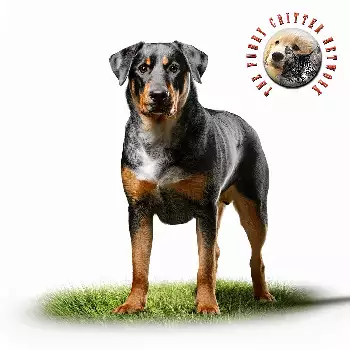
Standing next to a Beauceron for the first time, the first thing most people notice is the size. This is a big dog - not in the loose, wobbly way of some heavy breeds, but in a rangy, athletic, wolf-like way that reads as both powerful and capable. Males run 25.5 to 27.5 inches at the shoulder and can weigh well over 90 pounds in working condition. Females are somewhat lighter but still substantial. The breed's silhouette is rectangular rather than square - the body is slightly longer from shoulder to hip than the dog is tall, which contributes to the ground-covering, fluid movement that defined its usefulness as a stock dog on large French farms.

The head is the key to the breed's expression. It is long and chiseled without being narrow, with the muzzle and the flat skull approximately equal in length. There is no pronounced stop - the transition from skull to muzzle is smooth and gradual. The head is strong enough to be impressive but refined enough to avoid the heavy, coarse look of some large working breeds. The nose is always black. The lips are tight and dry, giving the muzzle a clean, close finish.

The eyes are one of the most compelling features of a well-bred Beauceron. They are dark brown, oval, and carry an expression that experienced breeders describe as frank and calm - a dog that looks at you directly, assesses what it sees, and decides how to proceed. It is not a soft or sentimental gaze. Lighter eyes are considered a fault and change the expression significantly, giving a different, less characteristic look. The ears, in countries where cropping is not practiced, are carried semi-erect or folded over at the tip. Natural ears frame the face well and do not detract from the breed's bold appearance.

The neck is strong and muscular, arching slightly and carrying the head with a proud carriage. It flows into well-laid-back shoulders and a firm, level topline. The chest is broad and deep, reaching to or near the elbow. The ribcage is well-sprung and the loin is short and muscular. The croup slopes slightly toward the tail, which is long, reaches at least to the hock, and is carried in a gentle J-curve at rest. A tail carried too high or too low alters the silhouette significantly.

The forelegs are straight and well-boned, with vertical pasterns. Hindquarters are powerful and well-angulated, with well-developed second thighs. The breed's movement is one of its defining characteristics - a long-striding, effortless trot that covers ground with minimal vertical motion. A Beauceron moving correctly across a field looks like it could keep going all day, which is exactly the point. Short, choppy movement is considered a significant fault.

The double dewclaws on each rear leg are the breed's most unusual physical feature and one of the few aspects of Beauceron anatomy that surprises people who haven't encountered the breed before. These are not the vestigial, floppy single dewclaws seen on many breeds - the Beauceron's rear dewclaws are connected to the leg by bone, not just soft tissue, and form what looks like a rudimentary extra toe. Both nails must be present and functional for show eligibility; a dog lacking the full double dewclaw is disqualified from conformation. Some breeders believe these dewclaws improved grip and stability on uneven ground while herding. They require regular trimming and occasional cleaning but are otherwise low-maintenance.

The coat is a double coat with a flat, close-lying outer layer and a dense, woolly undercoat that thickens considerably in cold weather. On most of the body the outer coat is short and dense; there is slightly longer hair on the neck and throat, on the back of the thighs, and on the tail. The coat is weather-resistant and designed for an outdoor working dog - it sheds rain and mud reasonably well and dries quickly. It is not a glamour coat and should never be trimmed or styled.

Two color patterns are accepted. The most common is black and tan, also called black and rust: a predominantly black dog with tan markings on the eyebrows, cheeks, chest, legs, and under the tail. The tan on the legs gives the classic "red stockings" appearance that inspired the breed's Bas Rouge nickname. The second accepted color is harlequin, which adds irregular patches of gray distributed over the body on top of the black and tan base. Harlequin Beaucerons should have more black than gray; predominantly gray or white dogs are considered faults. Pure white is a disqualification. Historically the breed appeared in other colors including solid red and tawny, but these are no longer accepted in the breed standard.

Sexual dimorphism is notable in this breed. Males are distinctly more masculine in head type and overall substance than females, which are refined enough to be clearly feminine without approaching lightness. An experienced eye can usually distinguish sex at a glance.

Affectionate With Family
The Beauceron forms deep, lasting bonds with their household and is known for being especially devoted to the women of the family. They are affectionate on their own terms - not a lap dog, but genuinely attached.
Good With Young Children
This breed can be good with children they are raised with, but their size and herding instincts make them better suited to older, respectful kids. Young children can be accidentally bumped or herded.
Good With Other Dogs
Beaucerons can be dominant with other dogs, particularly of the same sex. Early socialization helps, but they are not reliably dog-friendly and do best in households where they are the primary or only dog.
Shedding Level
Year-round moderate shedding picks up significantly in spring and fall coat blows. Weekly brushing keeps it manageable, but there will be hair on the furniture.
Coat Grooming Frequency
The short, flat coat is one of the easier maintenance coats among working breeds. Weekly brushing and occasional baths handle the basics; dewclaw trimming is the one grooming task unique to this breed.
Drooling Level
The Beauceron has a tight, dry mouth and is not a drooling breed. You will not find jowl spray on your walls or slobber on guests.
Coat Type
A dense, weather-resistant double coat - short on most of the body with slightly longer hair on the neck, tail, and hindquarters. The undercoat grows thick in cold weather.
Openness To Strangers
Adults are typically reserved and watchful with strangers, assessing before accepting. This is not shyness or aggression but a quiet, evaluating wariness that is deeply characteristic of the breed.
Playfulness Level
Beaucerons have a working-dog seriousness that means play comes second to purpose, but they are not without humor or enthusiasm for fetch and activity, especially when young.
Watchdog/Protective Nature
Natural guardian instincts are strong and reliable. The Beauceron will alert, assess, and act if it judges a genuine threat to be present - not all bark, no bite.
Adaptability Level
This breed needs space, work, and an experienced owner. It can adapt to suburban life only with substantial daily exercise and mental engagement. Apartment living is not a realistic option.
Trainability Level
Highly trainable with the right approach - this breed wants to work and respond to clear, consistent leadership. They can push back on wishy-washy handling, but reward-based training combined with structure gets excellent results.

Beauceron History & Development

The Beauceron's documented history begins in 1587 with one of the earliest written references to a French herding dog matching the breed's description. By the early 1800s, the type was well established across the agricultural region of La Beauce, the flat grain-producing plain south and southwest of Paris. These were farm dogs first and foremost - large, strong, and capable enough to move massive flocks of sheep across open terrain, hold them when stopped, and guard them from predators. A single Beauceron was expected to work with minimal human direction, covering large distances daily and making independent decisions about how to control the stock.

The breed's cousin, the Briard (Berger de Brie), shares the same general working origins. In the late 19th century, French dog fanciers began to formalize the distinction between the two types. In 1896, a veterinarian named Pierre Megnin published an article distinguishing the short-coated shepherd (the Beauceron) from the long-coated shepherd (the Briard), providing what became the foundation for the separate breed standards. The first Beauceron Club was formally established in 1911, and the breed standard was codified around that time.

Beyond herding, the Beauceron was always valued for its protective instincts. French farmers relied on these dogs to guard property, warn of intruders, and act as a general-purpose working partner. The breed's combination of herding intelligence and guardian courage made it a natural candidate for military work. During both World War I and World War II, Beaucerons served the French military as messenger dogs, mine and bomb detection dogs, search and rescue workers, and patrol animals. The breed's wartime service is well documented and contributed to its reputation as one of the most versatile working dogs produced by any country.

Outside of France, the Beauceron remained largely unknown for much of the 20th century. Dedicated breeders in Belgium, Germany, and the Netherlands maintained working lines, and the FCI provided international breed recognition, but it was not until the 1970s and 1980s that small numbers of Beaucerons began arriving in North America. The first American Beauceron Club was formed in 1980. AKC Miscellaneous Class competition opened in 2006, and full AKC recognition in the Herding Group followed in 2007. Today the breed remains rare in the United States - not a breed you will find in most pet stores or on the AKC popularity charts, but beloved by the relatively small number of people who know it well.

Modern Beaucerons continue to work in French police and military service, in personal protection, in search and rescue, and increasingly in American and European dog sports including Schutzhund/IPO, French Ring, herding trials, obedience, and agility. The breed has also found a following as an elite personal companion for experienced dog people who want a large, intelligent partner capable of serious work. The dual emphasis in the American Beauceron Club's Code of Ethics - preserving both working ability and sound conformation - reflects the breed community's commitment to keeping this dog what it has always been: a capable, versatile working animal that happens to also be a loyal family member.

Portraits from the 18th and 19th centuries document the Beauceron in French aristocratic households, having caught the notice of nobility who valued the breed as a companion and estate guardian. This historical record puts the Beauceron in the rare company of dogs that were trusted by both farmhands managing livestock and by the households of kings - an unusual reach that speaks to the breed's combination of practical capability and dignified bearing.

Beauceron Temperament & Personality

The Beauceron is often described as a dog with the brain of a Border Collie in a 100-pound body, and that comparison gets at something real. This is an intensely intelligent, problem-solving breed with a working-dog focus that never fully switches off. A Beauceron is always observing, always cataloging, always assessing who is where and what is happening. This quality made it invaluable as a livestock manager on French farms where it worked with minimal direction - and it makes living with a Beauceron a different experience than living with most other large breeds.

The breed is fundamentally calm and self-possessed. A well-bred, properly raised Beauceron is not anxious, not reactive, and not prone to nuisance barking. It is watchful and alert without being neurotic. This is a dog that can stand quietly for long periods monitoring its environment, then respond decisively when it judges that action is warranted. The expression of calm assessment combined with physical capability is one of the breed's most striking qualities to people who encounter it for the first time.

With their own family, Beaucerons are devoted and affectionate in a working-dog way - present, attentive, and loyal without being clingy or demanding of constant interaction. They form strong bonds with their household and are known for being especially attentive to women in the family. They tend to be protective of family members without being asked and will position themselves physically between family and perceived threats without any formal training. This protective instinct is innate and reliable - not manufactured through protection sport work, though it can certainly be refined through that avenue.

With strangers, adults are reserved and evaluating. This is not shyness or social anxiety - a Beauceron knows exactly what it is doing when it stands and looks at a visitor with calm, assessing attention. It is waiting to form its own opinion. A properly socialized Beauceron can learn to accept guests, strangers on walks, and new situations, but it will never be the tail-wagging, bounce-up-to-everyone dog that some people want from a large breed. If that is what you need, the Beauceron is the wrong choice.

The dominant streak that shows up in working lines and less experienced breeding deserves honest discussion. Beaucerons can be challenging for owners who are not comfortable setting clear, consistent expectations. This is not a breed that forgives vague or inconsistent leadership - it will simply fill that vacuum itself. A Beauceron that has been allowed to set its own rules about what is acceptable is a difficult problem to correct in adulthood. The fix is not harshness - this breed does not respond well to physical punishment or confrontational training - but firm, consistent structure from day one. When handled this way, the breed's intelligence and desire to work become tremendous assets rather than problems.

With children, the Beauceron can be wonderful when raised with them from puppyhood and when the children are old enough to interact appropriately. However, the herding instinct is alive in this breed, and a Beauceron will sometimes attempt to manage a group of running, screaming children the same way it would manage livestock - circling, nudging, occasionally nipping at heels. This behavior needs to be redirected and corrected consistently. The breed is probably not the best choice for a household with toddlers or very young children, not because of aggression, but because of size and herding impulse.

Beauceron Family Life & Living Requirements

This is not a dog for first-time owners, and that is worth saying plainly. The Beauceron's intelligence, size, strength, and working-dog requirements add up to a dog that demands genuine commitment and experience. An inexperienced owner will struggle not because the dog is bad but because it will make decisions the owner is not prepared for, fill leadership vacuums the owner doesn't know exist, and become bored and frustrated in ways that manifest as destructive or controlling behavior.

Space requirements are real. A Beauceron needs room to move - a large fenced yard at minimum, and ideally access to open land where it can stretch out and cover ground. The fencing should be solid and at least five to six feet tall. This is not a breed known for obsessive escaping, but a bored Beauceron that has decided the other side of the fence is more interesting will test the barrier. Underground electronic fencing is not appropriate for a breed with this level of drive and prey instinct.

Exercise needs are substantial. An adult Beauceron needs a minimum of 60 to 90 minutes of vigorous physical activity daily - and "vigorous" means more than a neighborhood walk. Running, hiking, off-leash work in a safe area, herding, fetch with real engagement, or training sessions that demand physical and mental output are what this breed needs. A 20-minute stroll and some yard time is not enough and the dog will tell you so in ways you do not want. On days when weather or schedule disrupts the routine, mental work - serious obedience training, scent work, problem-solving exercises - can partially substitute but doesn't replace physical output over the long term.

Shedding is moderate and manageable with regular effort. The Beauceron blows coat twice a year, typically spring and fall, and during these periods daily brushing is needed to keep up with the volume. Year-round, weekly brushing handles normal shedding. The coat is not high-maintenance by any measure, but if you expect a dog that contributes nothing to household hair, this is the wrong breed.

The Beauceron is not appropriate for apartment living under any reasonable circumstances. It can function in a suburban home if the yard is adequate and the exercise commitment is real, but rural or semi-rural life suits this breed far better. These dogs were bred to work open land and they carry that need in their structure and temperament.

This breed is not right for people who want a passive companion, for households that are away all day without providing appropriate dog care, or for owners who want a dog that will be universally friendly with all visitors and strangers. The Beauceron's reserve and protective instincts require an owner who is comfortable with a watchdog and who has socialized the dog thoroughly enough to make it discriminating rather than suspicious.

Beauceron Training & Exercise Needs

Socialization is where Beauceron ownership either succeeds or sets up future problems. The critical window runs from roughly 8 to 16 weeks, and what a Beauceron puppy encounters during those weeks - different people, different environments, different sounds, different surfaces, other animals - shapes its adult response to novelty. A Beauceron that is not broadly socialized in puppyhood will become increasingly suspicious and reactive as an adult, because the breed's default response to the unfamiliar is assessment and caution rather than easy acceptance. This is a puppy that needs to ride in the car, visit the hardware store, meet children, see city streets and farm settings, and encounter as many different situations as possible before its socialization window closes.

Basic obedience training should begin in puppyhood and continue throughout the dog's life. This is not a breed that learns something once and then does it reliably forever without maintenance. The Beauceron's intelligence means it will test the edges of its understanding and your consistency. Regular training sessions - even short daily sessions of 10 to 15 minutes focused on reinforcing basics and adding new skills - keep the relationship on track and give the dog the mental engagement it craves.

Training method matters more with this breed than with many others. Beaucerons do not respond well to harsh, physically confrontational methods. They are sensitive to the quality of the relationship and to the fairness of the interaction. Heavy-handed training does not produce compliance - it produces a dog that either shuts down or becomes resentfully compliant at best, reactive and untrustworthy at worst. Positive reinforcement combined with clear, consistent expectations and genuine leadership is the approach that works. This breed wants to please an owner it respects; the work is to be worth respecting.

Beyond basic obedience, Beaucerons thrive in working pursuits. Herding trials are a natural fit - the herding instinct is genuine and reliably present. Schutzhund/IPO and French Ring sport provide the combination of obedience, tracking, and protection work that fully engages the breed's capabilities. Agility is another excellent outlet. These are not casual weekend activities for this dog; they are the kinds of meaningful engagement that make the difference between a well-adjusted Beauceron and a bored, difficult one.

Exercise must be taken seriously as a daily commitment. Adult Beaucerons need 60 to 90 minutes of genuine physical work each day - running alongside a bicycle, working a long trail at a real pace, herding sessions, or structured sport training. Young dogs under 18 months should not be subjected to high-impact repetitive exercise that stresses developing joints, but they still need substantial mental engagement and moderate physical activity. An under-exercised Beauceron will find its own outlets, and those outlets will not be ones you choose.

Beauceron Health Concerns

The Beauceron is considered a healthy breed overall, with a documented lifespan of 10 to 12 years. For a dog of this size, that is a reasonable expectation - large and giant breeds tend to have shorter lifespans than small breeds, and the Beauceron's 10 to 12 year range places it in line with other large herding breeds. The breed does not have the extensive list of documented genetic conditions that plague some more popular large breeds, but there are specific concerns that responsible owners and breeders need to know.

The CHIC program for Beaucerons requires OFA hip evaluation, OFA echocardiogram by a cardiologist, and annual ACVO eye examinations from age two through eight. Recommended additional screenings include OFA elbow evaluation, autoimmune thyroiditis testing, and von Willebrand's Disease. A DNA test for the HUU (hyperuricosuria) mutation - the same gene mutation linked to urate stones in Dalmatians - is available for Beaucerons and used by responsible breeders when making breeding decisions.

Common Health Issues

  • Hip dysplasia: Abnormal development of the hip joint leading to joint laxity - Pain, and progressive osteoarthritis. A required OFA screening for all breeding Beaucerons due to documented incidence in the breed.
  • Dilated cardiomyopathy - DCM, : A heart muscle disease causing enlargement of the cardiac chambers and reduced pumping ability. Documented in Beaucerons and serious enough to require OFA echocardiography by a cardiologist as part of CHIC certification.
  • Gastric dilatation-volvulus - GDV/bloat, : Life-threatening condition where the deep-chested stomach fills with gas and rotates on its axis, cutting off blood flow. Requires emergency surgery; Beaucerons' chest conformation puts them at elevated risk.
  • Elbow dysplasia: Abnormal development of the elbow joint - Encompassing several related conditions that lead to pain, lameness, and eventual arthritis. Recommended OFA elbow screening for breeding dogs.
  • Autoimmune thyroiditis - Hypothyroidism, : Immune-mediated destruction of thyroid tissue causing reduced hormone production. The genetic form documented in Beaucerons leads to weight gain, lethargy, and coat changes; managed with lifelong oral medication.
  • Progressive retinal atrophy - PRA, : Hereditary degeneration of retinal cells causing progressive vision loss. Annual ACVO eye examinations through age eight are required for CHIC-certified breeding stock.

Preventive Care & Health Monitoring

  • OFA hip and elbow evaluations before breeding - PennHIP accepted as an alternative for hip evaluation in dogs as young as 16 weeks.
  • OFA echocardiogram performed by a board-certified veterinary cardiologist required for CHIC certification - Annual cardiac auscultation recommended for breeding dogs throughout their lives.
  • Annual ACVO eye examination by a veterinary ophthalmologist required from age two through age eight for CHIC certification. - Annual ACVO eye examination by a veterinary ophthalmologist required from age two through age eight for CHIC certification.
  • Autoimmune thyroiditis DNA testing - Recommended CHIC submission, ; annual thyroid panel recommended for breeding dogs through age five, then every two years.
  • HUU (hyperuricosuria) DNA test available and used by responsible breeders to screen for the gene mutation associated with urate stone formation. - HUU (hyperuricosuria) DNA test available and used by responsible breeders to screen for the gene mutation associated with urate stone formation.
  • GDV risk reduction: feed from ground level rather than elevated bowls - Split daily ration into two smaller meals, and restrict vigorous exercise for at least an hour after feeding.

Beauceron Grooming & Maintenance

The Beauceron is one of the easier large dogs to keep groomed. The short, flat outer coat doesn't trap debris the way longer coats do, sheds rain and mud reasonably well, and dries quickly after getting wet. There are no breed-specific clips, trims, or elaborate styling requirements. What the Beauceron does need is consistent, regular attention to keep shedding under control and the coat in good condition.

Weekly brushing with a medium-bristle brush or rubber grooming mitt handles routine coat maintenance during non-shedding periods. During the spring and fall coat blows, daily brushing is necessary to stay ahead of the volume - this breed sheds its dense undercoat in quantities that can be impressive if you are not prepared. A slicker brush or undercoat rake during heavy shed periods makes the job easier and faster. The Beauceron does not need regular bathing - a few times a year is sufficient unless the dog has rolled in something memorable. Over-bathing strips the coat's natural oils and reduces its weather resistance.

The double dewclaws on each rear leg require special mention. Unlike single rear dewclaws on other breeds - which many owners have removed at birth - the Beauceron's rear dewclaws are structurally connected to the leg and are never removed. They do grow quickly, especially since they bear no weight and contact no ground surface to naturally wear down. Monthly trimming of all four paws plus both double dewclaws is essential. Neglected double dewclaws can curl, catch on objects, or grow into the leg - a painful situation that requires veterinary attention to correct.

Ear care involves a quick weekly check for redness, odor, or discharge and a gentle cleaning with a veterinarian-approved ear cleaner when needed. The Beauceron's ears are not heavy, pendulous, or prone to moisture trapping the way some breeds are, but they still warrant routine attention. Dental care should follow standard guidelines: daily brushing is ideal, with dental chews and professional cleanings as a supplement. Nail trimming beyond the dewclaws follows standard schedule - nails that click on hard floors are too long and should be trimmed.