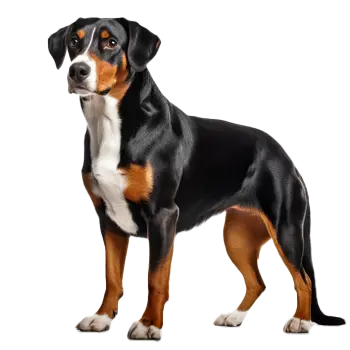
The Appenzeller Mountain Dog presents as a compact, muscular, and highly athletic animal - the sort of dog you look at and immediately understand was built to cover ground in difficult conditions. Its nearly square profile - height at the withers closely matching the body's length - gives it a balanced, capable look different from both the longer-bodied herding breeds and the heavier draft-type mountain dogs. This is the middle ground between speed and strength.
The tri-color coat is the breed's most immediately striking feature. The base color is either black or the richer Havana brown, overlaid with precisely placed rust markings above both eyes (giving the characteristic "four eyes" expression), on the cheeks, along the chest, and on all four legs. White marks the facial blaze, the chest, and sometimes the paws. The pattern is bold and clean - well-defined markings with crisp separation are required by the standard. A poorly marked specimen is easy to distinguish from a correctly marked one.
The head is clean and proportionate, with a moderately broad skull, a clear stop, and a muzzle of moderate length tapering to a black or brown nose. The eyes are small, almond-shaped, and carry a direct, alert expression - these are eyes that notice everything. The ears are medium-sized, set high and wide on the skull, and fold flat against the cheeks when the dog is engaged. The neck is of moderate length, slightly arched, and flows cleanly into well-laid-back shoulders.
The body carries its power in the broad, moderately deep chest and in the well-muscled hindquarters that provide the driving thrust behind the breed's ground-covering trot. The back is firm and level, the loin short and muscular. The feet are compact and round, with well-arched toes and thick hard pads - the feet of a dog that has historically spent working hours on rough alpine terrain.
The tail is tightly curled over the back or along the flank in the breed's distinctive spiral, one of the features by which the Appenzeller Mountain Dog is most quickly identified among the four Sennenhund breeds. A correct tail is tight, firm, and consistent; a loose or hanging tail is a fault. In motion the tail stays curled; at rest it may lower, returning to position when the dog's attention is engaged.
Height falls between 20 and 23 inches at the withers, weight from 48 to 70 pounds with males at the upper end. Movement at the trot is smooth and efficient - the natural reach and drive of a well-built individual reflects the mountain heritage clearly. The double coat has a short, flat, slightly shiny outer layer over a dense undercoat in grey, brown, or black. The coat sheds year-round with heavier seasonal blowouts in spring and fall.
Comparing the Appenzeller Mountain Dog to its three Swiss Sennenhund cousins is useful for setting physical expectations. The Bernese Mountain Dog is significantly heavier and longer-coated, bred more for draft work than speed. The Greater Swiss is the largest of the four, a powerful draft dog. The Entlebucher is the smallest. The Appenzeller Mountain Dog sits in the middle of the group in terms of size but leads it in terms of speed and athleticism - the most agile of the four, and the one whose physical build most directly reflects its cattle-driving heritage.
Affectionate With Family
★★★★★
Deeply devoted to its household, the Appenzeller Mountain Dog keeps track of its people and settles close - present, watchful, and genuinely affectionate with those it knows and trusts.
Good With Young Children
★★★★☆
Patient and playful with children when raised with them, though the herding instinct can translate into heel-nipping or circling with small kids who move unpredictably.
Good With Other Dogs
★★★☆☆
Generally manages well with other dogs when socialized early, though this breed's confident nature means it may assert itself with other dominant animals.
Shedding Level
★★★★☆
The double coat sheds steadily year-round with significant blowouts in spring and fall - regular brushing keeps the volume manageable.
Coat Grooming Frequency
★★★☆☆
Weekly brushing is the routine requirement; no professional grooming, trimming, or clipping is needed to maintain this practical mountain dog's coat.
Drooling Level
★☆☆☆☆
Minimal to no drooling - the tight muzzle and dry mouth of this breed make it a clean house companion despite its working-dog energy.
Coat Type
★★★☆☆
Short, flat, and slightly shiny topcoat over a dense insulating undercoat - built for all-weather alpine conditions and easy to maintain.
Openness To Strangers
★★☆☆☆
Naturally reserved and watchful with people it does not know; a mountain guardian that makes its own assessments before offering acceptance.
Playfulness Level
★★★★☆
High energy and enthusiastic about play throughout its life - this dog will bring you a toy at eight years old with the same urgency it had at eight months.
Watchdog/Protective Nature
★★★★★
Alert, vocal, and territorial - the Appenzeller Mountain Dog takes its guardian role seriously and will not be quiet about anything it considers a threat.
Adaptability Level
★★★☆☆
Adapts reasonably well to different environments provided exercise and mental needs are consistently met; suburban settings work better than dense urban apartments.
Trainability Level
★★★★★
Quick to learn and motivated when training stays engaging; consistent positive reinforcement brings out the best in this intelligent, cooperative breed.