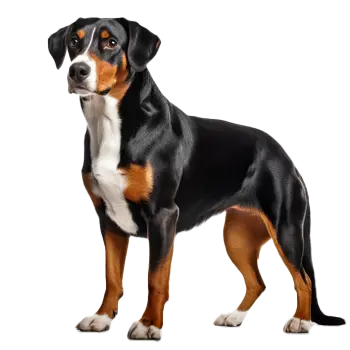
The Appenzeller Cattle Dog looks like exactly what it is: a medium-sized working dog built for speed, agility, and endurance over rough mountain ground. Everything about the structure serves a function. The compact, nearly square body packs muscular power into a frame that moves quickly, changes direction fast, and covers miles of alpine terrain without laboring. This is not a stocky dog and not a leggy one - it sits in the middle, well-balanced and genuinely athletic.
The coat is the breed's most recognizable feature. The tri-color pattern - black or Havana brown as the base, with rust markings on the cheeks, above the eyes, on the chest, and along the legs, plus white on the muzzle blaze, chest, and sometimes the feet - is vivid and precisely arranged. The small rust dots above each eye, known as the "four eyes" pattern, give the face an alert, intelligent expression that is familiar to anyone who has spent time with the breed. The markings must be clearly defined and well-separated; blended or muddy color transitions are faults in the breed standard.
The head is clean and proportionate, with a moderately broad slightly domed skull and a distinct stop. The muzzle is moderate in length, strong and tapering, with a black nose in black-based dogs or brown in Havana-based dogs. The eyes are small, almond-shaped, and typically dark brown, carrying a direct and intelligent expression. The ears are medium-sized, set high and wide, and fold forward flat against the cheeks when the dog is engaged.
The chest is broad and moderately deep for the lung capacity needed in sustained work. The back is level and firm, the loin short and muscular, and the hindquarters provide the driving power behind the breed's trot. The feet are compact and round with well-arched toes and hard pads - feet shaped by generations of mountain terrain.
The tail in its natural position is tightly curled over the back or along the flank. It becomes part of the breed's distinctive silhouette and should be firm and consistent in its curl. A loose or straight tail is a fault. In motion, the tail stays curled; at rest it may lower, but returns to position when attention engages.
Height falls between 20 and 23 inches at the withers, weight from 48 to 70 pounds. Movement is smooth and ground-covering at the trot, with natural reach and drive that reflects generations of mountain work. The gait should look effortless rather than choppy - a well-built Appenzeller Cattle Dog in motion is satisfying to watch, the limbs working in a coordinated rhythm that covers ground efficiently.
The double coat is short and flat on the outer surface over a dense, insulating undercoat that provides warmth for cold alpine mornings. The outer coat's slight sheen makes the tri-color markings appear vivid and well-defined even on a dog that works outdoors regularly. Shedding is year-round with heavier blowouts in spring and fall. Overall the breed presents as compact, capable, and balanced - nothing exaggerated, everything purposeful.
Size comparison to the other Swiss mountain dog breeds is instructive for understanding what the Appenzeller Cattle Dog is. The Bernese Mountain Dog is a much larger, heavier animal bred for draft work. The Greater Swiss is even larger. The Entlebucher, the smallest Sennenhund, is compact and quick like the Appenzeller but lighter in frame. The Appenzeller Cattle Dog sits in the middle of the four - medium-sized, muscular without being heavy, fast without being slight. It is the most athletic-looking of the group and the one whose build most clearly communicates speed and agility over raw pulling power.
Affectionate With Family
★★★★★
With the people it trusts, this breed is warmly devoted - it tracks family members through the household and settles close, always aware of where its people are.
Good With Young Children
★★★★☆
Good with older children who can engage respectfully; the cattle-dog heritage means younger kids may find themselves being herded, so supervision matters.
Good With Other Dogs
★★★☆☆
Generally gets along with other dogs when socialized early, though its confident and territorial nature may create friction with dogs that push back.
Shedding Level
★★★★☆
Expect year-round shedding and heavy seasonal blowouts in spring and fall - a lint roller and regular brushing are household necessities.
Coat Grooming Frequency
★★★☆☆
Weekly brushing handles routine maintenance; no trimming, clipping, or professional grooming is needed to keep this working coat in good condition.
Drooling Level
★☆☆☆☆
Essentially zero drooling - the clean muzzle and tight lips of this breed make it one of the tidier larger dogs to share a home with.
Coat Type
★★★☆☆
Short, flat, shiny topcoat over a dense undercoat - weather-resistant and practical for a dog that spends time in varied outdoor conditions.
Openness To Strangers
★★☆☆☆
Reserved and watchful with unfamiliar people - this is a natural guardian that needs to assess before it accepts, which is a feature, not a flaw.
Playfulness Level
★★★★☆
High play drive that stays active through adulthood; this dog engages with games, toys, and fetch with genuine enthusiasm well past puppyhood.
Watchdog/Protective Nature
★★★★★
One of the breed's most defining traits - vocal, alert, and serious about its guarding role whether working a Swiss farm or living in a neighborhood.
Adaptability Level
★★★☆☆
Flexible enough for different environments when its exercise and mental needs are consistently met, but clearly happiest with space and a sense of purpose.
Trainability Level
★★★★★
Highly intelligent and motivated to learn when training stays engaging and reward-based; boredom is a bigger training issue than stubbornness.