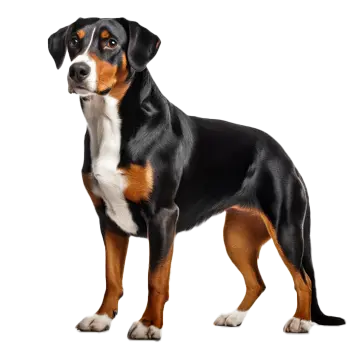

Appenzell Mountain Dog

Appenzeller Sennenhund

Quick Facts

🐕 Breed Group
FCI Group 2 (Swiss Mountain and Cattle Dogs), UKC Guardian Dog Group, AKC Foundation Stock Service (Herding)
📏 Size Category
Medium
📏 Height
Males: 20-22 inches (52-56 cm), Females: 19-21 inches (50-54 cm)
⚖️ Weight
Males: 55-70 pounds (25-32 kg), Females: 44-60 pounds (20-27 kg)
⏱️ Life Expectancy
12-15 years
🧣 Coat Type
Double coat - thick, straight, glossy top coat with dense undercoat
🎨 Coat Colors
Black tricolor, Havana brown tricolor (with rust and white markings)
😀 Temperament
Lively, reliable, self-assured, energetic, fearless, intelligent
🏃 Exercise Needs
High
🎓 Training Difficulty
Moderate - intelligent but can be strong-willed; responds well to confident handling
👶 Good with Children
Yes, with supervision; may attempt to herd younger children
🐾 Good with Other Pets
Conditional - generally good with dogs raised together; may chase smaller animals

Other Names & Breed Recognition

Appenzell Mountain Dog is one of the most common English-language names for the breed formally known as the Appenzeller Sennenhund in its native Switzerland. The name translates the German directly: Appenzell identifies the northeastern Swiss canton where the breed originated, and Mountain Dog renders the Sennenhund designation that connects all four Swiss mountain dog breeds. The translation is imperfect, since Sennenhund more precisely means "dog of the Senn," referring to the Alpine cattle herders and dairymen who were the breed's traditional owners and working partners, but Appenzell Mountain Dog has become established in English through decades of use in breed literature, kennel club communications, and popular reference materials.

The breed carries several additional names that appear in different contexts. Appenzell Cattle Dog emphasizes the breed's primary historical function as a cattle herder and drover rather than its geographic origin. Appenzeller, used as a standalone term, serves as convenient shorthand in breed-specific communities. In Switzerland itself, the dogs are sometimes called Blass, a reference to the white blaze on the forehead that is a characteristic feature of the breed's tricolor markings. The German-language name Appenzeller Sennenhund remains the formal designation used by the Federation Cynologique Internationale and Swiss breed organizations.

The Appenzell Mountain Dog belongs to the family of four Swiss Sennenhund breeds, which also includes the Greater Swiss Mountain Dog, the Bernese Mountain Dog, and the Entlebucher Mountain Dog. Among these four breeds, the Appenzeller represents the medium-sized type, smaller than the Greater Swiss and Bernese but larger than the compact Entlebucher. All four breeds share common ancestry, characteristic tricolor markings in black or brown with rust and white, and a heritage of working alongside Alpine farmers in the mountainous regions of Switzerland. The Appenzeller is distinguished within this group by its tightly curled tail carried over the back, a feature unique among the Sennenhund breeds and suggestive of Spitz influence in its development.

Recognition varies among international kennel clubs. The FCI registers the breed as the Appenzeller Sennenhund in Group 2, Section 3 for Swiss Mountain and Cattle Dogs. The United Kennel Club recognizes it in the Guardian Dog Group. The Canadian Kennel Club includes it in the Working Group. The American Kennel Club has enrolled the breed in its Foundation Stock Service since 2007, a preliminary step toward eventual full recognition in the Herding Group, but as of 2026, full AKC recognition has not yet been granted. The breed remains rare internationally and is classified as endangered by ProSpecieRara, the Swiss foundation for the preservation of genetic heritage in agriculture.

Appenzell Mountain Dog Organizations & Standards

The Schweizerischer Club fur Appenzeller Sennenhunde, founded in 1906 by Professor Albert Heim, serves as the primary breed organization in Switzerland and the breed's country-of-origin club recognized by the FCI. Professor Heim, a geologist and naturalist who devoted enormous energy to the classification and preservation of Swiss dog breeds, wrote the first valid breed standard for the Appenzeller and was instrumental in distinguishing it as a separate breed from the other Sennenhund types. The Swiss club maintains the breed registry, organizes breed events, promotes health testing, and works actively to preserve the working characteristics that define the breed. Given the Appenzeller's endangered status within Switzerland, the club plays a critical role in maintaining a viable breeding population.

The FCI breed standard describes the Appenzell Mountain Dog as a medium-sized, almost squarely built, well-balanced, muscular, and agile dog. The standard emphasizes functional structure, calling for a dog that is slightly longer than tall in a ratio of approximately ten to nine, with a broad, deep chest, strong loins, and a level topline. The distinctive tightly curled tail, set high and carried over the back, is a defining breed feature. The standard requires a tricolor coat that is always composed of a principal color of either black or Havana brown, with symmetrical rust-brown and white markings following a specific pattern: white from chin over chest to belly, white on feet and tail tip, and a white blaze extending from the forehead. Faults that disqualify from registration include wall eyes, kinked tail, single coat, and any coat pattern that is not tricolor.

The Appenzeller Mountain Dog Club of America serves as the breed's advocate in the United States, promoting responsible ownership, supporting the AKC Foundation Stock Service enrollment process, and maintaining educational resources for prospective owners. The club works to build the population of registered Appenzellers in North America while preserving the breed's working heritage and health. Similar breed clubs operate in Canada, the United Kingdom, and several European countries, though the breed remains uncommon outside Switzerland and surrounding German-speaking regions.

The UKC breed standard, which places the Appenzeller in the Guardian Dog Group, shares the FCI standard's emphasis on functional structure and working capability while providing its own interpretation of correct type. The UKC standard specifically notes that Spitz influence is suspected in the breed's heritage, reflected in the curled tail carriage, high energy level, watchfulness, and a more refined head and body than those of the other three Sennenhund breeds. Both standards agree that the breed should present an alert, confident expression and demonstrate the agility, endurance, and strength required for its traditional roles as a herder, drover, and farm guardian.

Kennel Club Recognition

  • FCI: Recognized, Group 2 - Pinscher and Schnauzer
  • United Kennel Club (UKC): Recognized, Guardian Dog Group
  • Canadian Kennel Club (CKC): Recognized, Working Group
  • The Kennel Club (UK): Recognized, Working

Appenzell Mountain Dog Physical Description

The Appenzell Mountain Dog is a medium-sized, powerfully built dog that communicates strength, agility, and functional athleticism in every proportion. Males stand 20 to 22 inches at the shoulder and typically weigh 55 to 70 pounds, while females are slightly smaller at 19 to 21 inches and 44 to 60 pounds. The body is compact and almost square in proportion, slightly longer than tall, with a broad, deep chest that provides ample lung capacity, strong loins, and well-muscled hindquarters. The overall impression is of a dog built for sustained physical work in demanding mountain terrain, combining the substance to move livestock and pull carts with the agility to navigate steep, uneven ground.

The head is wedge-shaped and well-proportioned to the body, with a flat skull, a moderate stop, and a straight, tapering muzzle. The eyes are small, almond-shaped, and range from light to dark brown, conveying an expression that is alert, intelligent, and slightly wary. The ears are triangular with rounded tips, set high on the skull, and hang close to the cheeks when the dog is at rest; when alert, they lift at the base and turn forward, framing the face and enhancing the breed's characteristically keen expression. The nose is black in dogs with black coats and brown in Havana brown individuals.

The most visually distinctive feature of the Appenzell Mountain Dog is its tail. Set high, the tail is carried in a tight curl over the back when the dog is in motion, forming the distinctive post horn shape that immediately identifies the breed among the Swiss Sennenhund group. This curled tail carriage is unique to the Appenzeller among its Swiss cousins and is believed to reflect Spitz-type influence in the breed's ancestry. At rest, the tail may hang naturally, but in motion or when the dog is alert, it curves tightly over the croup. A kinked tail is a disqualifying fault.

The coat is double, consisting of a thick, straight, glossy top coat that lies close to the body and a dense undercoat that provides insulation against the cold Alpine temperatures of the breed's homeland. The coat is always tricolored. The principal color is either black or Havana brown, with symmetrical rust-brown markings over the eyes, on the cheeks, on the chest, and on the legs, and white markings following a specific pattern that includes a blaze from forehead to muzzle, white from chin over chest extending toward the belly, white feet, and a white tail tip. The symmetry and clarity of these markings contribute significantly to the breed's striking visual presence and are assessed carefully in conformation evaluation.

Affectionate With Family
The Appenzell Mountain Dog bonds deeply with its family and demonstrates genuine warmth toward household members, seeking proximity and engagement throughout the day. This is a breed that wants to be involved in family activities rather than observing from the sidelines, and it expresses its affection through physical closeness, attentive following, and an almost constant readiness to participate in whatever the family is doing. The bond intensifies with time and shared activity, and owners who provide the mental and physical stimulation this breed craves are rewarded with a devotion that is unmistakable and enduring.
Good With Young Children
The Appenzell Mountain Dog is generally patient and protective with children it has been raised alongside, often assuming a watchful, guardian posture around the youngest family members. However, the breed's herding instincts can manifest as nipping at the heels of running children, an instinctive behavior that requires consistent redirection through training rather than punishment. The breed's medium size and exuberant energy level also mean it can inadvertently knock over small children during enthusiastic play. Supervision is advisable, and teaching both the dog and the children appropriate interaction is essential for a harmonious relationship.
Good With Other Dogs
The Appenzell Mountain Dog can coexist well with other dogs, particularly those it has been raised alongside, though it may display dominance behaviors and assertiveness that require management in multi-dog households. The breed's confident, self-assured temperament means it does not always defer to social pressure from other dogs, and some individuals, particularly intact males, may be assertive or competitive with dogs of the same sex. Early and thorough socialization helps establish appropriate canine social skills, and the breed generally integrates well into households with other dogs when introductions are managed carefully and hierarchy is allowed to settle naturally.
Shedding Level
The Appenzell Mountain Dog sheds moderately throughout the year, with significant increases during seasonal coat changes in spring and autumn when the dense undercoat releases in heavy volume. During these shedding periods, daily brushing is needed to manage the quantity of loose hair that otherwise migrates to clothing, furniture, and floors. Even between seasonal blows, the breed produces enough loose hair to require regular attention. Prospective owners should be prepared for a meaningful shedding commitment and should plan for regular grooming as a routine household maintenance task.
Coat Grooming Frequency
The Appenzell Mountain Dog's double coat requires regular but not elaborate grooming to remain healthy and functional. Weekly brushing with a slicker brush or undercoat rake removes loose hair, distributes natural oils, and prevents the undercoat from matting, particularly in areas behind the ears and around the hindquarters. During the heavy shedding seasons, grooming frequency should increase to daily sessions. The coat's natural texture is relatively self-maintaining between brushing sessions, and the breed does not require professional grooming, clipping, or trimming under normal circumstances.
Drooling Level
The Appenzell Mountain Dog is a clean, dry-mouthed breed that produces minimal drool under normal circumstances. The breed's tight lip structure and moderate muzzle length prevent the accumulation and release of saliva that characterizes heavier-jowled breeds. Some minor drooling may occur in anticipation of food or after vigorous exercise, but chronic or excessive drooling is not characteristic of the breed. Owners will not find wet spots on furniture, clothing, or floors as a routine consequence of living with this dog.
Coat Type
The Appenzell Mountain Dog carries a functional double coat consisting of a thick, straight, glossy top coat and a dense undercoat that provides insulation against the cold Alpine temperatures of its Swiss homeland. The top coat lies close to the body and has a distinctive sheen when the dog is in good health. The undercoat grows thick in winter and thins considerably in summer, creating the seasonal shedding pattern that owners must manage. The coat requires no trimming or shaping and maintains its correct texture and appearance through regular brushing alone.
Openness To Strangers
The Appenzell Mountain Dog is naturally reserved with unfamiliar people, a trait that reflects its heritage as a property guardian and watchdog in the Swiss Alps. The breed does not rush to greet strangers with enthusiasm but instead evaluates newcomers with a watchful, assessing demeanor. Well-socialized individuals will accept visitors who are welcomed by their owners, though warmth develops gradually. Without adequate socialization from puppyhood, this natural reserve can deepen into suspicion or shyness, making early and ongoing exposure to a variety of people essential for producing a well-adjusted companion.
Playfulness Level
The Appenzell Mountain Dog carries a vibrant, enthusiastic playfulness that persists well into adulthood and makes it an engaging companion for active families. The breed's energy level fuels extended play sessions, and it particularly enjoys games that engage its physical abilities and working instincts, including fetch, tug, chase games, and activities that involve problem-solving or scent work. This playful exuberance is one of the breed's most appealing qualities but requires channeling through structured activities, as an Appenzell with pent-up play drive and insufficient outlet will create its own entertainment, often in ways the household would prefer it did not.
Watchdog/Protective Nature
The Appenzell Mountain Dog excels as a watchdog, combining acute alertness, territorial awareness, and a strong, carrying bark that serves as an effective deterrent and alarm system. The breed was developed partly as a farm guardian, and that heritage produces a dog with an instinctive awareness of its territory and a readiness to announce anything unusual with considerable vocal force. The protective instinct extends to the family, and the breed will position itself between its people and perceived threats with confident authority. This natural watchdog capacity requires management through socialization to prevent it from escalating into excessive suspicion or inappropriate guarding behavior.
Adaptability Level
The Appenzell Mountain Dog was developed for the active, outdoor life of Swiss Alpine farming and carries that heritage into domestic settings with significant spatial and exercise requirements. Apartment living is not recommended for this breed, as its energy level, vocal tendencies, and need for movement create practical challenges in confined spaces. The breed adapts best to homes with secure yards and access to outdoor areas where it can exercise its considerable energy. Changes in routine, environment, or family composition require adjustment periods, and the breed's strong attachment to its people means it does not handle extended separation well.
Trainability Level
The Appenzell Mountain Dog is highly intelligent and genuinely eager to learn, traits that make it responsive to training when the handler provides confident, consistent leadership and engaging instruction. The breed's working heritage has produced a dog that thrives on having a job to do and excels in structured training activities including obedience, agility, herding, and search and rescue. However, the breed's self-assured temperament means it will test boundaries and may attempt to assert its own agenda if the handler fails to establish clear expectations. Positive reinforcement methods produce excellent results, and the breed's food motivation and desire to please its owner create multiple avenues for effective training engagement.

Appenzell Mountain Dog History & Development

The history of the Appenzell Mountain Dog reaches deep into the agricultural and pastoral traditions of the Swiss Alps. The breed's origins are debated among historians and breed experts, with two primary theories having gained acceptance. The first proposes that the breed descends from ancient native dogs that inhabited the Alpine regions since the Bronze Age, developing through natural selection in the demanding mountain environment. The second, and more widely held, theory traces the breed's ancestry to large mastiff-type dogs brought to Switzerland by Roman legions during their conquest of the Alpine regions approximately two thousand years ago, which then crossed with local working dogs to produce the foundation stock for the four Sennenhund breeds.

The earliest written description of the breed appears in Friedrich von Tschudi's Das Thierleben der Alpenwelt, published in 1853, which describes a high-pitched barking, short-haired, medium-sized, multicolored dog of Spitz type used partly to guard homesteads and partly to herd cattle. This description captures the essential dual function that defined the breed's development: the Appenzell Mountain Dog was never exclusively a herder or exclusively a guardian but always a versatile all-purpose farm dog capable of managing cattle, pulling carts, guarding property, and serving as a companion to the Alpine farming families that depended on it.

The breed's formal development as a registered entity began in the late nineteenth century when the Swiss Cynological Society established a special commission to identify and preserve the characteristics of the Appenzell Cattle Dog. Eight dogs were shown at the first International Dog Show in Winterthur in 1898 and entered in a newly created class for cattle dogs. Professor Albert Heim, the geologist and naturalist who became the foremost advocate for Swiss dog breeds, took a personal interest in the Appenzeller and championed its recognition as a breed distinct from the other Sennenhund types. The Appenzeller Sennenhund Club was founded in 1906 under Heim's guidance, and a stud book was established to maintain breeding records and preserve the breed's working characteristics.

Despite more than a century of formal breed organization, the Appenzell Mountain Dog remains one of the rarest of the Swiss breeds and is the only Swiss dog breed classified as endangered by ProSpecieRara, the Swiss foundation for genetic heritage preservation. A 2004 study found that the breed accounted for approximately 19 percent of all dog registrations in the canton of Appenzell but only about 1.1 percent of registrations nationwide in Switzerland. Outside its homeland, the breed is genuinely rare, with small but dedicated breeding populations in North America, the United Kingdom, and several European countries working to establish the breed while maintaining genetic diversity and working capability.

Appenzell Mountain Dog Temperament & Personality

The temperament of the Appenzell Mountain Dog reflects centuries of selection for a versatile working dog that needed to manage cattle, guard property, and integrate into the daily life of an Alpine farming family. The result is a breed characterized by high energy, keen intelligence, confident self-assurance, and a deeply embedded work ethic that demands an outlet. The Appenzeller is not a dog that is content to spend its days lounging; it is a dog that needs a purpose, whether that purpose is herding livestock, competing in dog sports, or simply engaging in structured daily activities that challenge its mind and body.

Within the family, the Appenzell Mountain Dog is loyal, affectionate, and attentive, forming strong bonds with its people and demonstrating a genuine desire to participate in household activities. The breed's attachment to its family is deep and consistent, expressed through proximity, responsiveness, and an alertness to the emotional states and routines of the people it lives with. Many owners describe their Appenzellers as velcro dogs that follow them from room to room, a characterization that reflects the breed's pack-oriented nature and its need for social engagement rather than any anxious dependency.

The breed's wariness toward strangers is a consistent temperamental feature that reflects its guardian heritage. The Appenzell Mountain Dog does not greet unfamiliar people with effusive enthusiasm; instead, it observes, evaluates, and reserves judgment until it has determined whether the newcomer is welcome. This reserve can manifest as standoffishness or, in poorly socialized dogs, as fear-based reactivity. Comprehensive socialization from puppyhood is essential for producing a dog that can distinguish between routine social encounters and genuine threats, allowing the breed's natural watchfulness to function as an asset rather than a liability.

The breed's vocal tendencies deserve honest acknowledgment. The Appenzell Mountain Dog is a barker. Its deep, carrying bark served a practical purpose in the Alpine valleys, alerting farmers to approaching strangers, predators, or wandering livestock from considerable distances. In a domestic setting, this same voice announces visitors, passing pedestrians, unusual sounds, wildlife, and anything else the dog deems noteworthy. While training can moderate the frequency and duration of barking, the underlying vocal instinct is deeply hardwired and cannot be eliminated. Prospective owners with noise-sensitive neighbors or in densely populated living situations should consider this characteristic carefully before committing to the breed.

Appenzell Mountain Dog Family Life & Living Requirements

The Appenzell Mountain Dog thrives in a home that provides space, activity, and consistent engagement with its family. A house with a securely fenced yard in a suburban or rural setting represents the ideal living arrangement, giving the dog room to move, patrol, and express its natural energy between structured exercise sessions. The breed is not well suited to apartment living due to its exercise requirements, vocal tendencies, and need for space. Even in homes with yards, the Appenzell Mountain Dog requires daily structured activity beyond what self-exercise in a fenced area can provide.

The breed integrates well into active family life and generally enjoys the company of children, though its herding instincts can produce heel-nipping behavior directed at running children that requires consistent correction. The dog's medium size and sturdy build make it physically compatible with family play, but its exuberance and energy level mean that interactions with very young children should always be supervised to prevent accidental knockdowns or overly enthusiastic play. Older children who can participate in the dog's training and exercise routines often develop particularly strong bonds with the breed.

Compatibility with other household animals depends significantly on socialization history and individual temperament. Dogs raised with other canines generally coexist well, and the breed's pack-oriented nature means it often benefits from canine companionship. Compatibility with cats and other small animals is more variable; the breed's herding drive and chase instinct can create conflict with animals that run, though many Appenzellers learn to accept household cats they have been raised alongside. Introductions to existing household animals should be conducted carefully and gradually.

The breed's strong attachment to its family means it does not handle extended isolation well. An Appenzell Mountain Dog left alone for a full workday without sufficient exercise, mental stimulation, or companionship is likely to express its frustration through destructive behavior, excessive barking, or escape attempts. Owners who work long hours should provide daytime exercise through a dog walker, arrange for doggy daycare, or provide a canine companion to reduce the isolation that triggers problem behaviors. The breed does best in households where at least one family member is present for significant portions of the day.

Appenzell Mountain Dog Training & Exercise Needs

The Appenzell Mountain Dog is one of the more trainable breeds in the working group, bringing intelligence, physical capability, and a genuine desire to please its owner to the training process. The breed learns quickly and retains information well, making it capable of performing complex tasks and excelling in a variety of organized canine sports. However, the breed's self-assured temperament includes a measure of independence and willfulness that requires confident, consistent handling from its trainer. An Appenzeller that perceives weak or inconsistent leadership may attempt to fill the leadership vacuum itself, producing a dog that makes its own decisions about which instructions to follow.

Positive reinforcement methods produce excellent results with this breed. The Appenzell Mountain Dog is food-motivated, praise-responsive, and engages enthusiastically with training activities that it perceives as meaningful or enjoyable. Short, varied training sessions maintain the breed's focus and prevent the boredom that leads to disengagement. The breed excels in organized activities including obedience, agility, herding trials, rally, and search and rescue work, where its intelligence, physical stamina, and problem-solving ability are genuine assets. Many Appenzeller owners discover that providing their dog with a structured competitive activity transforms the breed's restless energy into focused, purposeful performance.

Early socialization is critically important for the Appenzell Mountain Dog. The breed's natural wariness toward strangers and tendency to be territorial can develop into problematic fearfulness or aggression if the puppy is not systematically exposed to a wide range of people, environments, sounds, and situations during the critical socialization period between three and sixteen weeks of age. Socialization should continue through adolescence and into adulthood, reinforcing the foundation established in puppyhood and preventing the breed's natural caution from deepening into reactivity.

Exercise requirements are substantial and non-negotiable. The Appenzell Mountain Dog needs a minimum of sixty to ninety minutes of vigorous exercise daily, and many individuals require more. Long hikes, running, swimming, fetch, agility training, and herding activities all satisfy the breed's physical needs. Mental stimulation through puzzle toys, training sessions, and scent work is equally important and should be incorporated into the daily routine alongside physical exercise. An under-exercised Appenzeller becomes a management problem, channeling its considerable energy into barking, digging, chewing, and other destructive behaviors that reflect unmet needs rather than character defects.

Appenzell Mountain Dog Health Concerns

The Appenzell Mountain Dog benefits from a relatively robust genetic constitution shaped by its heritage as a working farm dog in demanding mountain environments. The breed's moderate size, functional proportions, and absence of extreme physical features contribute to a generally sound structural foundation. The average lifespan of twelve to fifteen years is excellent for a dog of this size, and many well-maintained individuals remain active and vigorous well into their senior years. However, the breed's small population size raises concerns about genetic diversity, and responsible breeding practices are essential for maintaining health within a limited gene pool.

Hip and elbow dysplasia represent the most significant orthopedic concerns in the breed, as they do in most medium-sized working dogs. These developmental joint conditions involve malformation during growth that leads to abnormal wear, cartilage damage, and progressive arthritis. Screening breeding stock through OFA or equivalent radiographic evaluation programs is the primary strategy for reducing incidence. The breed's active lifestyle and athletic build mean that joint health is particularly important for maintaining the mobility and quality of life that the dog needs to thrive.

Ectopic ureter is a condition documented at higher rates in the Appenzeller than in the general dog population. In this congenital condition, one or both ureters bypass the bladder and connect to an abnormal location, typically the urethra or vagina, causing urinary incontinence. The condition is most commonly diagnosed in young female dogs and is correctable through surgical intervention. Breeders should be aware of this breed predisposition and monitor puppies for signs of urinary incontinence that could indicate the condition.

Progressive retinal atrophy, hemolytic anemia, and bloat round out the list of conditions that occur with sufficient frequency in the breed to warrant awareness. Regular ophthalmologic examinations can detect early signs of retinal disease before clinical vision loss occurs. Routine blood panels including complete blood count provide cost-effective screening for hemolytic anemia. Bloat prevention strategies including divided meals, slow feeding, and avoiding exercise around mealtimes reduce risk for this potentially life-threatening condition. The breed's relatively small worldwide population makes health data collection challenging, and owners should report health events to breed clubs to contribute to the growing body of knowledge about health patterns in the Appenzell Mountain Dog.

Common Health Issues

  • Hip dysplasia - A developmental malformation of the hip joint common in medium and large breeds, causing progressive arthritis and mobility impairment; responsible breeders screen breeding stock through OFA or equivalent radiographic evaluation programs.
  • Elbow dysplasia - A group of developmental abnormalities affecting the elbow joint that can produce chronic lameness and pain; radiographic screening of breeding stock reduces incidence in subsequent generations.
  • Progressive retinal atrophy (PRA) - A group of inherited degenerative eye diseases that cause gradual vision loss progressing to blindness; regular ophthalmologic examinations and genetic testing help identify carriers and affected dogs before breeding.
  • Ectopic ureter - A congenital condition in which one or both ureters bypass the bladder and connect to an abnormal location, causing urinary incontinence; documented at higher rates in the breed than in the general dog population and correctable through surgical intervention.
  • Hemolytic anemia - An autoimmune condition in which the body destroys its own red blood cells, producing weakness, pale gums, jaundice, and collapse; early detection through routine blood panels and awareness of symptoms allows for timely treatment.
  • Bloat (gastric dilatation-volvulus) - A life-threatening emergency more common in deep-chested breeds in which the stomach fills with gas and may rotate; the breed's moderate chest depth places it at some risk, and owners should be aware of prevention strategies and emergency signs.

Preventive Care & Health Monitoring

  • OFA hip and elbow evaluation for breeding stock - Request documentation from breeders showing that both parents have been screened for hip and elbow dysplasia with results registered through an orthopedic evaluation program before producing litters.
  • Annual ophthalmologic examination - Regular eye screening by a board-certified veterinary ophthalmologist detects progressive retinal atrophy and other inherited eye conditions early, informing breeding decisions and allowing management of affected dogs.
  • Urinary screening in young puppies - Monitor for signs of urinary incontinence that could indicate ectopic ureter, particularly in female puppies; early veterinary evaluation and imaging allow for timely surgical correction.
  • Routine complete blood count monitoring - Annual blood panels including complete blood count help detect early signs of hemolytic anemia, allowing for prompt intervention before clinical signs become severe.
  • Bloat prevention through feeding management - Feed two or three smaller meals daily rather than one large meal, avoid vigorous exercise immediately before and after eating, and discuss prophylactic gastropexy with your veterinarian for at-risk individuals.
  • Maintain lean body condition throughout life - Weight management reduces stress on joints affected by dysplasia and supports overall health; active breeds like the Appenzell Mountain Dog require portion control matched to their actual activity level rather than unrestricted feeding.

Appenzell Mountain Dog Grooming & Maintenance

The Appenzell Mountain Dog's double coat requires regular but straightforward grooming to remain healthy, functional, and visually presentable. The thick, glossy top coat and dense undercoat work together to provide protection against weather extremes, but they also produce a meaningful volume of loose hair that requires management through consistent brushing. Weekly brushing sessions with a slicker brush, pin brush, or undercoat rake remove dead hair, distribute natural skin oils, and prevent the undercoat from packing into mats, particularly in areas behind the ears, under the forelegs, and around the hindquarters.

Seasonal shedding increases significantly in spring and autumn, when the undercoat releases in dense clumps as the dog transitions between its winter and summer coat densities. During these periods, daily brushing sessions of fifteen to twenty minutes are needed to manage the volume of loose hair and prevent it from accumulating on furniture, clothing, and floors. The shedding intensity during these seasonal transitions is substantial enough that some owners invest in a high-velocity dryer to speed the process of removing loose undercoat, though this is a convenience rather than a necessity.

Bathing should be performed as needed rather than on a fixed schedule, typically every six to eight weeks under normal circumstances or more frequently if the dog has been working or playing in muddy or otherwise dirty conditions. The coat's natural oils provide weather resistance and a healthy sheen that excessive bathing would strip away, so restraint in bathing frequency is advisable. When bathing is necessary, a mild dog-specific shampoo should be used, and the coat must be dried thoroughly afterward to prevent moisture from becoming trapped in the dense undercoat, which can promote bacterial or fungal skin problems.

Beyond coat care, routine maintenance includes regular nail trimming every two to three weeks, ear cleaning on a weekly basis to prevent moisture buildup and infection, and dental care through regular brushing with canine-specific toothpaste or provision of appropriate dental chews. The breed's natural ears, which hang close to the head and restrict airflow to the ear canal, require particular attention, as the warm, moist environment they create can promote bacterial and yeast overgrowth if not kept clean and dry. Active dogs that work or exercise outdoors should receive post-activity inspections for ticks, burrs, and minor wounds, particularly during warmer months when parasite exposure is highest.