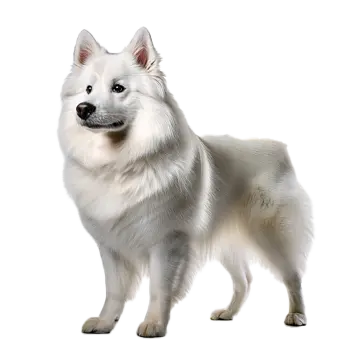

The American Eskimo Dog has traveled through a remarkable series of name changes that mirror the cultural currents of twentieth-century America. The breed's ancestors arrived in the United States with German immigrants during the nineteenth century as German Spitz dogs, white-coated members of the ancient and widespread Spitz family that had been popular in Pomerania and the coastal regions of northern Germany for centuries. In the United States, these dogs were initially known simply as Spitz dogs or white Spitz, a generic designation that covered a loose population of similar-looking Nordic-type dogs without formal breed boundaries.
The breed's first formal name change came during World War I, when widespread anti-German sentiment made anything associated with Germany commercially and socially toxic. Breeders and owners quietly dropped the German designation, and the dogs became known as American Spitz. That name held for a few years before evolving into American Eskimo Spitz, a designation adopted from the kennel name of Mr. and Mrs. F.M. Hall, who registered their dogs with the United Kennel Club around 1913. By the mid-1920s the name had settled into American Eskimo, despite the breed having absolutely no historical connection to Eskimo or Inuit peoples. The name stuck, and the UKC formally recognized the breed under it.
The shortened form American Eskimo appears frequently in casual usage and in many breed references, though the full registered name with both the AKC and UKC is American Eskimo Dog. The affectionate nickname Eskie has become nearly universal among owners and enthusiasts. Some older sources reference American Eskimo Spitz, the transitional name that briefly appeared before the breed settled on its current designation. The breed is sometimes confused with the Japanese Spitz, which bears a strong visual resemblance but is a distinct breed with separate development. Similarly, the Canadian Eskimo Dog, despite the name overlap, is an entirely different breed with ancient Arctic working heritage and no genetic relationship to the American Eskimo Dog.
The American Kennel Club recognized the breed in 1995 and placed it in the Non-Sporting Group, a somewhat awkward fit for a dog with clear Nordic working heritage but one that reflects the breed's evolution into a companion and performance dog rather than a working sled or draft animal. The UKC classifies it more intuitively in the Northern Breed group. The Canadian Kennel Club lists the breed in its Miscellaneous Class, reflecting ongoing progress toward full recognition. The FCI does not currently recognize the American Eskimo Dog as a distinct breed, as it considers the breed essentially a variant of the German Spitz, though the two breeds have diverged significantly in type and standard over the past century.