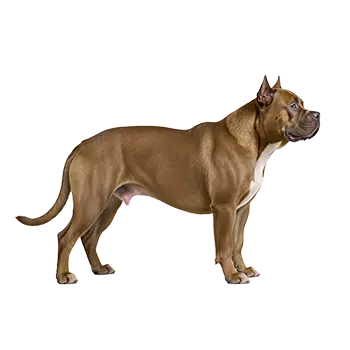
The Am Bully presents a specific visual impression that makes it immediately recognizable: a compact, heavy-boned, heavily muscled dog that looks significantly more substantial than its actual height would suggest. The breed standard describes a dog giving the impression of great strength for its size, and a correct American Bully does exactly that. The combination of wide chest, thick bone, dense muscle, and broad blocky head creates a silhouette unlike any other breed.
Size varies substantially across the four ABKC varieties. The Pocket Bully has adult males under 17 inches at the shoulder; the Standard Bully ranges from 17 to 20 inches; the XL Bully tops out at 20 to 23 inches for males. Despite the different heights, all varieties should share the same proportional compactness and muscling that defines the breed's type. A Pocket Bully should look like a miniaturized version of the Standard, not a different kind of dog. Weight varies accordingly, with Standard dogs typically in the range of 65 to 90 pounds and XL males potentially reaching 110 to 130 pounds.
The head is one of the Am Bully's most defining features. It is large, broad, and blocky, with a pronounced stop and wide-set, round to oval eyes carrying a calm, confident expression. The muzzle is medium in length, broad, and well-padded. The lips are clean and semi-loose. Ears may be natural or cropped - both are accepted under the ABKC standard. The neck is short, muscular, and slightly arched, widening toward the shoulders.
The body is short and compact relative to the dog's overall muscling. The chest is broad and deep, with well-sprung ribs. The topline is level or very slightly sloping from withers to rump. The abdomen is moderately tucked. The hindquarters are broad and well-muscled, providing the physical power this breed carries in a compact frame. The tail is low-set, thick at the base, and tapering to a point; it is carried at or below the back line.
The coat is short, stiff, and smooth throughout. It requires minimal grooming and comes in all colors and patterns except merle coats and albinism, which are disqualified under both the ABKC and UKC standards. Common colors include blue, fawn, brindle, black, red, and white, with a wide variety of patterns and combinations. Color variety is one of the aspects of the breed that has attracted significant enthusiast attention and, in some cases, driven breeding decisions toward unusual or rare color combinations at the potential expense of health and structure.
Movement should be powerful and efficient given the breed's compact build. The Am Bully should move with purpose and coordination, not waddle or roll. Structural soundness - the ability to move freely without compensatory gait patterns - is a practical health indicator that buyers should observe in both parents and in any puppy they evaluate.
The Am Bully is occasionally confused with the American Bulldog or the American Pit Bull Terrier, but the differences are significant on close inspection. The Am Bully is shorter and more compact than the American Bulldog, with a rounder, blockier head and less overall height. Compared to the APBT, the Am Bully is substantially heavier-boned and more muscle-dense, with a broader chest and thicker build throughout. The three breeds represent three different points on the spectrum of bully-type development, and understanding the distinctions matters when researching what you actually want to own. A buyer who understands these distinctions before beginning their search will make better decisions and have more productive conversations with breeders than one who treats the names interchangeably. That clarity of purpose makes for a much more satisfying ownership experience.
Affectionate With Family
★★★★★
The Am Bully was purpose-built as a companion dog, and it shows - these dogs attach deeply to their people and express that attachment enthusiastically.
Good With Young Children
★★★★☆
Typically patient and playful with children, with a tolerance for activity that makes them natural family dogs - though their size and muscle mass warrant adult supervision.
Good With Other Dogs
★★★☆☆
Variable - well-socialized Am Bullies can integrate with other dogs, but some individuals carry the dog-selective tendencies of the pit bull-type breeds in their foundation.
Shedding Level
★★★☆☆
Moderate year-round shedders; the short coat keeps grooming simple but still contributes a steady baseline of hair to household surfaces.
Coat Grooming Frequency
★☆☆☆☆
The short, stiff coat is minimal maintenance - a weekly wipe-down or brushing is genuinely all most Am Bullies need.
Drooling Level
★★☆☆☆
Modest droolers in most cases, with some individual variation based on lip tightness and facial structure.
Coat Type
★☆☆☆☆
Short, stiff, and smooth throughout - as practical and low-maintenance as a coat gets.
Openness To Strangers
★★★☆☆
More outgoing with strangers than many working breeds - the companion orientation of the breed tends to produce dogs that are friendly rather than suspicious.
Playfulness Level
★★★★★
Enthusiastic and exuberant - Am Bullies bring real energy to play and are happiest when physically engaged with their people.
Watchdog/Protective Nature
★★★★☆
Their physical presence is a deterrent, and they are alert to changes in their environment, though the breed standard explicitly discourages human aggression.
Adaptability Level
★★★☆☆
Adaptable to different environments when their exercise needs are met; heat sensitivity is a real consideration, particularly in brachycephalic individuals.
Trainability Level
★★★☆☆
Intelligent and food-motivated, which makes training accessible, but they can be stubborn - consistent, positive training from puppyhood establishes the cooperation pattern that holds.