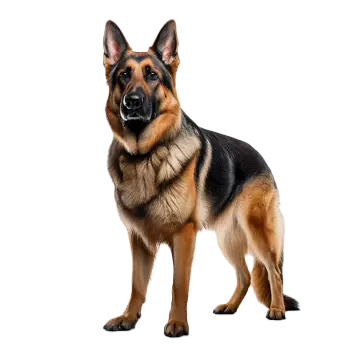
The wolf part of the name was not invented out of nowhere. The German Shepherd Dog carries an unmistakably lupine outline - the erect ears, the long muzzle, the deep chest and powerful hindquarters, the dense double coat, and the trotting gait that covers ground with fluid, wolfish efficiency. Early British observers who encountered these dogs in the years after World War I could be forgiven for finding the "wolf dog" description plausible. The resemblance is in the silhouette and the movement, not in the temperament.
Males stand 24 to 26 inches at the shoulder and typically weigh 65 to 90 pounds; females are proportionally lighter and slightly smaller. The body is longer than it is tall, strongly muscled throughout without coarseness. The proportions are those of a working dog built for sustained, efficient movement across varied terrain - the chest deep for lung capacity, the neck strong for balance and carriage, the rear quarters powerful for drive.
The head is proportionally wedge-shaped, with a moderately arched skull tapering cleanly to a long muzzle. The lips are dry and tight-fitting. The teeth meet in a full scissors bite. The eyes are almond-shaped, dark, and medium-sized; the expression produced is the characteristic quality that strikes most people immediately - alert, measuring, and intensely intelligent. The ears are erect, medium-sized, open at the front, and forward-facing. Puppies go through a floppy ear phase during development that resolves with maturity.
The neck is long and muscular, arched in carriage. The chest is deep, with a brisket reaching to or below the elbow. The back carries the characteristic slight slope from withers to croup - a functional feature that positions the hindquarters for powerful drive. The tail is bushy, hanging in a gentle saber curve at rest and not carried above the back line in motion.
The double coat consists of a straight or slightly wavy outer coat of medium length with a soft, dense undercoat. A longhaired variety with softer outer coat and feathering exists and is accepted by some registries. Colors include black and tan, black and red, sable in shades from pale gold through dark wolf-gray, and solid black. The coat is weather-resistant - another feature that contributed to the wolf comparison in an era when most companion breeds were visually softer in appearance.
The trotting gait is the breed's most celebrated physical quality. In a correctly built dog moving freely, the rear drives powerfully and the front reaches well forward, the back steady and level throughout. This is the flying trot von Stephanitz specifically selected for - the gait of a dog that could work all day across the kind of terrain that exhausts most other breeds. Watching a well-bred German Shepherd Dog move at a trot remains one of the most striking sights in dogdom, and it is exactly what the "wolf dog" observers of the 1920s were watching when they coined that name.
It is worth noting that not all German Shepherd Dogs being shown today reflect the correct working standard. Some show lines - particularly those bred for what certain competitive judging communities reward - carry exaggerated rear angulation and a dramatically curved topline that produces a flashy but functionally inferior dog. Von Stephanitz's standard explicitly prioritized utility, and a dog built to actually work should look like it could. Buyers seeking a companion or working dog, as opposed to a show-ring competitor, do well to consult with breeders whose dogs carry working titles alongside their conformation evaluations. The physical standard and the working standard should produce the same dog - and when they do, the result is everything the name once promised and considerably more.
Affectionate With Family
★★★★★
Deeply bonded to their household - they follow, watch, and track their people with an attentiveness that owners either find endearing or overwhelming, depending on temperament.
Good With Young Children
★★★★☆
Gentle and protective with children they have been raised with; early socialization matters, and the dog's size always warrants supervision with very young kids.
Good With Other Dogs
★★★☆☆
Manageable in multi-dog households when socialized appropriately; the breed's confidence and working drive can create friction with poorly matched companions.
Shedding Level
★★★★★
Year-round heavy shedders with two seasonal blowouts - this is a breed where dog hair on clothing and furniture is a constant fact of life.
Coat Grooming Frequency
★★★☆☆
Several brushings per week during normal periods; daily sessions with a deshedding tool during seasonal coat changes keep the indoor hair situation manageable.
Drooling Level
★☆☆☆☆
Minimal drooling - one of the breed's few low-maintenance characteristics.
Coat Type
★★★☆☆
Dense double coat of medium length; a longhaired variety exists and is accepted by some registries.
Openness To Strangers
★★☆☆☆
Reserved and watchful with unfamiliar people - this is a dog that assesses before it accepts, which is what the breed was built to do.
Playfulness Level
★★★★☆
Enthusiastic and engaged when mentally stimulated and comfortable; a bored or under-exercised dog will redirect that energy in less welcome directions.
Watchdog/Protective Nature
★★★★★
Alert, discerning, and committed to the safety of its household - one of the defining traits the breed has always been known for.
Adaptability Level
★★★☆☆
Adaptable to varied living environments if physical and mental needs are genuinely met - the breed struggles with idleness regardless of setting.
Trainability Level
★★★★★
Among the most trainable dogs ever developed - fast, precise learners with the drive to master complex tasks, which is why they lead working dog rosters worldwide.