Alsatian

German Shepherd Dog

Quick Facts

🐕 Breed Group
Herding Group
📏 Size Category
Large
📏 Height
Males: 24-26 inches, Females: 22-24 inches
⚖️ Weight
Males: 65-90 lbs, Females: 50-70 lbs
⏱️ Life Expectancy
7-10 years
🧣 Coat Type
Double coat, medium length
🎨 Coat Colors
Black and tan, sable, black, bicolor
😀 Temperament
Intelligent, loyal, courageous, confident
🏃 Exercise Needs
High
🎓 Training Difficulty
Easy
👶 Good with Children
Yes, with socialization
🐾 Good with Other Pets
Generally yes, with proper introduction

Other Names & Breed Recognition

If you grew up in Britain anytime before the 1980s, the dog most people call a German Shepherd was almost certainly known to you as an Alsatian. The name was not a casual nickname - it was the official registered name under The Kennel Club for five decades. If your neighbor had an Alsatian, they had exactly the same dog as someone in Germany who owned a Deutscher Schaferhund or someone in America who owned a German Shepherd Dog. Same breed, same temperament, same capabilities. The name alone was different, and the story behind that difference runs straight through the worst conflict in European history.

The breed goes by several names depending on where you are in the world and how deep into dog culture you want to go. In Germany it remains the Deutscher Schaferhund - the German Shepherd Dog, the name given to it by its founder, Captain Max von Stephanitz, in 1899. In North America and most of the world today it is the German Shepherd Dog, registered by the AKC since 1908. The abbreviation GSD is universally understood in the dog community. In South Africa, the Alsatian Shepherd Dog Club still uses the older name officially and shows no intention of changing. In everyday British speech, older generations still say Alsatian more naturally than German Shepherd, and both are understood.

The other formal alternate name - Alsatian Wolf Dog - is covered in a separate page. That was the full initial name used by The Kennel Club when the breed was renamed during the war. The "wolf dog" portion was dropped after campaigns by concerned breeders who worried the wolf association would damage the breed's legal standing and public acceptance. What remained was simply Alsatian, which served as the official British name until 1977 when The Kennel Club restored German Shepherd Dog as the primary designation. Alsatian then moved into parentheses alongside the official name, and was removed entirely in 2010.

For registry purposes today, the breed is universally recognized as the German Shepherd Dog. The GSDCA (German Shepherd Dog Club of America) is the national parent club in the United States. The Kennel Club in the UK now lists the breed under its German name with Alsatian noted as an alternate. The FCI carries the breed in Group 1 under its original German designation. Anyone in Britain who calls their dog an Alsatian is not wrong - they are speaking the language their parents and grandparents spoke - but formal documentation will say German Shepherd Dog.

Alsatian Organizations & Standards

The German Shepherd Dog Club of America (GSDCA) is the national parent club in the United States and the authority on the AKC breed standard. Founded in 1913, the GSDCA has developed one of the most comprehensive health and working evaluation programs of any breed club, including the breed's CHIC health testing requirements and the GSDCA Temperament Test - a formal assessment that evaluates whether an individual dog possesses the breed's expected behavioral characteristics. The GSDCA Health Award of Merit recognizes dogs that pass a full battery of health evaluations, and the club works with the OFA on all CHIC-required testing.

In Germany, the Verein fur Deutsche Schaferhunde (SV), founded by von Stephanitz in 1899, remains the world's largest breed registry for the German Shepherd Dog. The SV maintains its own rigorous breed survey system (Korung) and requires titled working evaluations before dogs can enter formal breeding programs. The standard the SV maintains is the original against which all other national standards are ultimately measured. The FCI defers to German standards for this breed, placing it in Group 1 (Sheepdogs and Cattledogs), Section 1 (Sheepdogs).

In the United Kingdom, The Kennel Club registers the breed in the Pastoral group and the British Association for German Shepherd Dogs (BAGSD) is one of the major breed clubs for enthusiasts and working dog handlers. During the decades when the breed was officially called the Alsatian, British clubs operated under that name, and some retain historical references to it. The breed standard used by The Kennel Club aligns with FCI requirements in most significant respects, describing a medium to large dog of balanced angulation, with a slightly sloping topline, a deep chest, and the characteristic noble, alert carriage of the head.

The GSDCA's CHIC health testing requirements for German Shepherd Dogs include OFA hip evaluation, OFA elbow evaluation, OFA cardiac examination, OFA thyroid evaluation, and a Degenerative Myelopathy (DM) DNA test from an approved laboratory. The DM test is required, though given ongoing research the dog's DNA result status does not currently disqualify a dog from the GSDCA Health Award of Merit. Buyers should request documentation showing that both parents of any puppy have current OFA clearances for hips, elbows, heart, and thyroid, as well as a DM test result on file. The GSDCA's health program is serious and well-funded, reflecting the breed community's awareness that genetic disease management in a popular breed requires consistent, long-term commitment.

Kennel Club Recognition

  • American Kennel Club (AKC): Recognized in 1908, Herding Group
  • United Kennel Club (UKC): Recognized, Herding Dog Group
  • Canadian Kennel Club (CKC): Recognized, Herding Group
  • FCI: Recognized, Group 1 - Sheepdogs and Cattledogs
  • The Kennel Club (UK): Recognized, Pastoral

Alsatian Physical Description

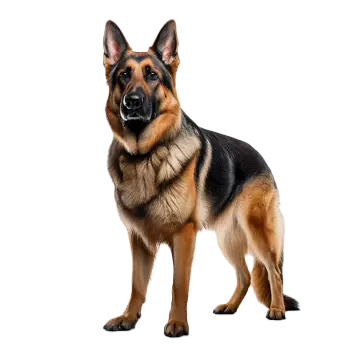
The Alsatian is a picture of working-dog efficiency. Nothing about the build is decorative - the proportions exist because they work. Males stand 24 to 26 inches at the shoulder and typically weigh 65 to 90 pounds; females are somewhat lighter and more refined at 22 to 24 inches and 50 to 70 pounds. The overall silhouette is that of a slightly longer-than-tall dog, strongly muscled but never coarse, with a smooth, flowing outline that speaks to a dog built for sustained effort across varied terrain.

The head is wedge-shaped and proportional - neither too broad nor too fine. The skull is moderately arched and tapers cleanly to a long, gradually tapering muzzle with strong, tight-fitting lips. The teeth meet in a full scissors bite. The eyes are almond-shaped, medium-sized, and dark - the expression they produce is the Alsatian's most recognizable feature: alert, intelligent, and intensely focused, with a quality that many owners describe simply as the feeling of being evaluated. The ears are erect, medium-sized, open at the front, and carried forward - in puppies they go through a floppy phase that alarms new owners, but they come up reliably as the dog matures.

The neck is moderately long and muscular, carried in an arched position when the dog is alert. The chest is deep rather than wide - the brisket reaching to or slightly below the elbow - and the ribs are well-sprung without being barrel-shaped. The abdomen is moderately tucked. The back is straight and strongly muscled, with the characteristic slight slope from withers to croup that is one of the breed's most recognized visual features. This slope is functional: it positions the hindquarters for the powerful driving motion that gave the breed its extraordinary trotting gait. The tail is bushy and hangs in a gentle saber curve at rest.

The double coat consists of a dense, straight or slightly wavy outer coat with a softer undercoat. Standard coat length is medium, lying close to the body. A longhaired variety with soft, somewhat parted outer coat exists and is recognized by some registries including The Kennel Club. The most common colors are black and tan, black and red, and sable - variations from dark wolf-gray through rich golden tan. Solid black dogs are also accepted. White dogs exist but are not recognized by the FCI or the AKC as German Shepherd Dogs, being registered separately in some countries.

The Alsatian's movement is one of its most striking characteristics. At a trot, the ground-covering stride appears effortless - rear legs driving powerfully and front legs reaching well forward, with the back remaining level and steady. This is the flying trot that von Stephanitz specifically bred for, the gait of a working dog that could cover miles without breaking stride or sacrificing efficiency. In a dog moving well, the whole picture flows. Judges and breeders who have dedicated careers to the breed describe it as one of the most beautiful trotting gaits in dogdom - and a well-bred Alsatian moving freely across a field gives you immediate evidence for that claim.

The overall impression of a correct Alsatian is one of balanced athleticism without exaggeration. The breed has suffered from fads in some showing communities - extreme rear angulation, a dramatically roached topline, movement that sacrifices function for theatrical appearance. Von Stephanitz's mandate was always utility first, and the breeders who hold closest to that standard produce dogs that look like they could work because they actually could. When evaluating a dog or choosing a breeder, a confident, balanced structure that matches the working standard is the target - not the exaggerated silhouette that has appeared in some show lines and drawn considerable criticism from working dog handlers.

Affectionate With Family
The Alsatian forms an intense bond with its people - this is a dog that tracks your movements, wants to be in the same room, and takes your emotional state as its own.
Good With Young Children
With proper socialization and a calm household, these dogs are patient and protective with children - though their size and energy call for supervision with very small kids.
Good With Other Dogs
Variable - well-socialized Alsatians integrate fine with other dogs, but the breed's confidence and working drive can create friction with poorly matched companions.
Shedding Level
Heavy year-round shedders with two seasonal coat blowouts annually - owning one means making peace with dog hair on every surface.
Coat Grooming Frequency
Regular brushing several times a week manages the shedding; during seasonal blowouts, daily brushing and a good deshedding tool become necessary.
Drooling Level
Not a drooling breed - this is one area where Alsatian ownership is refreshingly low maintenance.
Coat Type
A dense double coat of medium length; a rarer longhaired variety also exists and is accepted under The Kennel Club standard.
Openness To Strangers
Characteristically reserved with people they do not know - this is a watchful breed that takes time to extend trust, which is a feature, not a flaw.
Playfulness Level
Enthusiastic and playful, especially in environments where they feel safe and engaged - a bored Alsatian will create its own games, usually at your expense.
Watchdog/Protective Nature
This is one of the breed's defining characteristics - alert, discerning, and willing to act when the situation calls for it.
Adaptability Level
Adaptable to different living situations provided their exercise and mental stimulation needs are genuinely met - they struggle in environments that leave them idle.
Trainability Level
Among the most trainable dogs in existence - fast learners with the drive and focus to master complex tasks, which is why they are the working dog world's first call.

Alsatian History & Development

The name Alsatian has a sharper origin story than most alternate breed names. It was not a gradual regional drift or a casual nickname that stuck. It was a deliberate political act, imposed during wartime, that gave a German breed an identity palatable to people whose sons were fighting German soldiers in the trenches of France.

The breed itself began in Germany in 1899, when Captain Max Emil Friedrich von Stephanitz attended a dog show and purchased a dog he considered the ideal German herding dog. He named the dog Horand von Grafrath, registered him as SZ1 in the newly founded Verein fur Deutsche Schaferhunde (SV), and declared him the founding sire of the Deutscher Schaferhund. Von Stephanitz's vision was explicitly utilitarian: a working dog above all else. As sheep herding declined with the industrialization of German agriculture, he pivoted the breed toward police and military work, and it was in that capacity that the German Shepherd first appeared in Britain and America - through the mouths of soldiers who had encountered these dogs on the Western Front and came home amazed.

By the time the war ended in 1918, British dog enthusiasts were genuinely interested in importing the breed. But the name was a problem. The UK Kennel Club, responding to intense anti-German sentiment in British society, officially renamed the breed the Alsatian Wolf Dog in 1919. The name came from the Alsace-Lorraine region on the French-German border - a contested territory that had switched national control multiple times, and therefore felt less definitively German than the breed's actual origins. The "wolf dog" appendage was soon a problem of its own: it alarmed a public already nervous about wolf-blooded animals, and campaigns by concerned breeders succeeded in dropping it. The name Alsatian remained.

Despite the name, the breed thrived in Britain. When The Kennel Club first accepted registrations in 1919, fifty-four Alsatians were registered. By 1926 that number exceeded 8,000. Two World War I veterans, the canine film stars Rin Tin Tin and Strongheart, generated enormous public enthusiasm for the breed across the English-speaking world. In the United States, the AKC briefly changed the name to Shepherd Dog during the war and restored it to German Shepherd Dog in 1931. Britain held out far longer.

The name Alsatian persisted through World War II, through the 1950s and 1960s, and well into the 1970s as the standard British term. By the mid-1970s, a sustained campaign by breeders and enthusiasts arguing for the restoration of the proper breed name finally moved The Kennel Club to allow re-registration as German Shepherd Dog in 1977. Alsatian moved into parentheses in the formal breed name. In 2010, it was removed from formal designation entirely. But in everyday British speech, it never fully went away - and among older generations especially, Alsatian remains a comfortable, familiar word for a very familiar dog.

The irony of the Alsatian story is that the political effort to separate the breed from its German identity ultimately failed to diminish either the breed's reputation or its German associations. The dog kept doing German things - working with police, military, search and rescue teams - under its British name, and everyone involved understood exactly what it was. The name was a diplomatic fiction maintained for fifty years, and what it reveals is less about the breed than about the remarkable grip these dogs took on the British public from the moment they arrived.

Alsatian Temperament & Personality

The Alsatian is not a casual dog. It is a working breed in the fullest sense - not just historically but behaviorally, right now, in your house. Von Stephanitz built a dog with a brain and the drive to use it, and those qualities did not diminish when the breed moved into companion homes. What you get with an Alsatian is a dog that thinks, watches, problem-solves, and tracks patterns in its environment with a level of attention that most breeds simply do not apply to daily life. This is simultaneously the breed's greatest asset and the source of most of the behavioral problems owners encounter when they are not prepared for it.

The working intelligence is real and specific. Alsatians excel in structured tasks - obedience, protection sports, search and rescue, scent detection - because their minds are built for that kind of engagement. In a home that does not provide it, that same intelligence turns inward and finds less productive outlets. Destructive behavior, excessive vocalization, obsessive movement patterns, and anxiety are what happen when this particular mental engine has nothing to run on. This is not a breed you can leave in a yard and expect to be fine.

The bond with their primary handler or family is intense. Alsatians are known for what breeders and trainers call "one person" or "one family" orientation - a depth of attachment that is deeply rewarding when it clicks and can be complicated when it tips into over-attachment or frustration-based behavior when separated. The characteristic wariness of strangers is not shyness or anxiety in a well-bred, well-socialized dog - it is measured assessment. They watch people, read them, and decide at their own pace. A dog that warms up slowly to your houseguest but shows no arousal or tension is behaving correctly. A dog that is reactive, hard to calm, or persistently anxious around normal social situations has been failed by its socialization program, not by its genetics.

The GSDCA's formal temperament test reflects the breed standard's explicit requirement for mental stability under pressure. The standard calls for a confident, self-assured dog that is approachable and willing to engage with work. Sharpness - meaning hair-trigger reactive aggression - is not the same as protectiveness and is not what the breed is supposed to produce. Buyers should be clear-eyed about this distinction when selecting a breeder and evaluating adult dogs.

Family life works well with an Alsatian when the foundation is built correctly. These dogs are affectionate, physically expressive within their family circle, and often form extraordinary bonds with children they have grown up with. They are not pushy or demanding in the way high-energy sporting breeds can be, but they are present. They want to be included. They will follow you from room to room, park themselves at your feet, and be acutely aware of any change in the household atmosphere. That attentiveness, when it is grounded in a stable, confident temperament, produces a dog that is one of the most responsive and satisfying companions in the working dog world.

Alsatian Family Life & Living Requirements

The Alsatian fits best in a household that understands it is getting a working dog and prepares accordingly. This is not a breed you acquire and figure out later. The mental and physical demands are real from the start, and meeting them consistently is what separates well-adjusted Alsatians from the ones that end up in rescue at two years old because nobody had anticipated what they were dealing with.

Space matters but is not the whole picture. Alsatians can live comfortably in homes without large yards if their exercise and mental enrichment needs are met through deliberate daily activity. What they cannot tolerate is long hours of idleness and isolation. A dog that spends eight hours alone, comes home to a tired owner, and gets a fifteen-minute walk is not having its needs met regardless of the size of the property. Investing in dog daycare, a dog walker, or puzzle-based enrichment during long absences is not optional for this breed - it is a management baseline.

With children who have been raised alongside an Alsatian, the relationship is typically excellent. The breed's protective instinct extends naturally to the children of its household, and the patience of a well-socialized Alsatian with a child it trusts is real. Structured introductions and early socialization with children of different ages reduces any tension around unpredictable child behavior. Teaching children to interact respectfully with the dog completes the equation.

Housing with other pets usually works well when the Alsatian has been socialized appropriately. The breed's herding instinct occasionally asserts itself around small, fast-moving animals. Cat introductions made when the dog is young and the rules are consistently reinforced usually produce households where everyone coexists peacefully. The Alsatian's territorial awareness means that new animal introductions in adulthood take more careful management than puppy-stage introductions.

Financially, this is a breed that deserves honest advance budgeting. Veterinary costs - especially for hip and elbow dysplasia management and the degenerative myelopathy that can develop in later years - can be significant. Quality nutrition for a large, active breed adds up. Pet insurance is worth evaluating seriously before the dog is acquired rather than after the first health event has occurred.

The Alsatian is fundamentally social. Isolation is genuinely difficult for this breed - not just inconvenient, but damaging to the stable temperament that is the breed's best quality. Owners who work long hours should make active plans for the dog's care during absences rather than assuming the dog will simply wait it out.

Alsatian Training & Exercise Needs

Training an Alsatian well is one of the most rewarding experiences in dog ownership. Training one poorly is one of the most frustrating. The breed's trainability is genuine - these are dogs that learn fast, remember reliably, and want to engage with structured work in a way that many breeds simply do not. But that trainability works in both directions. They learn good habits quickly and they learn bad ones just as fast. An Alsatian that has been allowed to develop rehearsed behaviors - jumping, pulling, reactive barking, demanding attention - requires consistent counter-conditioning to change, not because it is stubborn but because it remembers.

Positive reinforcement training works exceptionally well with this breed. Clear communication, consistent rewards, and a trainer who maintains their own emotional calm produce an Alsatian that is sharp, responsive, and motivated. Harsh or correction-heavy methods tend to produce shutdown, anxiety, or hand-shyness in a breed that needs confidence to work at its best. The GSDCA's temperament evaluation framework explicitly values stability and resilience - those qualities are cultivated through training that builds the dog's confidence rather than eroding it.

Exercise requirements are high and genuinely non-negotiable. An adult Alsatian needs substantial daily activity - at minimum an hour of real exercise split between opportunities for off-leash running, structured walking, and mentally engaging activity like retrieve games, scent work, or training sessions. They are not dogs satisfied by a brief yard outing. Their work ethic means they will happily do more if offered, and many owners discover that the breed's need for engagement pushes them into enjoyable activities they would not have pursued without the dog.

During puppyhood, the balance shifts. High-impact exercise - running hard, jumping, or long sustained activity - should be limited until skeletal maturity, which in this breed is around 18 months. Short, frequent play sessions and gentle leash walks serve puppy development better than long demanding outings. Puppyhood is, however, exactly the right time for socialization and training intensity - exposing the young Alsatian to a wide variety of people, environments, sounds, and situations builds the confident adult that the breed standard describes.

Formal sport and working activities - tracking, agility, herding trials, protection sports - are excellent outlets for Alsatians who have the drive and whose owners have the time to pursue them. These activities tap directly into the behavioral wiring the breed carries and produce dogs that are genuinely content in a way that no amount of casual walking fully replicates. Even owners who are not interested in competitive sport benefit from introducing structured activity; the discipline and engagement that comes with even basic foundation training transforms a high-need dog into a settled, confident companion.

Alsatian Health Concerns

The German Shepherd Dog carries real health vulnerabilities that any prospective owner should understand before committing to the breed. The GSDCA and the OFA have built a comprehensive testing program specifically because the breed community identified these conditions as documented and significant.

The lifespan of 7 to 10 years is shorter than many medium-large breeds, and buyers should factor both the emotional and financial reality of this into their decision. German Shepherd Dogs are a breed where working with reputable breeders who maintain full CHIC documentation on both parents gives the buyer the best realistic chance of a healthy dog. Purchasing from untested lines because it is cheaper or more convenient is a false economy in a breed with this health profile. The testing requirements exist for good reasons, and the breeders who comply with them are doing something meaningful for both their buyers and the breed.

Common Health Issues

  • Hip dysplasia - Documented frequently in German Shepherd Dogs; abnormal hip joint development causing pain, reduced mobility, and progressive arthritis over time.
  • Elbow dysplasia - A group of developmental conditions affecting the elbow joint causing front-limb lameness and chronic discomfort; required CHIC testing for all breeding stock.
  • Degenerative Myelopathy (DM) - Progressive neurological disease affecting the spinal cord; DNA test available through OFA and required for CHIC certification in the breed.
  • Exocrine Pancreatic Insufficiency (EPI) - Documented in German Shepherd Dogs; pancreas fails to produce adequate digestive enzymes resulting in severe weight loss and chronic digestive failure despite maintained appetite.
  • Perianal fistulas - Painful chronic lesions around the anal region with documented elevated frequency in German Shepherd Dogs; believed to have an immune-mediated component.
  • Hemangiosarcoma - Cancer of blood vessel walls occurring with elevated frequency in the breed; rapid progression makes early detection difficult.
  • Autoimmune thyroiditis - OFA thyroid evaluation is a CHIC requirement for the breed, reflecting documented hereditary thyroid disease in the German Shepherd Dog.

Preventive Care & Health Monitoring

  • OFA hip evaluation - Required CHIC test; buyers should verify both parents have passing hip evaluations.
  • OFA elbow evaluation - Required CHIC test for breeding stock.
  • Degenerative Myelopathy (DM) DNA test from an OFA-approved laboratory - Required for CHIC certification.
  • OFA cardiac examination - Required under GSDCA CHIC program.
  • OFA thyroid evaluation - Required under GSDCA CHIC program.
  • Early and extensive socialization from puppyhood - Critical for the temperament stability this breed requires; gaps in socialization create behavioral challenges that are harder to address in adulthood.
  • Weight management throughout life - Excess weight accelerates hip and elbow joint degeneration in a breed already predisposed to both conditions.
  • Limit high-impact exercise during puppyhood - Before 18 months, to protect developing joints.

Alsatian Grooming & Maintenance

Owning an Alsatian means owning its coat. The double coat - dense outer layer and soft, insulating undercoat - sheds year-round and blows out dramatically twice annually. During seasonal shed, the volume of loose undercoat produced can seem implausible. It floats through the house, accumulates in corners, and appears on dark clothing immediately and mysteriously. A good vacuum, a willingness to brush frequently, and realistic expectations about indoor cleanliness are prerequisites.

Regular brushing, ideally three to four times a week during normal shedding and daily during blowouts, is the primary grooming task. A slicker brush, a metal comb, and an undercoat rake are the three tools that earn their space in the kit. During heavy shedding, a deshedding tool that pulls loose undercoat rather than just brushing the surface coat reduces the volume of hair shed in the house substantially. Bathing is needed only occasionally - the coat has natural oils that are stripped by frequent washing, and most Alsatians stay reasonably clean with regular brushing between bath days.

Ears should be checked weekly. The upright ear carriage that is characteristic of the breed actually helps with airflow and reduces ear infection risk compared to floppy-eared breeds, but regular inspection catches debris or early signs of irritation before they develop into problems. Nails grow quickly on an active dog and should be trimmed every few weeks - dogs walked frequently on pavement wear them down naturally, but those exercised primarily on soft surfaces will need more frequent attention. Teeth benefit from regular brushing or appropriate dental chews; dental disease accumulates over time and contributes to the overall health burden in older dogs. Puppies should be introduced to all grooming procedures as early as possible so that compliance becomes habitual rather than a negotiation.

Professional grooming is an option during peak shedding season and can help manage the volume of loose undercoat before it distributes itself through the house. Most owners manage between professional appointments with their own brushing routine. The roughcoat or longhaired variety requires more attention to prevent mats, particularly behind the ears, in the collar area, and in the feathering on the legs. For both coat types, the investment in good brushing tools and consistent routine pays back in reduced shedding indoors and a coat that stays healthy and manageable throughout the year.