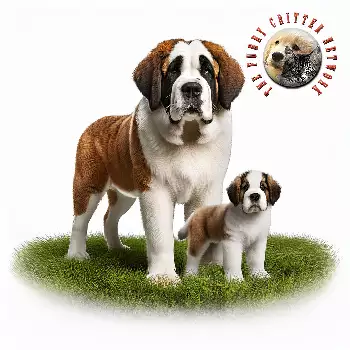
Standing beside a Saint Bernard is an experience that recalibrates your sense of scale. Males commonly reach 28 to 30 inches at the shoulder and can weigh well over 150 pounds - some exceed 180. Females are somewhat smaller but still represent a genuinely giant dog by any standard. The overall impression is one of balanced, deliberate mass - not the blocky, wide-bodied bulk of the English Mastiff but a taller, longer frame built for mountain terrain. The breed's proportions reflect its working origins: there is length in the leg and body that allowed these dogs to cover ground efficiently in deep snow, combined with the substance necessary to assist a person in distress.
The head is one of the breed's most distinctive features. It is massive and wide, with a broad, slightly arched skull and a clearly defined stop. The muzzle is short, deep, and blunt - not the elongated face of a sighthound or a Retriever, but the powerful front end of a working molosser. The flews are well-developed and pendulous, which contributes to the breed's legendary drooling. The eyes are medium-sized, dark brown, and carry the characteristic gentle, intelligent expression that makes these dogs so immediately appealing. The eyelids should be tight-fitting; loose or pendulous lids are associated with the eye conditions that show up in the breed's health profile.
The ears are medium-sized, pendant, set fairly high, and lie close to the cheeks when relaxed. The neck is strong and muscular, slightly arched, with well-developed dewlap. The chest is wide and deep, with well-sprung ribs giving substantial lung capacity - appropriate for a dog that worked at altitude. The back is broad and straight, the loin well-muscled and moderately tucked. The tail is long, hanging down at rest with a slight upward curve at the tip, and is carried no higher than the back line when the dog is moving or alert.
Two coat types are accepted. The smooth (shorthaired) variety has a dense, close-lying coat with a fine undercoat and slight feathering on the thighs and tail. The rough (longhaired) variety carries a medium-length coat of moderate density, with wavy or slightly wavy texture and longer feathering on the legs, tail, and around the face. The rough coat was developed through crossings with Newfoundlands in the 1830s but proved impractical for actual mountain rescue work - ice formed on the longer hair - and the monks ultimately favored smoothcoat dogs for work while longhairs were given away to valley breeders.
The standard base color is white with patches of red or brownish-yellow, or a continuous red or brownish-yellow mantle covering the back and sides with white at the muzzle, blaze, collar, chest, feet, and tail tip. A black mask and shading are common and desired. Brindle markings occur but are less typical. The white portions should be bright and the colored areas well-defined, giving the classic Saint Bernard silhouette instantly recognizable in photographs or paintings going back centuries.
Movement at a trot should be free, strong, and steady. Given the breed's size, a certain deliberateness is expected, but rolling gait or padding movement is not correct. Rear drive should be strong and coordinated with good front reach. Owners often describe watching a well-built Saint Bernard move as quietly impressive - you become aware just how much controlled power is operating beneath that calm exterior.
The overall silhouette is unmistakable. No other breed combines this particular scale with this particular gentleness of expression. The face reads as both powerful and kind simultaneously, which is not an accident of breeding - it reflects a dog selected for centuries on the basis of what it could do for people in distress. Size without functional proportion was not the goal. The hospice dogs had to work. What we have today is the descendant of that working type, refined over generations by breeders who understood that a Saint Bernard should look like it could still do the job.
Affectionate With Family
★★★★★
These big dogs pour themselves into their families completely - patient, warm, and happiest when they can be close to the people they love.
Good With Young Children
★★★★☆
Their gentle, patient disposition makes them wonderful with kids, though their sheer size calls for supervision with very young children.
Good With Other Dogs
★★★☆☆
Generally tolerant and easygoing with other dogs, though proper early socialization helps set the right tone for multi-dog homes.
Shedding Level
★★★★☆
Heavy shedders year-round, with seasonal coat blowouts that require real commitment from owners who care about their furniture.
Coat Grooming Frequency
★★★☆☆
The roughcoat variety needs brushing several times a week; the smoothcoat is more manageable but still benefits from regular attention.
Drooling Level
★★★★★
Legendary droolers - if you own one, a drool rag becomes a permanent accessory. This is simply part of the package.
Coat Type
★★★☆☆
Two varieties exist: the short, dense smoothcoat and the medium-length roughcoat, which is slightly wavy and carries feathering on the legs and tail.
Openness To Strangers
★★★☆☆
Friendly but not pushy with strangers - they tend to assess visitors calmly before deciding on a greeting.
Playfulness Level
★★★☆☆
Playful and goofy as puppies but settle into a more measured, dignified adult personality over time.
Watchdog/Protective Nature
★★★★☆
Their size alone is a deterrent. They are not aggressive guard dogs but will alert and position themselves between family and perceived threats.
Adaptability Level
★★☆☆☆
Built for the cold, they struggle in heat and need sufficient indoor space - apartments and warm climates are genuinely poor fits.
Trainability Level
★★★☆☆
Intelligent but can be independent-minded; consistent, patient training from puppyhood is essential given how much dog you end up with.