AKK

Alaskan Klee Kai

Quick Facts

🐕 Breed Group
Non-Sporting Group
📏 Size Category
Small to Medium
📏 Height
Males: 15-17 inches (standard size), Females: 13-15 inches (standard size)
⚖️ Weight
Males: 16-22 pounds, Females: 13-18 pounds
⏱️ Life Expectancy
12-16 years
🧣 Coat Type
Double coat, medium length
🎨 Coat Colors
Black and white, gray and white, red and white
😀 Temperament
Alert, energetic, curious, reserved with strangers
🏃 Exercise Needs
Moderate - daily activity required
🎓 Training Difficulty
Moderate
👶 Good with Children
Good with gentle, older children
🐾 Good with Other Pets
Can do well with early socialization

Other Names & Breed Recognition

AKK is the abbreviation used across breed communities, online forums, social media groups, and breeder networks to refer to the Alaskan Klee Kai. If you have spent any time around this breed or researching it online, you have almost certainly encountered the abbreviation before the full name - it shows up in conversation the way insiders talk about a breed they know well. Searching AKK in dog groups will land you squarely in a world of masked, husky-faced small dogs with outsized personalities.

The full name, Alaskan Klee Kai, comes from an Athabascan phrase meaning small dog. The breed was developed in Alaska in the 1970s by Linda Spurlin, who wanted to create a companion-sized version of the Siberian Husky without simply crossbreeding small dogs at random. Spurlin spent years carefully selecting and refining the lineage, introducing the American Eskimo Dog and Schipperke into the foundation stock to achieve the right size and proportions, then worked to stabilize type before releasing dogs to the public in 1988. The abbreviation AKK emerged naturally from the community of early enthusiasts as the breed became better known through the 1990s and into the internet era.

Beyond AKK and the full breed name, a few other names circulate in conversation. Some people simply call them Klee Kai as shorthand, dropping the Alaskan prefix. You may also occasionally see the spelling Klee Kaai in older documentation, though this is not standard today. The breed has never carried a colorful working nickname the way some breeds do - no regional descriptor has attached to them the way Wiener Dog attached to the Dachshund. AKK is simply the clean, practical shorthand that breeders and owners reached for because the full name, while descriptive, is a mouthful in everyday use.

From a registry standpoint, the AKK is primarily documented through the United Kennel Club, which has recognized the breed since 1997. The American Kennel Club accepted the breed into its Foundation Stock Service in October 2020, placing it on the path toward full recognition in the Non-Sporting Group. This means UKC registration is currently the standard for responsible breeders, and UKC papers are what the Alaskan Klee Kai Association of America uses to define a legitimately registered AKK. Full AKC recognition has not yet been granted as of this writing, and the breed community continues working toward that milestone while building the registration base and club infrastructure the AKC requires for full recognition.

AKK Organizations & Standards

The primary organization governing the AKK is the Alaskan Klee Kai Association of America, commonly referred to as the AKKAOA. This is the parent club recognized by the United Kennel Club and the body that sets and maintains the official breed standard. The AKKAOA maintains a list of approved breeders who have agreed to follow the club's code of ethics, which includes health testing requirements and responsible placement practices. If you are looking for an AKK, the AKKAOA breeder list is the first place responsible ownership research leads you.

The breed standard as maintained by the AKKAOA and the UKC describes the AKK as a small to medium spitz-type dog that presents in three distinct size varieties: toy (up to 13 inches), miniature (13 to 15 inches), and standard (15 to 17 inches, with some tolerance up to 17.5 inches). The standard emphasizes that the AKK must have a striking facial mask that contrasts sharply with the surrounding coat color - this mask is a defining characteristic and its absence is a fault. The breed comes in four base color patterns: black and white, gray and white, red and white, and solid white, though solid white is a disqualification under the UKC standard due to the absence of required mask contrast. Eye color is wide open - any color or combination, including parti-eyed and bi-eyed individuals, is acceptable.

Health testing expectations for AKK breeding stock, as guided by the AKKAOA and the Canine Health Information Center (CHIC) program through OFA, include thyroid evaluation for autoimmune thyroiditis, patella examination by an orthopedic specialist, ophthalmologic examination by a board-certified veterinary ophthalmologist, cardiac evaluation by a cardiologist, and a DNA test for Factor VII Deficiency. Dogs that complete all required testing and make results publicly available through OFA earn a CHIC number - this is the benchmark for health-tested breeding stock that the AKKAOA expects of its approved breeders. Asking for a breeding dog's CHIC number is a legitimate and important step in evaluating any breeder you are considering.

The breed's relationship with the AKC has been developing since 2020 when Foundation Stock Service status was granted. This is the starting point for breeds working toward full recognition and allows AKK dogs to compete in companion events. The AKKAOA has been working cooperatively with the AKC through this process, and the breed is anticipated to eventually receive full recognition in the Non-Sporting Group. Until that recognition is formalized, UKC papers remain the standard documentation for a properly registered AKK. The UKC breed standard and the AKKAOA standard are closely aligned, reflecting the collaborative relationship between the club and the registry. Some breeders also register dogs with the American Rare Breed Association, though this registry is generally considered secondary to UKC in the context of the breed's official documentation.

Kennel Club Recognition

  • United Kennel Club (UKC): Recognized, Northern Breeds

AKK Physical Description

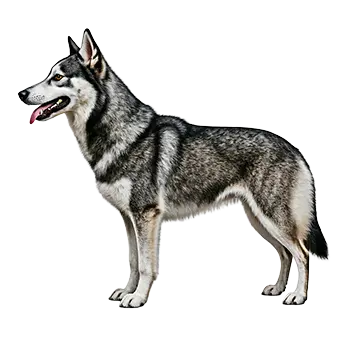
The first thing most people notice about an AKK is the face - specifically, that mask. It is the breed's most iconic visual feature, a bold band of contrasting color framing the eyes and muzzle against a lighter surrounding coat. Full masks are the most desirable, wrapping completely and symmetrically around the face. Stars, blazes, and partial masks exist and are acceptable but less preferred in the show ring. What the standard will not accept is no mask at all - an AKK without facial contrast falls short of the defining characteristic that makes the breed look like a husky in miniature. The expression behind that mask is consistently alert and keen - this is a dog that is paying attention, always watching what is happening around them.

The skull is wedge-shaped and proportionally balanced to the body, with a well-defined stop and a muzzle that tapers cleanly to the nose without being snipy or overly rounded. Ears are triangular, erect, well-furred on both inner and outer surfaces, and carried upright in classic spitz fashion. The eyes can be any color - brown, blue, green, hazel, amber - or any combination of these in one or both eyes. Parti-eyed individuals, where a single iris contains two distinct colors, are not unusual and are entirely correct under the standard. Bi-eyed dogs, where each eye is a different color, are also common and accepted.

The body is well-balanced and moderately muscled without being bulky. The AKK is not a heavy dog - it has a light, athletic quality in person that photographs do not always capture well. The chest is moderately broad and deep, the topline level, the loin short and firm. The overall impression is of a compact, capable small dog rather than a delicate toy. Three size varieties exist - toy (up to 13 inches), miniature (13-15 inches), and standard (15-17 inches) - and the proportions scale together rather than shifting as size changes. Within a single litter, puppies that fall into different size categories are not unusual and are a normal feature of the breed.

Sexual dimorphism is noticeable. Males tend to be larger, heavier-boned, and broader through the head and chest than females. Females are somewhat more refined in overall build while retaining the same essential type and expression. Both sexes should look balanced and athletic rather than coarse or fragile.

The tail curls up over the back or to the side in classic northern-breed fashion when the dog is active or alert, and drops lower when relaxed. It is well-furred and carried naturally - no docking is practiced or permitted. The feet are compact and well-arched with tough pads appropriate for varied terrain.

The double coat is composed of a dense, soft undercoat that provides insulation and a somewhat coarser, straighter outer coat that provides weather protection. The coat is medium in length, lying relatively flat rather than standing off the body dramatically, and it frames the neck in a modest ruff. Coat texture and density vary somewhat between individuals without one being more correct than the other.

In person, the AKK moves with a light, purposeful trot that covers ground efficiently. They are agile and quick, more nimble than their husky relatives simply because of the size difference. Overall, the AKK presents as a well-made, balanced, and visually striking small dog - and the comparison to a pocket husky, while not entirely anatomically precise, captures the visual impression that Linda Spurlin intended from the very beginning of the breed's development.

Affectionate With Family
With the people they trust, AKKs are warm, devoted companions who enjoy being close to their family. They bond deeply and are known for following their person from room to room.
Good With Young Children
The AKK generally does better with older, calmer children who understand how to respect a dog's space. Very young children and their unpredictable energy can be stressful for this watchful breed.
Good With Other Dogs
With proper early introductions, most AKKs coexist reasonably well with other dogs, particularly those in the same household. Meetings with unknown dogs should be managed carefully.
Shedding Level
The AKK carries a thick double coat that sheds moderately year-round, with two heavier seasonal blows that produce significant amounts of loose undercoat. Regular brushing keeps it manageable.
Coat Grooming Frequency
Brushing several times a week keeps the AKK coat tangle-free and reduces shedding around the home. During seasonal shed cycles, more frequent sessions are needed.
Drooling Level
Drooling is essentially a non-issue with the AKK. This is a clean-mouthed, tidy breed by nature.
Coat Type
The AKK has a classic northern-breed double coat - a dense soft undercoat beneath a somewhat coarser outer layer. Three size varieties exist but coat type is consistent across all.
Openness To Strangers
Reserved and watchful with new people is the AKK default mode. This is a breed-typical trait rooted in their watchdog instincts, not shyness requiring correction.
Playfulness Level
Alert and curious, the AKK has a lively, playful quality that their people find entertaining. They enjoy interactive games and mental challenges as much as physical play.
Watchdog/Protective Nature
The AKK takes its household sentry role seriously. They will alert you to anything out of the ordinary, and their wariness of strangers gives them a natural watchdog quality well beyond their small size.
Adaptability Level
AKKs can adapt to various living situations when their exercise and mental stimulation needs are met, though they are more comfortable in calmer, quieter homes than chaotic ones.
Trainability Level
Bright and quick to learn, the AKK picks up on patterns and routines rapidly. They respond best to reward-based training built on trust and consistency rather than force.

AKK History & Development

The AKK is a young breed by any historical measure. The entire story fits within the lifetime of its creator. Linda Spurlin of Wasilla, Alaska began developing the breed in the 1970s with a clear purpose: she wanted a companion-sized dog that carried the visual identity of the Siberian Husky without the exercise demands, space requirements, and working-dog intensity that made the full-sized Husky impractical for many households.

Spurlin's approach was deliberate and careful. She worked with Siberian Huskies as her foundation and selectively crossed in American Eskimo Dogs and Schipperkes to reduce size while maintaining the spitz-type structure, the distinctive facial mask, and the alert, intelligent expression she was working toward. The process took years of careful selection, with Spurlin evaluating each generation for correct type, temperament, and health before breeding onward. She was protective of the project during this development period, not releasing dogs for sale until she was confident the type had stabilized. Dogs were finally made available to the public beginning in 1988.

The abbreviation AKK emerged organically as the breed found its first community of enthusiasts. Early owners and breeders naturally shortened the name in conversation and correspondence, and by the time online communities began forming in the 1990s and early 2000s, AKK was firmly established as the standard shorthand. It appears in kennel names, breed club documentation, forum handles, and social media hashtags - the community adopted it so completely that new owners often encounter the abbreviation before they learn the full name.

The United Kennel Club recognized the AKK in 1997, providing the breed with its first official registry structure and a formal standard. The Alaskan Klee Kai Association of America formed around the same period as the breed's parent club, establishing breeder ethics standards and the CHIC health testing program in cooperation with OFA. These structures were critical in a breed this young - without them, type and health standards could fragment quickly across unregulated breeding programs.

In October 2020, the AKC accepted the AKK into its Foundation Stock Service, marking the beginning of the formal process toward full AKC recognition in the Non-Sporting Group. FSS status allows AKK dogs to compete in companion events through the AKC while the breed continues building the registration numbers and club infrastructure needed for full recognition. The AKKAOA has been working cooperatively with the AKC through this process, and the breed community's continued commitment to quality standards positions the AKK well for the road ahead. The abbreviation AKK is now so embedded in the community's identity that it appears in kennel names, club documentation, and breed communities worldwide - a shorthand that has taken on its own weight within just a few decades of the breed's existence.

AKK Temperament & Personality

Anyone who has spent time with an AKK will tell you that this is not a generic small dog. The personality that Siberian Husky ancestry built into a smaller package did not disappear with the size reduction. What you get with an AKK is a watchful, intelligent, curious, opinionated little dog who forms deep bonds with their family and keeps the world at a careful distance until trust is established.

With the people they know and trust, AKKs are warm and genuinely affectionate. They follow their person, want to be in the same room, and enjoy physical closeness on their own terms. This is not a breed that greets every stranger at the door with wagging enthusiasm. Visitors to your home will likely be assessed from a cautious distance before the dog decides how to proceed. This reserved quality is breed-typical and correct - it is the same guardian instinct that lives in the full-sized Husky, expressed in a smaller package. It is not shyness that needs correcting; it is the breed doing what it was built to do.

The AKK's intelligence is genuinely high and comes paired with a memory and an awareness of patterns that their owners find either impressive or maddening depending on the situation. These dogs notice things. They understand routines. They will figure out what you are doing before you have finished doing it, and they will have opinions about the process. This cognitive sharpness is part of what makes them so entertaining to live with and what makes them respond so well to training built on positive reinforcement and mutual respect.

Vocalization is worth discussing honestly. The AKK is not a yappy breed in the typical small-dog sense, but they do communicate vocally and they will alert you to anything outside the normal pattern of their day. Some individuals are more talkative than others, and many have developed a repertoire of howls, yodels, and chattering sounds that their owners find completely charming and that neighbors may find considerably less so. Good recall, clear boundaries, and a settled home routine all help manage the vocalization side of the personality.

The AKK is not an ideal fit for homes with very young children, primarily because the high-energy unpredictability of toddlers and the AKK's more reserved, sensitive nature do not pair well. With older children who understand how to read a dog and interact calmly and respectfully, the AKK can be an excellent companion. The key principle with this breed across all relationships - with children, with other animals, with new people - is that the dog needs to feel safe and unrushed in building trust. Push that process and you get a dog that stays anxious. Let it unfold at the dog's pace and you get a companion of real depth and loyalty. This is ultimately a breed that rewards patience with genuine devotion.

AKK Family Life & Living Requirements

The AKK fits into a wider range of living situations than their northern-breed ancestry might suggest. Unlike their Siberian Husky relatives, they are not a high-mileage working dog demanding hours of outdoor exercise daily. Their moderate size and moderate activity level make apartment living genuinely workable - with the important caveat that daily exercise, mental engagement, and consistent training are not optional for this breed regardless of square footage.

The best home for an AKK is one where someone is present for a significant portion of the day. This breed bonds closely and does not handle prolonged isolation well. A dog left alone in an apartment for nine hours a day will find its own entertainment, and the AKK's intelligence means that entertainment may become creative and destructive in ways you will regret. If your schedule demands long solo hours, this may not be the right match unless you can arrange mid-day visits, a dog walker, or doggy daycare.

The AKK is well-suited to calmer households. Constant chaos, loud unpredictability, and a revolving door of new people all day long will keep an AKK on edge in ways that are not healthy over time. They are not delicate, but they are sensitive - and a dog that cannot settle because the environment never settles is a stressed dog. A home where the dog can observe from a comfortable vantage point, knows the daily routine, and is not constantly overwhelmed by stimulation is a home where the AKK will genuinely thrive.

Secure fencing is important. The AKK has enough of the northern-breed wandering instinct to be a flight risk in an unsecured yard, and their small size makes them harder to spot if they do slip out. A solid fence that they cannot squeeze through or scale is the right answer. Off-leash exercise in unfenced areas should be approached with caution until your individual dog's recall is thoroughly reliable under real-world distraction. Underground electronic fences are not appropriate for this breed - they do not prevent other animals from entering, and a motivated AKK may simply run through the correction to get to whatever has caught their attention on the other side of the boundary.

AKK Training & Exercise Needs

Training the AKK goes well when you approach it correctly, which means reward-based methods, short engaging sessions, and consistency without rigidity. These dogs are sharp - they figure things out quickly and they remember what they learn. But they have a will of their own and are not the type of dog that simply complies because you told them to. There has to be something in it for them, and the good news is that praise, play, and food rewards provide plenty of motivation when used thoughtfully.

The AKK's intelligence means that boredom during training sessions causes disengagement. Long drilling repetitions of the same command do not work well with this breed. Varied, interesting training that keeps the dog thinking and rewards engagement consistently will get you much further than a rote approach. Starting training early - the day the puppy comes home - and making it a normal part of daily life rather than a separate formal event is the most effective framework for this breed.

Socialization is particularly important and should start as early as possible. The AKK's reserved quality with strangers is breed-typical, but the range of expression within that trait is wide. A well-socialized AKK who has met many people, animals, sounds, and environments during puppyhood will be a more confident, adaptable adult than one whose early experiences were narrow. This does not mean forcing the puppy into overwhelming situations - it means calm, positive, gradual exposure that builds confidence over time without creating anxiety.

Exercise needs are moderate. A daily walk of meaningful length plus active play is the baseline. AKKs also benefit from activities that engage their minds - puzzle toys, scent games, and learning new skills all count as genuine exercise for this breed. Agility is a natural fit for many individuals given their nimbleness and trainability. Avoid the temptation to under-exercise just because they are small - an under-exercised AKK will find its own outlets. Leash manners are worth investing in early, because an AKK that has learned to pull is harder to correct than one that never developed the habit in the first place.

AKK Health Concerns

The AKK is a generally healthy breed, particularly compared to many breeds with longer histories and accumulated genetic bottlenecks. As a relatively young and carefully developed breed with an active health testing culture, the AKK community has identified the key conditions worth monitoring and built testing protocols around them.

Congenital Cardiac Disease, including heart murmurs, has been documented in the breed, and cardiologist evaluation is part of the CHIC testing protocol. Cryptorchidism - retained testicles in males - has also been noted, possibly inherited from Siberian Husky foundation stock, and affected dogs should be neutered. Juvenile Cataracts have been observed, making ophthalmologist clearances a required part of CHIC certification. The CHIC number is your verification that a breeding dog's health has been evaluated according to the breed's established protocol - ask for it from any breeder you are seriously considering.

Common Health Issues

  • Factor VII Deficiency: A hereditary blood clotting disorder caused by two copies of a recessive gene. Affected dogs cannot clot blood normally and may bleed excessively after injury or surgery. A DNA test identifies clear - Carrier, and affected dogs, allowing breeders to prevent affected offspring through careful pairing.
  • Patellar Luxation: The kneecap slips out of its normal position at the end of the femur - Causing intermittent lameness. Severity ranges from occasional skipping to persistent pain requiring surgical correction.
  • Autoimmune Thyroiditis: The immune system attacks thyroid tissue - Which can lead to hypothyroidism over time. Signs include weight gain, lethargy, and coat changes. OFA thyroid panels are part of required health testing for AKK breeding stock.
  • Congenital Cardiac Disease: Heart murmurs and other cardiac malformations have been documented in the breed - Cardiologist evaluation is required for CHIC certification. Severity varies widely from insignificant to life-limiting.
  • Juvenile Cataracts: Opacity of the lens that can occur earlier in life than typical age-related cataracts - Ophthalmologist clearances are required for breeding stock.
  • Cryptorchidism: One or both testicles fail to descend normally in males - Retained testicles carry elevated cancer risk and affected dogs should be neutered.

Preventive Care & Health Monitoring

  • Factor VII DNA test: Required for all AKK breeding stock. Tests identify clear - Carrier, and affected status. Carrier dogs can still be bred responsibly but only to clear partners to avoid producing affected offspring.
  • OFA Patella Evaluation: Orthopedic specialist examination required for CHIC certification - Should be completed before dogs are used in breeding programs.
  • OFA Thyroid Panel: Blood testing for autoimmune thyroiditis required for CHIC certification - Testing should be repeated periodically as the condition can develop later in life.
  • Cardiac Evaluation by Cardiologist: Required for CHIC certification - Dogs used for breeding should be evaluated by a board-certified veterinary cardiologist.
  • Ophthalmologist Examination - OFA CAER, : Eye examination by a board-certified veterinary ophthalmologist required for CHIC certification. Checks for juvenile cataracts and other hereditary eye conditions.

AKK Grooming & Maintenance

The AKK's double coat is beautiful but it requires consistent attention. This is not a wash-and-forget coat - the dense undercoat that keeps an Alaskan dog warm through brutal winters is the same undercoat that accumulates loose hair in your home if you are not brushing regularly. The good news is that the coat is medium length rather than long, so mats are less of a problem than they would be in a heavily coated breed, and the outer coat is relatively easy to work through.

During normal periods, brushing two or three times a week is sufficient to stay ahead of loose hair and keep the coat looking neat. A slicker brush and a metal comb are the right tools - the slicker handles the outer coat and the comb works through the undercoat to pull out loose fibers before they settle onto your furniture and clothing. Twice a year, the AKK blows its undercoat in a seasonal shed considerably more dramatic than the steady year-round shedding. During these blow periods - typically spring and fall - daily brushing for several weeks is the practical reality. An undercoat rake or deshedding tool during blow season speeds up the process significantly and reduces the volume of loose fur finding its way around your home.

Bathing is not needed frequently. Every six to eight weeks is a reasonable interval for most AKKs unless the dog has gotten into something. The northern coat has natural oils that maintain its condition, and over-bathing strips those oils and disrupts the coat's protective qualities. A sound grooming routine includes regular nail trims every two to three weeks, ear checks to catch early accumulation of debris before infection develops, and consistent dental care. Teeth brushing several times a week or the use of dental chews helps prevent periodontal disease, which affects small breeds at higher rates than large ones. The AKK is generally a cooperative grooming subject when handling has been introduced calmly and consistently from puppyhood.