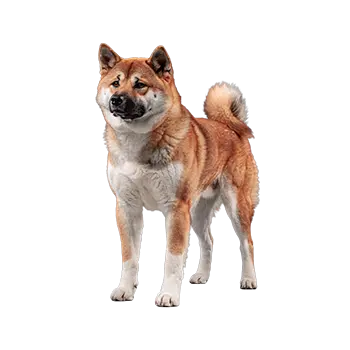
The Akita Ken is a large, powerful, well-balanced spitz-type dog whose physical impression is one of composed strength rather than excessive bulk. Males stand 25 to 27.5 inches at the shoulder, females 22.5 to 25 inches, with weight ranging approximately 75 to 120 pounds for males and 60 to 90 pounds for females. The Japanese standard describes a slightly lighter, more refined construction than the American Akita, with less emphasis on extreme bone and more emphasis on balance and overall proportionality. The body is slightly longer than tall, giving the dog a powerful but not chunky silhouette.
The head is broad and large, with a broad, flat skull and a defined but moderate stop. The muzzle is broad, deep, and rounded at the tip, not snipey or weak. The eyes are relatively small, deep-set, and triangular in shape, with a characteristic expression that combines dignity and wariness. Dark brown is the preferred eye color in the Japanese standard, and the expression conveys the breed's reserved, assessing character with great effectiveness. The ears are small, thick, and erect, angled slightly forward - always mobile and attentive. The combination of the broad skull, small deep-set eyes, erect forward ears, and clean muzzle produces the characteristic Akita head that is unlike any other breed.
The neck is powerful and thick, blending cleanly into strongly muscled shoulders. The topline is level and firm. The chest is well-developed and moderately broad, with deep, moderately arched ribs providing lung capacity for sustained activity. The loin is short, well-muscled, and firm. The hindquarters are broad and strong, well-muscled in the thighs, providing the drive needed for movement across the mountainous terrain of the breed's origin. The Akita Ken's movement is purposeful and ground-covering, with straight tracking and good drive - the efficient gait of a working dog rather than the flashy movement of a show ring specialist.
The tail is large and full, carried in a curl over the back - tightly curled, double curled, or in a sickle position. The tail hair is harsh and straight, spreading as it opens. The tail should reach the hock when let down. The feet are tightly knit, cat-footed, and well-padded, providing the secure footing the breed needed on mountain terrain.
The coat follows the Japanese standard's color restrictions strictly. The four accepted colors - red fawn, sesame, brindle, and pure white - are all presented with the characteristic urajiro marking except in pure white dogs. Urajiro is the cream or whitish coloring appearing on the sides of the muzzle, cheeks, under the jaw, on the neck, chest, body underline, and inside the legs. This pattern is so fundamental to the Japanese standard that judges evaluate it specifically, and dogs without proper urajiro in the accepted colors are penalized. The coat itself is firm and straight on the outer layer over a thick, soft undercoat - built for cold weather and resistant to moisture.
The urajiro pattern is one of the most distinctive and formally evaluated aspects of the Japanese Akitainu's appearance. This cream or whitish coloring appears specifically on the sides of the muzzle, on the cheeks, under the jaw, along the neck and chest, on the body underline, and on the inside of the legs. It is not simply light coloring - it is a defined and precise patterning that is evaluated by judges under the Japanese standard and the FCI standard alike. In pure white dogs, the urajiro requirement is waived because the entire dog is white. In all other colors, proper urajiro is a fundamental characteristic of correct type. This marking pattern is so embedded in the breed's identity that its presence or absence tells an experienced eye immediately whether the dog in question represents the Japanese type or has been influenced by American Akita crosses.
Affectionate With Family
★★★★★
The Akita Ken's devotion to its household is total and deeply expressed within the family circle. This is the breed that the Hachiko story comes from - loyalty that runs to the core of the dog's character.
Good With Young Children
★★★☆☆
The breed's cultural association with children in Japan is genuine, but size, strength, and independent assessment require that adult supervision be consistent and active rather than assumed.
Good With Other Dogs
★☆☆☆☆
Same-sex aggression is strongly documented and consistently described by breed clubs and experienced owners. Many Akita Ken individuals cannot safely share space with other dogs, and management should be planned accordingly.
Shedding Level
★★★★☆
Substantial year-round shedding with two heavy seasonal coat blows annually. Daily brushing during shedding periods is necessary to manage the dense undercoat effectively.
Coat Grooming Frequency
★★★☆☆
Weekly brushing between seasonal sheds keeps the coat in order. The Akita Ken's natural tendency to self-groom reduces bathing frequency and helps maintain a relatively clean coat between sessions.
Drooling Level
★★☆☆☆
Minimal drooling is typical. Some moisture after drinking or eating is normal, but the Akita Ken is not a heavy drooler by large-breed standards.
Coat Type
★★★★☆
A firm double coat with straight, harsh outer guard hairs over a dense, plush undercoat. The coat's texture is characteristic of a working northern breed built for cold climates and outdoor conditions.
Openness To Strangers
★☆☆☆☆
Reserve and wariness with unfamiliar people is a defining breed trait, not a behavioral deviation. The Akita Ken does not distribute trust widely or quickly, and that selectiveness should be respected as part of the breed's character.
Playfulness Level
★★★☆☆
Playful within its trusted family group and capable of a lighter, more playful expression with people it knows well. The dignity and reserve that define the breed's public face soften considerably in private.
Watchdog/Protective Nature
★★★★★
The Akita Ken's alertness, physical capability, and instinctive wariness of strangers combine to make it an exceptionally effective natural guardian. This is a dog that was bred to protect and that takes that function seriously.
Adaptability Level
★★☆☆☆
The Akita Ken has specific requirements around management, space, and owner experience that limit its adaptability to casual or inexperienced households. This is not a breed that adjusts easily to neglect or inconsistency.
Trainability Level
★★★☆☆
Intelligent and capable of learning, but strongly independent. The Akita Ken trains effectively with patient, consistent, positive reinforcement from someone whose authority the dog respects - which must be earned rather than assumed.