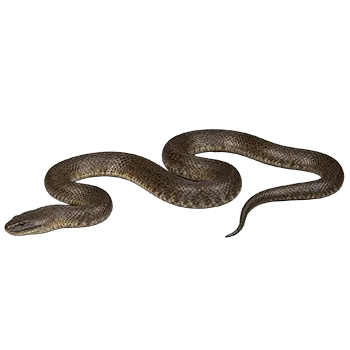

The Dog-Faced Water Snake (Cerberus rynchops) is a mildly venomous, rear-fanged colubrid inhabiting coastal and estuarine waters across a vast range stretching from the Indian subcontinent through Southeast Asia and into the northern coastline of Australia. The species occupies a distinctive ecological niche among snakes, spending much of its life in brackish water environments including mangrove forests, tidal mudflats, river mouths, and coastal lagoons. Its common name derives from the broad, blunt shape of its head, which gives the animal a vaguely canine appearance when viewed from certain angles, a feature that distinguishes it visually from many other water-dwelling snake species in its range.
The formal scientific description of the Dog-Faced Water Snake was published by the German-born naturalist Johann Gottlob Schneider in 1799, during a period of intense activity in European herpetological taxonomy. Schneider worked primarily from preserved specimens that had been collected in coastal India and shipped to European museums and private cabinets of curiosity. The genus name Cerberus references the multi-headed guardian hound of Greek mythology, an allusion to the snake's dog-like facial profile, while the specific epithet rynchops derives from Greek roots meaning snout or beak, further emphasizing the distinctive head shape that caught the attention of early naturalists.
Prior to its formal description in the Western scientific tradition, the Dog-Faced Water Snake had been well known to the coastal communities of South and Southeast Asia for centuries, if not millennia. Fishermen, mangrove harvesters, and inhabitants of riverine and estuarine settlements across the species' range were intimately familiar with its habits, its preferred habitats, and its largely inoffensive nature. This deep body of indigenous knowledge existed entirely outside the framework of Linnaean taxonomy but represented a sophisticated understanding of the animal's ecology that in many respects anticipated findings that Western science would not formally document until the twentieth century.
The taxonomic history of the genus Cerberus has undergone significant revision in recent decades. For much of the twentieth century, the Dog-Faced Water Snake was treated as a single widespread species with considerable geographic variation. However, molecular phylogenetic studies conducted in the early twenty-first century revealed that what had been classified as Cerberus rynchops actually comprised a complex of several distinct species. Populations from Australia, New Guinea, and various island groups in Southeast Asia have been elevated to separate species status, including Cerberus australis and Cerberus dunsoni, narrowing the range attributed to Cerberus rynchops in the strict sense while illuminating the evolutionary history of the genus as a whole.