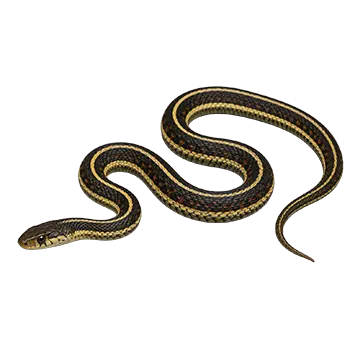

The Common Garter Snake has been a staple of wildlife television programming since the earliest days of broadcast nature documentaries. Its accessibility, its willingness to tolerate handling, and its photogenic striped patterning have made it a go-to subject for filmmakers seeking to introduce general audiences to reptile biology without the intimidation factor associated with larger or venomous species. From the pioneering natural history programs of the mid-twentieth century through the high-definition productions of the modern era, the garter snake has appeared on screen more frequently than perhaps any other North American serpent, serving as a reliable visual representative of the snake world for millions of viewers.
The Narcisse Snake Dens of Manitoba, Canada, where tens of thousands of red-sided garter snakes congregate each spring for their mating emergence, have provided some of the most visually spectacular wildlife footage ever captured in North America. Major documentary series produced by the BBC, National Geographic, and the Discovery Channel have all featured extended segments on the Narcisse aggregations, filming the extraordinary spectacle of writhing mating balls and undulating rivers of snakes emerging from limestone sinkholes. These sequences have become iconic within the wildlife documentary genre, frequently appearing in compilation programs and being cited as among the most remarkable wildlife phenomena on the continent. The footage introduced the garter snake to global audiences who might never encounter the species in person, establishing the Narcisse emergence as one of Canada's most recognized natural events.
Beyond the spectacle of mass aggregations, documentary filmmakers have used the Common Garter Snake to illustrate a wide range of biological concepts for television audiences. Programs focusing on thermoregulation, chemical communication, predator-prey dynamics, hibernation physiology, and reproductive strategies have all employed garter snake footage and research findings as accessible case studies. The species' well-documented resistance to tetrodotoxin, the potent neurotoxin found in rough-skinned newts of the Pacific Northwest, has been featured in multiple documentary segments exploring the evolutionary arms race between predator and prey, a topic that translates particularly well to visual storytelling.
Regional wildlife programming and local nature shows across the United States and Canada have also relied heavily on the Common Garter Snake as a featured animal. State and provincial wildlife agencies frequently produce educational videos featuring garter snakes for distribution to schools and community groups, and local television naturalists have long used live garter snakes as on-camera demonstration animals. The snake's calm demeanor under studio conditions and its tolerance of repeated handling make it an ideal subject for the live-animal segments that remain a popular element of local and regional broadcast programming.