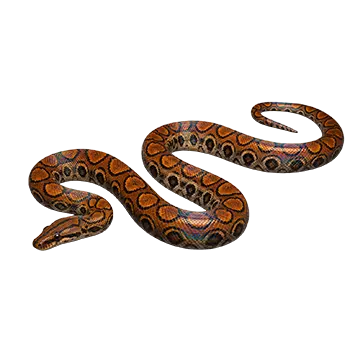

The Brazilian Rainbow Boa's presence in Western media began with the natural history illustrations and expedition accounts that European naturalists produced during the colonial era. From the seventeenth century onward, scientific illustrators accompanying expeditions to South America attempted to capture the diversity of Neotropical wildlife for audiences back home, and the rainbow boa's striking pattern of dark rings and ocelli against a warm reddish-brown ground color made it a compelling subject. However, the species' most celebrated feature, its holographic iridescence, proved extraordinarily difficult to render with the watercolor and engraving techniques available to early illustrators, and most pre-photographic depictions of the snake fail to convey the optical quality that distinguishes it from other similarly patterned boids.
Georg Marcgrave's Historia Naturalis Brasiliae, published in 1648, contained some of the earliest systematic illustrations of Brazilian reptiles produced by a European working from direct field observation. While Marcgrave's plates were more schematic than the lavish hand-colored engravings that would characterize later natural history publishing, they established a visual record of Brazilian serpent diversity that subsequent naturalists would reference and refine. The rainbow boa appeared in this and later compendia as one among many Neotropical snakes, its distinctiveness not yet fully recognized in a publishing medium that could not reproduce the structural coloration that sets it apart in life.
The golden age of natural history illustration in the eighteenth and nineteenth centuries brought more sophisticated depictions of the species, though the challenge of representing iridescence persisted. The hand-colored lithographs that graced the monographs of herpetologists such as Albert Gunther and George Boulenger at the British Museum presented the rainbow boa's pattern with increasing accuracy, but the static medium of print inevitably flattened the dynamic, angle-dependent color play that is the animal's defining visual characteristic. Written descriptions in these works frequently noted the iridescent quality and the difficulty of capturing it, creating a curious tension between text and image that would only be resolved with the advent of color photography.
The transition to photographic media in the early twentieth century finally allowed the Brazilian Rainbow Boa's iridescence to be documented and shared with audiences beyond those who had seen the living animal. Early color photographs of the species, published in herpetological journals and popular natural history magazines from the 1950s onward, revealed the full spectral brilliance of the snake's scales to a broad audience for the first time, generating widespread fascination and contributing significantly to the species' growing popularity among reptile enthusiasts and the general public alike.