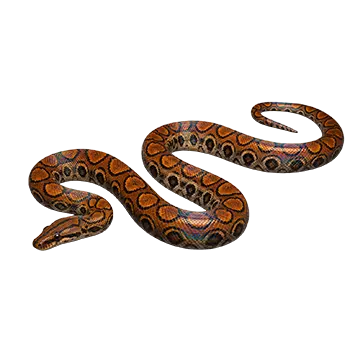

The Brazilian Rainbow Boa (Epicrates cenchria) is a medium-sized, semi-arboreal constrictor native to the tropical and subtropical regions of South America, with its core distribution centered on the vast lowland forests and savannas of Brazil. The species occupies a range that extends from the southern fringes of the Amazon Basin through the Atlantic Forest remnants of coastal Brazil and into portions of Suriname, French Guiana, Guyana, Venezuela, and Trinidad. It thrives in humid forest floors, riverine corridors, and the transitional zones between dense jungle and open cerrado grassland, displaying a habitat flexibility that belies its association with moisture-rich environments.
The species was first formally described to Western science by the Swedish naturalist Carl Linnaeus in 1758, who assigned it the binomial name Boa cenchria in the landmark tenth edition of Systema Naturae. Linnaeus worked from preserved specimens and the written accounts of earlier naturalists who had encountered the snake during explorations of the South American interior. The taxonomic history of the rainbow boa complex has been turbulent, with the genus assignment shifting from Boa to Epicrates as herpetological systematics matured during the nineteenth and twentieth centuries, and with numerous subspecies being described, lumped, and split as researchers debated the boundaries of geographic variation within the group.
For centuries before European contact, the Brazilian Rainbow Boa was intimately known to the indigenous peoples of the Amazon Basin and the Brazilian coastal forests. These communities possessed detailed practical knowledge of the snake's behavior, seasonal movements, diet, and reproductive habits, accumulated through generations of direct observation in shared habitats. The species' distinctive iridescent sheen, produced by microscopic ridges on its scales that refract light into spectral colors, made it one of the most visually memorable animals in the Neotropical fauna and ensured its prominent place in indigenous ecological knowledge systems.
The common name itself reflects what is perhaps the species' most celebrated feature. When exposed to sunlight or bright light, the Brazilian Rainbow Boa's scales produce a holographic iridescence that shifts through the full visible spectrum, an optical effect caused by the structural properties of the scale surface rather than by pigmentation. This phenomenon captivated early European naturalists just as it had captivated indigenous observers for millennia, and it remains the single trait most responsible for the species' enduring appeal in both scientific and popular contexts.