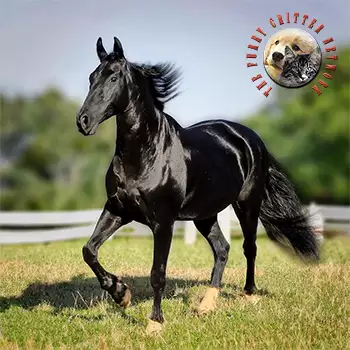

Origins & Development

The Tennessee Walking Horse traces its roots to the limestone pastures of Middle Tennessee in the late eighteenth and early nineteenth centuries. Settlers moving into the region brought a mixture of Narragansett Pacers, Canadian Pacers, Standardbreds, Morgans, Thoroughbreds, and American Saddlebreds, and these diverse bloodlines were crossed to produce a versatile mount suited to the rolling terrain. Breeders prized horses that could carry a rider smoothly over long distances across hilly farmland, and natural gaiting ability became the single most important selection criterion.

The foundation sire of the modern breed is generally recognized as Black Allan, also registered as Allan F-1, foaled in 1886. Black Allan was a cross between a Morgan stallion and a Hambletonian mare, and although he was considered a failure as a harness racer, his distinctive flat-footed walk, running walk, and canter made him extraordinarily valuable as a saddle horse. Breeders throughout Middle Tennessee sought his stud services, and his progeny consistently passed on the smooth, gliding gait that would define the breed.

By the early twentieth century, a recognizable type had emerged. These horses were taller and more refined than their frontier ancestors but retained the easy-going temperament and effortless gait that made them indispensable to plantation owners, rural physicians, and traveling preachers who spent long hours in the saddle. The consolidation of bloodlines during this period laid the groundwork for formal breed recognition.

The Tennessee Walking Horse Breeders' and Exhibitors' Association was founded in 1935 in Lewisburg, Tennessee, formalizing the breed registry and establishing standards. The organization began recording pedigrees, and the stud book was closed in 1947, meaning that only horses with registered parents could be added. This decision solidified the breed's genetic identity and marked its transition from a regional farm horse to a nationally recognized breed.

Historical Roles

Before mechanized farming and the automobile transformed rural life, the Tennessee Walking Horse served as the primary mode of transportation across the plantations and farms of the American South. Owners valued these horses because their smooth gaits allowed riders to cover large acreages without the fatigue associated with posting a trot. A planter could inspect hundreds of acres of crops in a single day and arrive home without the soreness that a trotting horse would inflict.

Rural doctors, circuit-riding judges, and itinerant ministers also relied heavily on Walking Horses. These professionals needed a mount that could travel reliably on unpaved roads and narrow trails, often in poor weather, while keeping the rider comfortable enough to work upon arrival. The breed's calm temperament was equally important in these roles, as a nervous or flighty horse was a liability on backcountry routes shared with livestock and wildlife.

During the Civil War, officers on both sides valued smooth-gaited Tennessee horses for staff and courier duty. While no single Walking Horse achieved the fame of certain Thoroughbred or Morgan war mounts, the gaited horses of the region were widely requisitioned because they could sustain a comfortable traveling pace over the rutted roads and muddy fields of the war's western theater.

As agriculture mechanized in the twentieth century, the breed's role shifted from utilitarian workhorse to pleasure and show mount. Trail riding emerged as the breed's most popular discipline, and the Tennessee Walking Horse found a second career as a family-friendly riding horse. Its willingness to cooperate with inexperienced riders made it a favorite among amateur equestrians, and the breed's reputation for sure-footedness kept it in demand for mountain and backcountry trail work.

Cultural Symbolism

The Tennessee Walking Horse is deeply woven into the cultural fabric of the American South, particularly in Middle Tennessee. The breed is the official state horse of Tennessee, designated by the state legislature in 2000, a recognition that reflects its importance to the region's agricultural heritage and identity. For many Tennesseans, the Walking Horse represents a direct link to the agrarian traditions that shaped the state.

The Tennessee Walking Horse National Celebration, held annually in Shelbyville, Tennessee, since 1939, is one of the longest-running horse shows in the United States. The event draws competitors and spectators from across the country and serves as both an athletic competition and a cultural festival. Shelbyville proudly calls itself the Walking Horse Capital of the World, and the Celebration is a centerpiece of the local economy and civic identity.

Beyond the show ring, the Tennessee Walking Horse has become a symbol of Southern hospitality and the leisurely pace of rural life. The breed's smooth ride is often described as riding in a rocking chair, an image that evokes comfort, tradition, and an unhurried approach to the land. This symbolism has been embraced by tourism boards, equine organizations, and rural communities across the Southeast.

The breed also holds significance within the broader American gaited horse tradition. Alongside the Missouri Fox Trotter and the Rocky Mountain Horse, the Tennessee Walking Horse represents a distinctly American contribution to horsemanship — breeds developed not for speed or war but for the practical demands of daily life on a rugged and expansive landscape.

Breed Clubs & Standards

The Tennessee Walking Horse Breeders' and Exhibitors' Association, headquartered in Lewisburg, Tennessee, remains the primary breed registry. The organization maintains the official stud book, oversees registration, and establishes the breed standard. According to the registry, the ideal Tennessee Walking Horse stands between 14.3 and 17 hands, with a long, sloping shoulder, a strong back, and well-angulated hindquarters that facilitate the breed's signature gaits.

The breed is recognized for three gaits: the flat-footed walk, the running walk, and the canter. The flat-footed walk is a brisk, four-beat gait in which the horse nods its head in rhythm with its stride. The running walk is an accelerated version of the same movement, with the horse gliding forward while the rider remains nearly motionless in the saddle. The canter is a collected, rolling three-beat gait. Judges evaluate smoothness, form, and willingness in the show ring.

Several affiliate organizations support specific segments of the Walking Horse community. The National Walking Horse Association, founded in 1998, focuses on promoting the flat-shod, or natural, performance of the breed and has been instrumental in advocating for sound training practices. The International Walking Horse Association and various state-level clubs also host shows, clinics, and trail events that emphasize the breed's versatility.

Breed standards explicitly value a willing disposition and a natural ability to perform the running walk without artificial aids. While the show world has historically been divided between performance (padded shoe) and plantation (flat-shod) divisions, the trend in recent decades has moved toward celebrating the horse's natural movement and temperament, reflecting broader changes in public attitudes toward equine welfare.

The Breed Today

The Tennessee Walking Horse remains one of the most popular breeds in the United States, with a strong presence in trail riding, recreational riding, and competitive showing. The breed's gentle disposition and smooth gaits continue to attract new owners, particularly older adults and riders returning to the saddle after years away. For many, the Walking Horse represents the ideal pleasure mount — comfortable, dependable, and forgiving of an imperfect seat.

Trail riding is by far the breed's most common use today. Walking Horses are a fixture at organized trail events across the country, and they are especially popular in the mountainous regions of the Southeast, where their sure-footedness and stamina shine. Events like the annual Big South Fork ride in Tennessee and the various state Walking Horse trail rides draw hundreds of participants and celebrate the breed's heritage as a cross-country traveler.

The show industry continues to evolve. The flat-shod divisions have grown significantly in recent years, and many shows now emphasize natural performance over exaggerated action. This shift has broadened the breed's appeal and attracted competitors from other disciplines, including dressage and western riding. Versatility classes that test the horse's ability to navigate trail obstacles, perform basic reining patterns, and work cattle have further expanded the breed's competitive profile.

Breeding programs today emphasize sound conformation, natural gait quality, and temperament. Advances in equine genetics have allowed breeders to make more informed decisions, and there is a growing emphasis on producing horses that are healthy, athletic, and well-suited to a variety of disciplines rather than a single show ring style.

Notable Individuals

Black Allan, foaled in 1886, is universally recognized as the foundation sire of the Tennessee Walking Horse breed. Despite being considered a failure in harness racing, his smooth natural gaits and the consistency with which he passed them to his offspring made him the most influential stallion in the breed's history. His legacy is preserved in the pedigrees of virtually every registered Tennessee Walking Horse alive today.

Midnight Sun, foaled in 1940, is one of the most celebrated show horses in Walking Horse history. He won the World Grand Championship at the Tennessee Walking Horse National Celebration in 1945 and 1946 and became a prolific sire whose descendants dominated the show ring for decades. His combination of presence, gait quality, and trainability set the standard for the performance horse.

Merry Go Boy, the 1947 and 1948 World Grand Champion, further established the bloodlines that would shape the breed through the second half of the twentieth century. Known for his floating stride and charismatic personality, Merry Go Boy sired numerous champions and remains one of the most admired stallions in the breed's studbook.

Gen's Armed and Dangerous, a modern performance horse, and other recent champions have continued to push the breed forward in both flat-shod and performance divisions. At the same time, individual trail horses have earned their own form of fame through social media, where owners share videos of their Walking Horses navigating mountain trails, crossing rivers, and demonstrating the breed's legendary calm in challenging situations. These everyday horses remind the community that the breed's greatest legacy is not in the show ring but on the trail.

Always consult a qualified professional before making any health-related decisions. This content is provided for informational reference only and should not replace professional guidance specific to your animal.