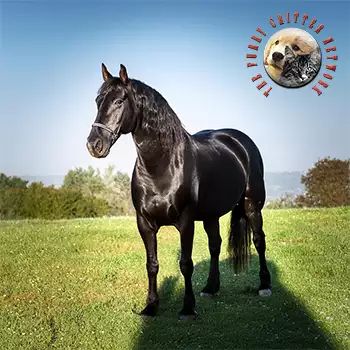

Origins & Development

The Percheron traces its ancestry to the Huisne river valley in the Perche region of northwestern France, a landscape of rolling hills and fertile pastureland that provided ideal conditions for raising large, sturdy horses. While the breed's exact foundational bloodlines remain a subject of scholarly debate, most historians agree that native French mares were crossed with Arabian stallions brought back from the Crusades during the eighth and ninth centuries. These Oriental infusions gave the Percheron a refinement and agility unusual for a heavy draft breed, contributing the clean head, large expressive eyes, and lighter movement that distinguish it from other European drafts.

By the late Middle Ages, the horses of the Perche were already recognized as a distinct type prized for their combination of size and elegance. Local breeders refined the stock over generations, selecting for soundness, endurance, and an even temperament. The region's limestone-rich soils and abundant grazing produced horses with exceptionally dense bone and resilient hooves, traits that became hallmarks of the breed. Monasteries and feudal estates played a central role in early breeding programs, keeping careful records and controlling access to the best stallions.

The establishment of the Le Pin and later the Haras du Pin national stud in the seventeenth century brought government oversight to French horse breeding, and Percherons benefited from more systematic selection. Arabian blood was reintroduced in carefully managed crosses during the eighteenth and early nineteenth centuries, further refining the breed without sacrificing its draft capabilities. By the 1820s, the Percheron had assumed a recognizable modern form — powerful yet athletic, with a distinctive gray or black coat and a proud carriage that set it apart on both farm and boulevard.

The founding of the Percheron Stud Book in France in the 1880s formalized breed standards and pedigree tracking, cementing the Percheron's status as a breed rather than a regional type. This documentation proved vital as international demand surged and breeders needed assurance of authentic bloodlines. The early stud book entries reveal that even at this stage, breeders valued both form and function, disqualifying horses that lacked either the substance for heavy work or the quality of movement expected of a breed with Arabian heritage.

Historical Roles

Long before the Percheron became associated with farm work, its ancestors served as warhorses capable of carrying armored knights into battle. The medieval destrier needed to be large enough to bear a fully equipped rider yet agile enough to maneuver in combat, and the horses of the Perche filled that role admirably. Their calm temperament under pressure and willingness to charge forward made them coveted mounts among French nobility, and reports suggest that Percheron-type horses were present at several pivotal engagements during the Hundred Years' War.

As the nature of warfare changed and heavy cavalry declined, the Percheron transitioned into roles that demanded sustained pulling power. The breed became the premier stagecoach horse of France during the eighteenth and nineteenth centuries, hauling heavy mail coaches along rutted roads at speeds that lighter horses could not sustain over distance. Their stamina, sure-footedness, and willingness to work in all weather conditions made them indispensable to the French postal and passenger transport systems. A well-matched team of Percherons could cover remarkable distances in a single day, and coaching inns along major routes kept fresh teams specifically bred for the purpose.

The Industrial Revolution brought new demands, and the Percheron adapted once again. In cities across France and later the United States, Percherons pulled omnibuses, delivery wagons, and fire equipment through crowded streets. Their docile nature in urban environments and ability to start heavy loads from a standstill made them the preferred breed for commercial hauling. On farms, they plowed fields, logged timber, and powered threshing equipment, becoming the backbone of agricultural production in an era before mechanization.

During both World Wars, Percherons served military logistics roles, hauling artillery, ammunition, and supply wagons along muddy roads that motorized vehicles often could not navigate. Their contribution to the war effort, while less celebrated than that of cavalry mounts, was essential to keeping armies supplied and moving. Thousands of Percherons were requisitioned from farms on both sides of the Atlantic, and the losses sustained during these conflicts significantly impacted breeding populations in France.

Cultural Symbolism

In France, the Percheron occupies a place of deep regional pride, particularly in the departments of Eure-et-Loir, Orne, Sarthe, and Loir-et-Cher that make up the historic Perche region. Local festivals, fairs, and agricultural shows regularly feature Percherons in parades and competitions, and the breed is regarded as a living emblem of rural heritage. Towns throughout the Perche display statues and murals of the breed, and the horse appears on municipal emblems, regional tourism materials, and artisanal product labels as a symbol of quality craftsmanship and enduring tradition.

Beyond France, the Percheron has come to symbolize the romantic ideal of the working horse — powerful yet graceful, strong yet gentle. In the United States, where tens of thousands were imported during the late nineteenth and early twentieth centuries, Percherons became icons of the pioneer spirit and the family farm. Their image graced agricultural catalogs, feed company advertisements, and county fair posters, representing reliability and honest labor. This cultural association persists today, with Percherons frequently chosen to represent heritage farming and artisanal food movements.

The breed also carries symbolic weight in equestrian art and literature, where the Percheron often appears as a figure of quiet dignity. Artists have long been drawn to the breed's distinctive profile — the broad forehead, arched neck, and muscular hindquarters create a silhouette that conveys both strength and nobility. Rosa Bonheur, the celebrated nineteenth-century French painter known for her detailed animal studies, depicted Percheron-type draft horses in several of her most admired works, helping to elevate the working horse to a subject worthy of fine art.

In contemporary culture, the Percheron has become associated with sustainable agriculture and the slow living movement. Small farms and homesteads that use draft horses for fieldwork frequently choose Percherons, and the breed has become a visible presence at sustainability fairs, heritage farming demonstrations, and educational programs that teach traditional skills. This modern symbolism connects the breed to broader conversations about environmental stewardship and the value of working partnerships between humans and animals.

Breed Registries & Standards

The Société Hippique Percheronne de France, founded in 1883, maintains the original French stud book and sets the breed standard that serves as the international reference. The French standard emphasizes overall balance and functional conformation, calling for a horse that combines draft power with quality of movement. Acceptable coat colors are limited to gray and black, with gray being the more traditional and prevalent color. The standard specifies minimum height requirements and evaluates horses on bone density, hoof quality, and the correctness of their gaits, reflecting the breed's dual heritage as both a working horse and a refined carriage type.

In the United States, the Percheron Horse Association of America, established in 1876 as the Norman-Percheron Association, is one of the oldest livestock breed registries in the country. The American registry has historically accepted a somewhat broader range of types than the French book, reflecting the diverse roles Percherons have filled in North American agriculture. American breeders have at times favored a larger, heavier type suited to Midwestern farming, while others have preserved a more athletic, French-style horse. The association maintains detailed pedigree records, hosts national shows, and administers breeding programs aimed at maintaining genetic diversity.

Other countries with significant Percheron populations maintain their own registries, including organizations in Great Britain, Canada, Australia, Japan, and several South American nations. Japan, in particular, has a long relationship with the breed, having imported Percherons in the late nineteenth century to improve domestic draft stock for agriculture and military use. The Japanese Percheron population developed somewhat independently, and Japanese breeders have contributed unique bloodlines that are increasingly valued by international breeding programs seeking to broaden the genetic base.

Modern breed standards across all registries share core priorities: structural soundness, correct movement, proper temperament, and the breed's characteristic combination of mass and refinement. Show classes typically evaluate horses at halter for conformation and in harness for movement and manners, with performance classes in pulling, driving, and increasingly under saddle. The growth of Percheron riding programs has prompted some registries to develop specific performance standards that recognize the breed's versatility beyond traditional draft work.

The Breed Today

The modern Percheron enjoys a resurgence of interest driven by diverse and expanding roles. While the breed's numbers declined sharply during the mid-twentieth century as mechanized agriculture replaced horse power, dedicated breeders on both sides of the Atlantic preserved core bloodlines through the lean decades. Today, Percheron populations are growing in many countries, supported by enthusiasts who value the breed for everything from competitive driving and exhibition hitches to sustainable farming and therapeutic riding programs.

One of the most visible contemporary roles for the Percheron is in exhibition and promotional hitches, where matched teams of gray or black Percherons pull ornate wagons in parades, fairs, and corporate events. These hitches serve as powerful brand ambassadors for the companies that sponsor them and introduce thousands of spectators to the breed each year. The precision driving required to manage a six- or eight-horse hitch through crowded streets showcases the Percheron's trainability, steadiness, and cooperative nature.

The draft horse pulling competition circuit remains a significant venue for Percherons, with teams regularly competing at state and county fairs across North America. These events test raw pulling power and teamwork, with top Percheron teams moving loads that exceed their combined body weight. The competitive pulling community maintains strong breed loyalty, and Percherons consistently rank among the top performers in both lightweight and heavyweight divisions.

Perhaps the most notable trend in the Percheron world is the breed's growing acceptance as a riding horse. Percherons and Percheron crosses are finding success in dressage, trail riding, and even low-level jumping, challenging the perception that draft breeds are suited only for harness work. Their smooth gaits, calm demeanor, and willingness to please make them excellent mounts for riders who appreciate a larger, steadier horse. Riding programs specifically designed for draft breeds have emerged in several countries, and some breed registries now offer performance awards for under-saddle achievements.

Notable Individuals

Among the most historically significant Percherons is Jean Le Blanc, a stallion foaled in 1823 who is considered the foundation sire of the modern breed. Virtually all registered Percherons today trace their lineage back to Jean Le Blanc through his sons and grandsons, making him one of the most influential individual horses in draft breed history. His prepotency — the ability to consistently stamp his offspring with his own qualities — was remarkable, and breeders of his era recognized that his get exhibited a uniformity of type that had previously been difficult to achieve.

In the United States, the stallion Doré imported in the 1860s had an enormous impact on American Percheron breeding. His offspring excelled in both the show ring and on the farm, and he helped establish the breed's reputation in a country that was rapidly expanding its agricultural frontier. Other influential American imports included Brilliant, whose descendants dominated American show rings for decades and whose bloodline remains prominent in contemporary pedigrees.

More recently, individual Percherons have gained recognition in competitive and public-facing roles. Percherons in major exhibition hitches have become celebrities in their own right, with fans following specific horses through social media and attending events specifically to see favorite team members. These horses often serve for a decade or more, building personal followings that help promote the breed to audiences who might never otherwise encounter a draft horse.

In the world of sport and recreation, Percheron crosses have achieved notable success in competitive disciplines. Several Percheron-Thoroughbred and Percheron-Warmblood crosses have competed successfully at regional and national levels in dressage and eventing, demonstrating the breed's ability to contribute athleticism, bone, and temperament to sport horse breeding programs. These crossbred achievements have prompted renewed interest in the Percheron as a foundation for versatile performance horses, expanding the breed's relevance well beyond its traditional draft roles.

Always consult a qualified professional before making any health-related decisions. This content is provided for informational reference only and should not replace professional guidance specific to your animal.