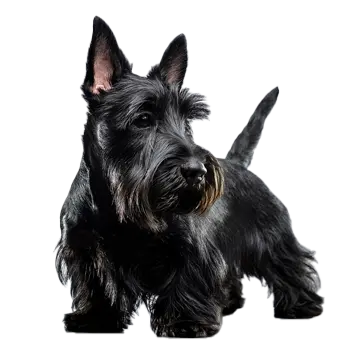

Origins & Development

The Scottish Terrier traces its roots to the rugged Highlands of Scotland, where small, sturdy terriers were bred for centuries to hunt vermin and protect homesteads. The exact origins of the breed are somewhat obscured by time, but dogs matching the Scottie's general description appear in records dating back to the fifteenth century. These early terriers were valued not for their appearance but for their tenacity and willingness to pursue quarry into underground dens and rocky crevices.

For much of their early history, several distinct terrier breeds from Scotland were grouped together under the broad label of "Scotch Terriers," making it difficult to separate the lineage of the modern Scottish Terrier from its close relatives. It was not until the latter half of the nineteenth century that breed enthusiasts began the careful work of distinguishing the Scottish Terrier as a breed in its own right, separate from the Skye Terrier, West Highland White Terrier, Cairn Terrier, and Dandie Dinmont Terrier.

The breed's development accelerated in the 1870s and 1880s, when a series of spirited debates among Scottish dog fanciers prompted efforts to draft a formal breed standard. Captain Gordon Murray and other early advocates championed the Scottish Terrier's distinctive profile — a compact body, erect ears, and a harsh, weather-resistant coat. By 1883, the first breed standard was published, providing a blueprint that would guide breeders for generations.

Early Scottish Terriers were predominantly working dogs, bred for function over form. Their low-slung bodies and powerful legs allowed them to navigate the rocky Scottish terrain, while their dense double coats shielded them from harsh weather. Over time, selective breeding refined the Scottie's appearance into the dignified silhouette recognized today, but the breed's essential character — bold, resourceful, and fiercely determined — has remained remarkably consistent across the centuries.

Historical Roles

The Scottish Terrier was originally developed as a working earth dog, tasked with hunting and dispatching burrowing animals such as rats, foxes, and badgers. In the farming communities of the Scottish Highlands, these dogs served a critical pest-control function, protecting grain stores and livestock from vermin. Their compact size, powerful jaws, and fearless disposition made them exceptionally well suited to pursuing quarry underground, where larger dogs could not follow.

Beyond vermin control, Scotties played a broader role in the daily life of Highland households. They served as alert watchdogs, their sharp bark warning of approaching strangers long before they were visible on the horizon. Despite their small stature, Scottish Terriers earned a reputation for courage that far exceeded their size, and they were known to stand their ground against much larger animals when their homes or families were threatened.

As the breed gained recognition in the show ring during the late nineteenth century, the Scottish Terrier began to transition from working dog to companion animal among the British upper classes. Queen Victoria is often credited with popularizing the breed, though her well-documented love of dogs extended to many breeds. By the early twentieth century, the Scottie had firmly established itself as a fashionable companion, admired as much for its dignified bearing and distinctive appearance as for its working heritage.

During the twentieth century, Scottish Terriers became closely associated with several world leaders and public figures, which further elevated their profile as companions of distinction. Their role shifted almost entirely from working terrier to household companion and show dog, though their instinctive prey drive and independent spirit remain very much intact in the breed today.

Cultural Symbolism

Few dog breeds carry as much symbolic weight as the Scottish Terrier. The Scottie has long been embraced as an emblem of Scotland itself, appearing on postcards, souvenirs, and decorative items alongside tartans and thistles. The breed's dignified posture and distinctive silhouette have made it one of the most instantly recognizable dog breeds in the world, and its image has been used to represent qualities such as loyalty, independence, and quiet determination.

The Scottish Terrier's cultural symbolism extends well beyond its homeland. In the United States, the Scottie became a widely recognized icon during the early to mid-twentieth century, appearing on everything from fabric prints and greeting cards to bookends and lawn ornaments. The breed's silhouette — compact, square, and unmistakable — lent itself perfectly to graphic design, and it became one of the most frequently depicted dog breeds in American decorative arts of the era.

Perhaps the most universally recognized cultural appearance of the Scottish Terrier is its role as one of the original playing pieces in the board game Monopoly. Introduced in the 1930s, the Scottie token quickly became one of the game's most popular pieces, cementing the breed's image in the minds of millions of players around the world. The token has endured across decades of the game's evolution, becoming an icon in its own right.

The Scottish Terrier also holds a special place in the symbolism of resilience. The breed's characteristic stubbornness and refusal to back down have made it a popular metaphor for perseverance in the face of adversity. This association has been reinforced by the breed's connection to notable historical figures known for their own tenacity, further intertwining the Scottie's image with qualities of steadfastness and courage.

Breed Clubs & Standards

The formal organization of Scottish Terrier enthusiasts began in the early 1880s, when the Scottish Terrier Club of England was founded in 1882, followed shortly by the Scottish Terrier Club of Scotland in 1888. These early clubs played a pivotal role in defining and refining the breed standard, settling longstanding debates about the ideal size, coat texture, and proportions of the Scottish Terrier. Their efforts transformed a loosely defined regional working dog into a breed with a clear and codified identity.

In the United States, the Scottish Terrier Club of America was established in 1900, making it one of the older breed-specific clubs in the country. The STCA has served as the parent club for the breed under the American Kennel Club, overseeing breed education, health initiatives, and competitive events. The club has been instrumental in maintaining breed standards while also promoting responsible breeding practices and health testing.

The breed standard itself has undergone periodic revisions since its initial publication, but its core elements have remained remarkably stable. The standard calls for a small, compact, short-legged dog with a hard, wiry outer coat and a soft, dense undercoat. The head should be long in proportion to the body, with small, erect, pointed ears and dark, keen eyes that convey an alert and intelligent expression. The overall impression should be one of power and agility packed into a small frame.

Today, Scottish Terrier breed clubs exist in countries around the world, from the United Kingdom and the United States to Australia, Canada, and throughout continental Europe. These organizations continue to host specialty shows, maintain breed registries, and support health research. They also serve as vital resources for prospective owners, connecting people with reputable breeders and providing guidance on the unique temperament and care requirements of the Scottish Terrier.

The Breed Today

The Scottish Terrier remains a well-regarded breed in the modern dog world, though its popularity has waxed and waned over the decades. After reaching peak popularity in the United States during the 1930s and 1940s — when Scotties were among the most registered breeds with the AKC — the breed has settled into a more modest but dedicated following. Today's Scottie enthusiasts tend to be deeply knowledgeable about the breed and committed to its preservation.

In the show ring, the Scottish Terrier continues to be a competitive and admired breed. Scotties have earned Best in Show at the Westminster Kennel Club Dog Show on multiple occasions, a testament to the breed's enduring appeal among judges and spectators alike. The breed's dramatic grooming style, which emphasizes the long eyebrows, beard, and skirt, makes it one of the most visually striking terriers in competition.

Health awareness has become a central focus for the breed community in recent decades. Scottish Terriers are known to be predisposed to certain health conditions, including von Willebrand disease, Scottie cramp, and a higher-than-average incidence of certain cancers. Breed clubs and health foundations have invested significant resources in research, genetic testing, and education to help breeders make informed decisions and improve overall breed health.

As a companion, the modern Scottish Terrier retains the independent spirit and dignified personality that have defined the breed for centuries. Scotties are known for forming deep bonds with their families while maintaining a characteristic aloofness with strangers. They are not typically described as eager-to-please dogs in the manner of retrievers or herding breeds, and their independent nature can present training challenges for first-time dog owners. However, for those who appreciate a dog with personality, intelligence, and a certain noble self-assurance, the Scottish Terrier remains an immensely rewarding companion.

Notable Individuals

The Scottish Terrier has been the chosen companion of several prominent historical figures, most notably a succession of American presidents. Franklin D. Roosevelt's Scottie, Fala, is perhaps the most famous presidential pet in American history. Fala accompanied Roosevelt nearly everywhere, became a beloved public figure in his own right, and was even referenced in a famous campaign speech. A statue of Fala stands beside Roosevelt at the Franklin Delano Roosevelt Memorial in Washington, D.C., the only presidential pet so honored.

President Dwight D. Eisenhower also kept Scottish Terriers in the White House, and President George W. Bush was frequently photographed with his Scotties, Barney and Miss Beazley. Barney became something of a media personality, starring in a series of holiday videos produced by the White House that were among the first viral pet videos of the early internet era. The association between Scottish Terriers and the American presidency has reinforced the breed's image as a dog of distinction and character.

Beyond the political sphere, Scottish Terriers have been favored by a wide range of public figures over the years. Humphrey Bogart and his wife Lauren Bacall owned Scotties, as did Bette Davis and Shirley Temple. The breed's appeal among Hollywood celebrities during the golden age of cinema helped sustain its popularity and cultural visibility throughout the mid-twentieth century.

In the world of competitive dogs, several Scottish Terriers have achieved remarkable distinction. Multiple Scotties have won Best in Show at the Westminster Kennel Club Dog Show, with the breed's striking presentation and confident ring presence consistently capturing the attention of judges. These individual champions have served as ambassadors for the breed, drawing new admirers and helping to sustain interest in the Scottish Terrier across generations.

Always consult a qualified professional before making any health-related decisions. This content is provided for informational reference only and should not replace professional guidance specific to your animal.