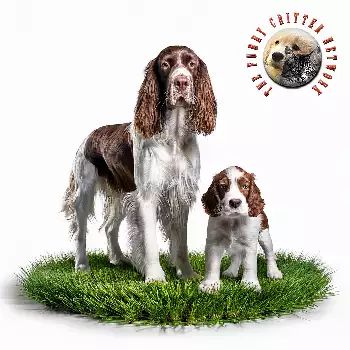

The English Springer Spaniel descends from a broad family of land spaniels that were common across the British Isles for centuries. During the Renaissance period, spaniels were broadly grouped by function rather than by breed, and the dogs that would eventually become Springers were valued for their ability to flush — or "spring" — game birds from dense cover. These early spaniels were versatile hunters used on a variety of terrain, from open moorland to thick woodland undergrowth.
Before formal breed classifications existed, spaniels from the same litter could be categorized differently based on size. Larger pups that excelled at springing game were called Springers, while smaller littermates that specialized in woodcock hunting were designated as Cockers. This functional division persisted for generations and was the primary way English sportsmen distinguished between spaniel types well into the 19th century.
The formal separation of the English Springer Spaniel as a distinct breed began in earnest during the late 1800s. The Kennel Club in England granted the breed its own classification in 1902, ending the long-standing practice of registering Springers and Cockers from the same litters under different categories. This milestone allowed breeders to establish consistent breeding programs and develop a recognizable breed standard that emphasized the Springer's athleticism, balanced proportions, and keen working instinct.
Early breeding programs drew heavily from dogs in the Norfolk and Shropshire regions, where landed gentry maintained kennels of exceptional working spaniels. The Aqualate line, associated with Sir Thomas Boughey, is often cited as one of the foundational bloodlines of the modern English Springer Spaniel. These dogs set the template for the breed's characteristic build — sturdy and compact, yet agile enough to cover rough ground at speed for an entire day of shooting.