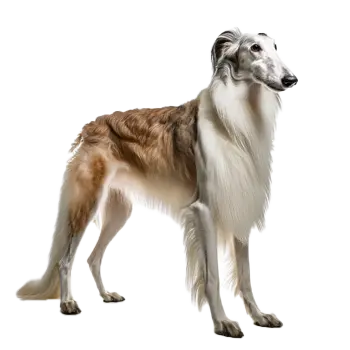

The Borzoi traces its lineage to medieval Russia, where aristocratic families developed the breed for coursing wolves, hares, and foxes across the vast open steppes. Early ancestors of the breed are believed to have descended from ancient sighthound types brought to Russia through trade routes connecting the Middle East and Central Asia. Over centuries of selective breeding, Russian nobility refined the dogs for speed, endurance, and the ability to withstand harsh continental winters.
Historical records suggest that the breed began to take recognizable form during the 17th century, when Russian nobles maintained elaborate hunting estates and kept detailed breeding records. The dogs were known by several names throughout their history, including the Russian Wolfhound, a designation that persisted in English-speaking countries well into the 20th century. The name Borzoi itself derives from the Russian word "borzый" (borziy), meaning swift or fast.
Breeding programs in Tsarist Russia were large-scale affairs, with some noble estates maintaining kennels of over a hundred dogs. Grand Duke Nikolai Nikolaevich of Russia operated one of the most famous breeding programs at his Perchino estate, producing dogs that influenced the breed's development worldwide. These kennels were meticulously managed, with careful attention paid to maintaining the ideal combination of speed, stamina, and coat density.
The breed's development was not confined to a single region of Russia. Different noble families produced slightly varying types depending on the local game and terrain. Some lines emphasized raw speed for open-steppe coursing, while others favored heavier builds suited to woodland hunting. The eventual breed standard sought to unify these regional variations into a single cohesive type that preserved the best qualities of each lineage.