
Origins & Development

The Suphalak is a rare, naturally occurring cat variety from Thailand whose documented history reaches back to the Ayutthaya Kingdom (1351–1767). Its earliest descriptions appear in the Tamra Maew, a body of illustrated Thai manuscripts known in English as the Treatise on Cats or Cat-Book Poems, which catalogued the cats considered auspicious enough to keep and breed.

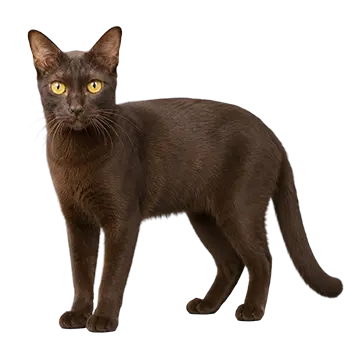
In those manuscripts the breed is referred to as Thong Daeng, a Thai term meaning copper or red gold, a reference to its solid, even, reddish-brown coat. The same poems describe the cat as magnificent and compare its rarity to that of gold itself.

Because the Suphalak shares a warm brown coloration with the Burmese, it is frequently described as an ancestor of the modern Burmese breed. Others classify it not as a distinct breed at all but as a color variety of the broader native Thai landrace known as the Maew Boran, or ancient cat.

Whatever its precise taxonomic status, the Suphalak developed as a pure Thai cat without deliberate outcrossing to foreign breeds, which is one reason modern preservationists treat it as a heritage variety rather than a manufactured show breed.

Role in Thai Society

For much of its history the Suphalak existed less as a formally managed breed and more as a prized cultural object. The Tamra Maew framed certain cats as bringers of fortune, and the Thong Daeng was among the good cats thought to confer prosperity on their households.

Cats of this copper coloration were associated with wealth and status and were, by tradition, the sort of animal suitable as a gift to royalty or nobility rather than a common street cat.

This elevated role helps explain why the breed was both treasured and scarce. A cat regarded as a living symbol of luck was not casually distributed, and its breeding was never organized on a large scale.

Cultural Symbolism & Folklore

In Thai tradition the Suphalak carries strong associations with wealth, luck, and nobility, reinforced by the poetry of the Tamra Maew that likened the cat to gold.

A well-known piece of folklore ties the breed's rarity to the 18th-century wars between Siam and Burma. As the story goes, after the fall of Ayutthaya the Burmese king learned from the captured Cat-Book Poems that these copper cats were said to make their owners wealthy, and ordered his soldiers to gather up every Suphalak and carry them off along with other royal treasures.

Thai storytellers today recount this apocryphal tale as a humorous explanation both for why the breed became so scarce and for why it so closely resembles the Burmese cat. Whether or not the events occurred as described, the legend captures the cat's enduring place in the national imagination.

Preservation & Breed Recognition

By the early 21st century the genuine Suphalak had become exceedingly rare, its lines blurred by decades of casual crossbreeding of brown cats labeled Thong Daeng.

Preservation centered on a small number of dedicated breeders in Thailand, most notably Kamnan Preecha Pukkabut of the Thai Cat Preservation Center in Ampawa, who spent much of his life working to revive the heritage cats described in the Tamra Maew.

In 2014 the effort gained an organizational backbone with the founding of The International Maew Boran Association (TIMBA), which set out to understand the genetics behind the copper coat and to identify cats throughout Thailand suitable for a controlled breeding program. TIMBA maintains that the Suphalak is a natural breed and should not be conflated with the Western-developed sable Burmese.

International recognition followed more slowly. The World Cat Federation acknowledged the variety after years of advocacy, a milestone widely reported in Thai media as global validation of a national treasure.

The Suphalak Today

The modern Suphalak remains one of the rarest cats associated with Thailand. For a period the only example in any formal breeding program was a single male, Samsen, housed at the Thai Cat Preservation Center.

Subsequent work expanded that base. A small group of genetically tested foundation cats — roughly half a dozen, predominantly female — was assembled for active breeding, and the first solid copper-chocolate kittens born outside Thailand arrived in the mid-2010s following the export of breeding stock to the United States.

Today the breed is sustained by a tight-knit network of preservation-minded breeders rather than a mass market. Prospective owners typically encounter long waiting lists, limited availability, and an emphasis on protecting the integrity of the bloodlines over rapid expansion.

Notable Individuals & Bloodlines

Because the Suphalak's revival rests on so few animals, several individual cats occupy an outsized place in its recent history. The male named Samsen, kept at the Thai Cat Preservation Center, is repeatedly cited as the lone Suphalak in a structured program before the wider effort took shape.

The export of breeding cats marked another turning point. A female cleared for breeding in the early 2010s was among the first of her kind shown in Thailand and then sent abroad, helping seed the earliest overseas litters.

Rather than celebrity pets, the notable individuals of this breed are essentially its foundation cats — the handful of genetically verified animals whose offspring make up most of the living population. In a variety this scarce, pedigree record-keeping and the reputation of individual foundation lines carry unusual weight.

Always consult a qualified professional before making any health-related decisions. This content is provided for informational reference only and should not replace professional guidance specific to your animal.