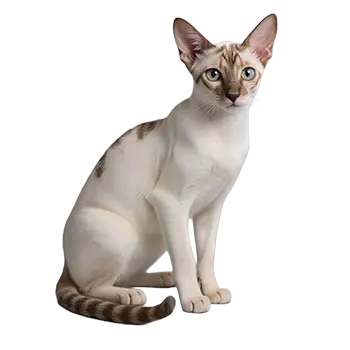

The Colorpoint Shorthair traces its origins to the mid-twentieth century, when a small group of American breeders set out to produce a cat with the elegant body type and engaging personality of the Siamese but in a wider range of point colors. Traditional Siamese cats were recognized only in seal, chocolate, blue, and lilac point, which left breeders curious about what other striking color combinations might be achieved while preserving the breed's distinctive traits.
To accomplish this, breeders crossed Siamese cats with American Shorthairs and, in some programs, with red tabby domestic shorthairs during the 1940s and 1950s. The initial crosses introduced genes for red and cream point coloring as well as the tabby pattern at the points. Through careful backcrossing to Siamese over multiple generations, breeders were able to recover the long, tubular body, wedge-shaped head, and vivid blue eyes that define the Siamese type while retaining the new point colors.
By the early 1960s, these efforts had produced cats that were virtually indistinguishable from Siamese in every respect except color. The Cat Fanciers' Association began accepting Colorpoint Shorthairs for registration in 1964, granting the breed championship status in 1974. This recognition marked a significant milestone, validating decades of selective breeding work.
The question of whether the Colorpoint Shorthair constitutes its own breed or simply an extension of the Siamese remains a matter of registry philosophy. CFA continues to classify it as a separate breed, while organizations such as The International Cat Association and the World Cat Federation register these cats as Siamese in non-traditional colors. This dual classification reflects broader discussions within the cat fancy about how breed boundaries should be drawn.