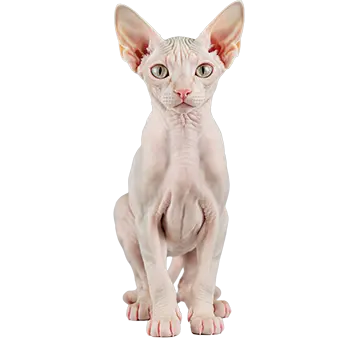

Origins & Development

The Bambino is one of the youngest cat breeds in the world, having been established in the United States in the mid-2000s. It is a deliberate cross between the Sphynx, which contributes its distinctive hairless coat, and the Munchkin, which contributes the short-legged conformation produced by a dominant genetic mutation. The result is a small cat that combines two of the most recognizable mutations in the cat fancy in a single animal.

The breed is generally credited to breeders Pat and Gordon Osborne, who registered the Bambino with The International Cat Association in 2006. The name was chosen from the Italian word for baby, reflecting both the cat's small stature and the youthful, kitten-like appearance it tends to retain throughout life. From the outset the Bambino was conceived as a companion breed rather than a working animal, bred for temperament and novelty rather than for any practical task.

Because the Bambino draws on two established breeds, its early development relied heavily on careful pairing of Sphynx and Munchkin lines, as well as outcrossing back to those parent breeds to maintain genetic diversity. This breeding strategy remains important today, since the founding population was small and the breed continues to develop within a relatively limited gene pool.

The Bambino's history is therefore best understood not as a long folk tradition but as a modern, documented act of selective breeding, one that sits firmly within the contemporary culture of designer cats.

The Designer Cat Movement

The Bambino belongs to a wider wave of designer cat breeds that emerged in the late twentieth and early twenty-first centuries. As established breeds became well documented and widely available, some breeders turned to combining distinctive traits from different lines to create cats with a particular look or personality. The Bambino, the Minskin, the Dwelf, and similar crosses all arose from this impulse to merge hairlessness and short legs into novel forms.

This movement was made possible by a better understanding of feline genetics and by the popularity of the Sphynx and Munchkin as foundation breeds. Each parent breed had already attracted a devoted following, and the Bambino offered enthusiasts a way to enjoy both signature features at once. The breed thus reflects a broader cultural shift toward cats as designed companions chosen for aesthetic and emotional appeal.

The designer cat movement has not been without controversy. Critics argue that stacking multiple mutations can compound welfare risks, while supporters maintain that responsible breeders can produce healthy, sociable animals. The Bambino sits at the center of this ongoing conversation, which has shaped how the breed is discussed within the wider cat community.

Cultural Symbolism & Perception

Few cats provoke as immediate a reaction as the Bambino. Its hairless skin, large ears, and short legs give it an unusual silhouette that people tend to find either endearing or startling. For admirers, the breed embodies a kind of perpetual kittenhood, a small and affectionate animal that seems to invite closeness and play. For skeptics, the same features raise questions about how far selective breeding should reshape an animal's body.

This division has given the Bambino a distinctive place in feline culture. It is often used as a talking point in debates about novelty breeds and animal welfare, and it appears frequently in lists of the world's most unusual cats. The breed's striking appearance also makes it a favorite subject for photographers and social media accounts, where its expressive face and warm, suede-like skin photograph well.

Symbolically, the Bambino has come to represent the tension at the heart of modern cat breeding: the desire to create something visually remarkable balanced against responsibility for the animal's long-term wellbeing. Owners frequently describe the experience of explaining their cat to curious strangers, a reminder that the breed carries cultural weight beyond the home.

Breed Recognition & Standards

The Bambino is recognized by The International Cat Association as an experimental breed, a category that allows newer breeds to be registered and shown while their populations and standards continue to develop. The written standard describes a small, muscular cat with a hairless or nearly hairless coat, short legs, a rounded abdomen, and the large ears and prominent eyes inherited from its Sphynx ancestry.

Not every registry recognizes the Bambino, and several major organizations decline to accept breeds derived from the Munchkin. These bodies cite concerns about breeding for the short-legged trait and about combining multiple mutations. As a result, the Bambino's official status varies considerably depending on the registry and the country, which can affect where and how the breed may be shown.

For prospective owners, this patchwork of recognition matters less for daily life than for showing and pedigree documentation. Reputable breeders typically work within a recognized registry, follow its standard, and provide health information about both parent lines. Understanding which registry recognizes the breed, and on what terms, is a useful first step for anyone researching the Bambino seriously.

The Breed Today

The Bambino remains a niche breed with a small but dedicated following. It is most commonly found in the United States, where it originated, though catteries and enthusiasts exist in several other countries. Because the breeding population is limited and litters are relatively rare, well-bred Bambinos can be difficult to obtain and command premium prices.

Within the cat fancy, the breed occupies a specialized corner shared with other hairless and short-legged cats. Owners often connect through online communities devoted to Sphynx-type and Munchkin-type cats, exchanging advice on skin care, temperature management, and the particular needs of small companion breeds. These communities form an important part of the breed's modern culture.

The Bambino's future depends heavily on responsible breeding practices and on continued attention to genetic diversity and health. As awareness grows, the breed is increasingly discussed not only as a curiosity but as a companion animal whose care requires real commitment. That shift toward informed ownership is among the most significant developments in the breed's short history.

Notable Individuals & Breeders

Because the Bambino is such a recent breed, its notable figures are breeders and individual cats rather than historical personalities. The founding cattery established by the breed's originators holds a central place in its story, and the early breeding lines they developed underpin much of the population that exists today.

Individual Bambinos have gained modest fame through social media, where their unusual looks attract attention and affection from large followings. These cats serve as informal ambassadors for the breed, introducing the wider public to its appearance and personality while their owners share day-to-day care routines.

Within the breeding community, reputation rests on health testing, ethical pairing, and transparency about the welfare considerations the breed raises. The most respected Bambino breeders are known less for any single famous cat than for their consistent, careful approach to a breed that remains both young and closely scrutinized.

Always consult a qualified professional before making any health-related decisions. This content is provided for informational reference only and should not replace professional guidance specific to your animal.