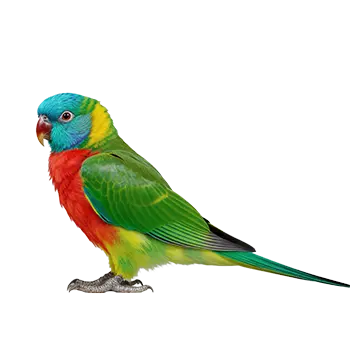

Origins & Natural Habitat

The Splendid Parakeet (Neophema splendida) is endemic to the arid and semi-arid interior of southern Australia, where it inhabits a landscape defined by mallee eucalyptus, mulga scrub, and spinifex grassland. Its range spans portions of western New South Wales, northwestern Victoria, southern South Australia, and the semi-arid belt of southwestern Western Australia. Within this territory the species favors open woodland with a grassy understorey, particularly areas where annual wildflowers and native grasses produce a seasonal abundance of seed. Unlike many Australian parakeets that concentrate near permanent watercourses, the Splendid Parakeet is adapted to regions where surface water can be scarce, obtaining much of its moisture from the fleshy fruits and succulent vegetation it includes in its diet.

The bird occupies a well-defined ecological niche among the six recognized species of the genus Neophema, a group of small, predominantly ground-feeding parakeets found only in Australia. Among its congeners it is the most inland-adapted, venturing deeper into the arid zone than the Turquoise Parakeet or the Elegant Parakeet, both of which prefer more temperate, wooded country. This ecological separation has been shaped over millennia by the progressive drying of the Australian interior, a climatic trend that favored species capable of exploiting ephemeral food resources and tolerating extreme heat.

Splendid Parakeets are generally observed in pairs or small family groups rather than the large, noisy flocks associated with many other Australian parrots. Their quiet disposition and tendency to feed unobtrusively on the ground among low vegetation made them difficult for early European observers to detect, contributing to the delayed timeline of their scientific description. When disturbed, the birds typically fly to a nearby tree and perch motionless among the foliage, relying on their green dorsal plumage for camouflage despite the male's vivid chest and facial coloring.

The species' dependence on native vegetation communities has made it sensitive to changes in land use. Pastoral grazing, the spread of introduced grasses, and the clearing of mallee for broadacre agriculture have all reduced the extent and quality of its preferred habitat. Despite these pressures, the Splendid Parakeet has demonstrated a degree of resilience, periodically appearing in areas where it had not been recorded for years, suggesting that its nomadic tendencies allow it to exploit favorable conditions across a wide geographic range.

Discovery & Scientific Classification

The Splendid Parakeet was first described for Western science by the English ornithologist John Gould in 1840, based on specimens obtained during his ambitious survey of Australian birdlife between 1838 and 1840. Gould was immediately struck by the male's extraordinary plumage, a combination of cobalt-blue face, emerald-green upperparts, and a broad patch of vivid scarlet across the chest, and he bestowed the species name splendida in recognition of its appearance. The type specimen was collected in the interior of South Australia, a region that Gould found both ornithologically rewarding and physically punishing during his fieldwork.

Gould placed the species within what was then a loosely defined assemblage of small Australian parakeets. Over the following decades, taxonomists refined the classification, eventually settling the bird within the genus Neophema alongside five other species: the Turquoise Parakeet, the Elegant Parakeet, the Rock Parakeet, the Blue-winged Parakeet, and the Orange-bellied Parakeet. Molecular phylogenetic studies conducted in the late 20th and early 21st centuries confirmed the monophyly of Neophema and clarified relationships within the genus, positioning the Splendid Parakeet as sister to the Turquoise Parakeet, with which it shares several morphological and behavioral traits.

For much of the 19th century, the Splendid Parakeet remained one of the least known members of its genus. Specimens in museum collections were uncommon, and field observations were sporadic. The species' secretive habits and its preference for remote, sparsely populated country meant that even experienced Australian naturalists encountered it infrequently. Some early accounts confused females and juveniles with other Neophema species, adding to the taxonomic uncertainty that persisted until more systematic surveys were undertaken in the early 1900s.

The bird's rarity in the wild gave it an almost mythical status among Australian ornithologists during the late 19th and early 20th centuries. Expeditions mounted specifically to locate Splendid Parakeet populations often returned empty-handed, and periods of several years passed during which no confirmed sightings were reported. This elusiveness only heightened the species' desirability among collectors and aviculturists, setting the stage for the international trade that would eventually establish captive populations far from the Australian interior.

Rise in European & International Aviculture

The Splendid Parakeet first reached European aviaries in small numbers during the second half of the 19th century, arriving alongside shipments of other Australian parrots that were then flowing into the bird markets of London, Antwerp, and Hamburg. Early importations were erratic and the birds were considered delicate, with high mortality during the long sea voyages from Australia. Nevertheless, those specimens that survived the journey commanded significant prices and attracted intense interest from wealthy aviculturists who prized novelty and visual impact above all else.

By the early 20th century, a modest but dedicated community of European breeders had begun to achieve consistent reproductive success with the species. British aviculturists were particularly active, and the Avicultural Society's journal carried regular reports on breeding attempts, dietary experiments, and the management of Splendid Parakeets in outdoor aviaries. The species' relatively calm temperament, willingness to nest in standard budgerigar-style nest boxes, and tolerance of temperate climates made it more tractable in captivity than some of its Neophema relatives, though it remained less prolific than the ubiquitous Budgerigar.

The Australian government's progressive tightening of wildlife export regulations during the 20th century, culminating in a near-total ban on the export of native fauna in 1960, forced international aviculture to become self-sustaining. This legislative shift had a paradoxical effect on the Splendid Parakeet's captive population: it elevated the value of existing breeding stock and incentivized the careful management of bloodlines, leading to healthier and more genetically diverse captive flocks in the long term. European and later American and Asian breeders developed closed studbook approaches that treated the species with a seriousness once reserved for larger, more expensive parrots.

Today the Splendid Parakeet is well established in aviculture across Europe, North America, Japan, and parts of South America. Selective breeding has produced a range of color mutations, including blue, lutino, and cinnamon variants, some of which are now more commonly encountered in captivity than the wild-type plumage. While purists debate the merits of these mutations, their proliferation reflects the depth and maturity of the captive population and the species' secure status as a staple of the international bird-keeping community.

Cultural Significance in Australia

Within Australia the Splendid Parakeet occupies a distinctive cultural niche that reflects the broader Australian relationship with native wildlife. The bird's striking appearance has made it a popular subject for wildlife artists and photographers, and its image appears on a range of Australian-produced merchandise, from postage stamps to tea towels. The species was featured on an Australian postal issue in 1998 as part of a series celebrating the country's small parrots, an endorsement that cemented its status as one of the more recognizable members of the Neophema genus in the public imagination.

In regional communities across inland Australia, the Splendid Parakeet carries a quieter but no less meaningful significance. Birdwatchers traveling to the mallee country of South Australia or the semi-arid woodlands of western New South Wales often cite the species as a target bird, one whose sighting justifies the long drive and dusty conditions. Local tourism operators in towns near known Splendid Parakeet habitat have occasionally leveraged the bird's appeal, promoting guided birdwatching excursions that contribute to regional economies otherwise dependent on agriculture and mining.

The species also holds a place in the history of Australian ornithological exploration. The difficulty of locating Splendid Parakeets in the wild during the late 19th and early 20th centuries became a recurring theme in the journals and correspondence of prominent Australian naturalists. Accounts of arduous inland expeditions, extreme heat, and the elation of finally encountering a male perched in a mulga tree have become part of the lore of Australian field ornithology, lending the species a romantic aura that persists among birding enthusiasts.

Indigenous Australian communities in the species' range have their own long-standing relationships with the bird, though these have been less extensively documented in published literature than the European-derived narratives. Oral traditions in some Aboriginal communities reference small, brightly colored parakeets as indicators of seasonal change, their appearance in certain areas signaling the availability of particular food plants. Efforts by contemporary researchers to incorporate Indigenous ecological knowledge into Splendid Parakeet conservation planning represent a growing and important dimension of the species' cultural story.

Conservation History & Turning Points

The conservation history of the Splendid Parakeet is shaped by its naturally low population density, its occurrence in remote and often poorly surveyed landscapes, and the pressures exerted by habitat modification and the historical wildlife trade. During the late 19th and early 20th centuries, collectors pursuing specimens for museums and the live bird market added to the pressures facing wild populations, though the species' elusive habits provided a degree of natural protection that more conspicuous parrots lacked.

Australia's 1960 ban on the export of native wildlife marked a critical turning point for the Splendid Parakeet and many other Australian species. By removing the legal pathway for commercial collection, the ban allowed wild populations to recover from decades of extraction while simultaneously catalyzing the development of self-sustaining captive breeding programs abroad. Within Australia, the species was progressively listed under state and territory wildlife protection legislation, affording it formal legal protections that complemented the federal export restrictions.

Field surveys conducted from the 1970s onward gradually improved understanding of the species' distribution and abundance, revealing that the Splendid Parakeet, while never common, was more widely distributed than earlier accounts had suggested. The perception of extreme rarity that had characterized much of the 20th century was partly a consequence of inadequate survey effort in the remote habitats where the bird occurred. Improved road access, more systematic survey methodologies, and the growing participation of amateur birdwatchers in citizen science programs all contributed to a more accurate and encouraging picture of the species' status.

Current conservation assessments classify the Splendid Parakeet as a species of least concern at the global level, though it remains protected under Australian law and its habitat continues to face threats from land clearing, altered fire regimes, and the impacts of introduced predators such as foxes and feral cats. Conservation efforts today focus on habitat management, predator control, and the maintenance of landscape connectivity that allows nomadic species like the Splendid Parakeet to move across the inland in response to shifting resource availability.

The Species Today

The Splendid Parakeet in the 21st century exists in two distinct but interconnected worlds: the wild populations of the Australian interior and the extensive captive populations maintained by aviculturists worldwide. In the wild, the species continues to occupy its traditional range across the arid and semi-arid zones of southern Australia, where it is encountered by birdwatchers and researchers with moderate regularity. Population estimates remain imprecise due to the species' nomadic tendencies and the vastness of its habitat, but there is no evidence of a significant decline in recent decades, and the overall trajectory is considered stable.

In captivity, the Splendid Parakeet is firmly established as one of the most popular small parrots in the hobby. Its manageable size, relatively quiet voice, and amenable temperament make it well suited to suburban aviaries and indoor flight cages alike. Breeders have developed a sophisticated understanding of the species' nutritional, environmental, and social needs, and captive birds routinely achieve lifespans at the upper end of the wild range. The availability of multiple color mutations has broadened the species' appeal, attracting hobbyists who might otherwise gravitate toward larger or more vocal parrot species.

Avicultural societies and online communities dedicated to Neophema parakeets provide forums for the exchange of husbandry knowledge, breeding records, and genetic management strategies. These networks play an important role in maintaining the health and diversity of captive populations, particularly in regions where the number of unrelated breeding lines is limited. Some breeders participate in formal studbook programs or cooperative breeding arrangements designed to minimize inbreeding and preserve the genetic integrity of captive flocks.

The relationship between wild and captive populations is largely one-directional; captive birds are not returned to the wild, and the genetic divergence between long-established captive lines and wild stock is likely increasing over time. Nevertheless, the existence of a large and well-managed captive population provides a form of insurance against the unlikely but not impossible scenario of a catastrophic decline in the wild. The Splendid Parakeet's dual existence, thriving both in the Australian bush and in aviaries from Berlin to Buenos Aires, reflects a conservation and cultural trajectory that is cautiously optimistic.

Always consult a qualified professional before making any health-related decisions. This content is provided for informational reference only and should not replace professional guidance specific to your animal.