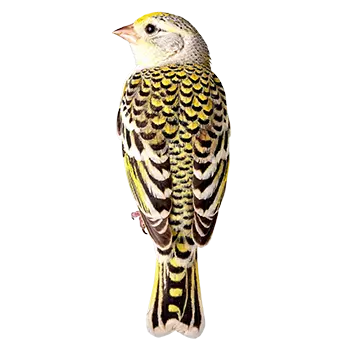

The Lizard Canary's intricate spangled plumage made it a natural subject for the artists and illustrators who documented the emerging world of fancy canary breeding from the 18th century onward. Unlike solid-colored canaries, whose visual appeal in artwork depended largely on the skill of the colorist, the Lizard presented a genuine technical challenge: capturing the precise, repeating pattern of crescent-shaped spangles required an artist with both ornithological knowledge and considerable draftsmanship. Early depictions appeared in the hand-colored plates that accompanied European natural history and avicultural publications, where the Lizard was often singled out as a variety worthy of detailed illustration.
Among the most significant early visual records of the Lizard Canary are the plates found in 18th- and 19th-century British birdkeeping manuals. Works such as those published by the naturalists and aviculturists of the Georgian and early Victorian periods included carefully rendered images of Lizard Canaries alongside other established varieties. These illustrations served both as aesthetic objects and as practical references for breeders seeking to understand the ideal distribution of markings. The cap, spangles, and ground color were all depicted with an attention to detail that reflected the seriousness with which the variety was regarded.
The tradition of illustrating the Lizard Canary continued into the Victorian era, when advances in printing technology allowed for wider distribution of colored plates. Chromolithographs of canary varieties, including the Lizard, appeared in popular birdkeeping guides and periodicals, bringing the variety's distinctive appearance to audiences who might never attend a canary show. These images played an important role in shaping public perception of the Lizard as a bird of unusual beauty and refinement, distinct from the common yellow canary that most people associated with the species.
Fine art beyond the strictly avicultural sphere also engaged with canaries, though the Lizard's specific markings were less likely to be rendered with precision in paintings that used birds as incidental decorative elements. Still-life and domestic interior paintings from the 18th and 19th centuries occasionally feature caged canaries, and scholars of avian art have noted that some of these birds display markings consistent with the Lizard pattern, suggesting that the variety's visual distinctiveness registered with painters even when scientific accuracy was not the primary concern.