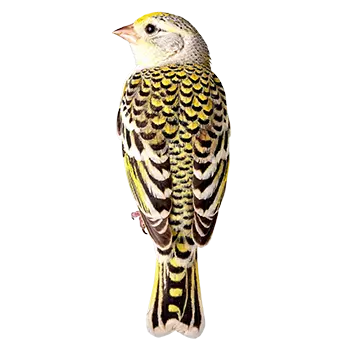

The Lizard Canary is widely regarded as the oldest established variety of domestic canary, with origins that most historians trace to France during the late 1600s. While the wild Atlantic canary (Serinus canaria) had been bred in captivity across southern Europe since the 15th century, the Lizard represents one of the earliest instances in which breeders deliberately selected for a specific plumage pattern rather than song quality or color alone. The variety takes its name from the distinctive spangled markings on its back and flanks, which early fanciers thought resembled the overlapping scales of a lizard. This reptilian visual analogy gave the bird an identity that has persisted, unaltered, for more than three centuries.
The precise geographic origin within France remains a matter of informed speculation rather than documented certainty. Many avicultural historians point to the Huguenot communities of northern France and the Low Countries as likely cradles of the breed. French Protestant weavers, who were skilled artisans with a keen eye for intricate pattern work, are believed to have been among the first to appreciate and selectively breed canaries exhibiting the spangled feather pattern. The connection between textile craftsmanship and a fascination with repeating visual motifs in plumage is more than anecdotal; similar communities were also responsible for early developments in other patterned canary varieties.
By the early 18th century, references to canaries with lizard-like spangling appear in European avicultural writings, indicating that the variety had already achieved enough consistency in its markings to be recognized as distinct from other canary types. The breed's identity was defined by three hallmarks: the regular, crescent-shaped dark spangles running in neat rows across the back and flanks; a clear, unbroken cap of pale feathering atop the head; and a general ground color that could be either gold (a warm yellow-buff) or silver (a cooler, paler tone). These characteristics remain the pillars of the Lizard Canary standard to this day.
What makes the Lizard's origin particularly notable in the broader history of aviculture is that it predates the organized canary fancy by well over a century. Long before breed societies, written standards, or competitive exhibitions existed, anonymous French breeders were making selection decisions sophisticated enough to fix a complex polygenic feather pattern into a reliably reproducible variety. The Lizard Canary's antiquity is not simply a point of trivia; it represents a remarkably early chapter in the human practice of breeding animals for aesthetic traits.