
Representation in Film & Television

The Half-Moon Conure has never achieved the level of cinematic recognition enjoyed by larger, more visually striking parrot species such as macaws or cockatoos. Hollywood productions seeking avian actors tend to favor birds with vivid plumage or dramatic crests that read well on screen, and the Half-Moon's predominantly green coloration makes it less immediately eye-catching in a visual medium. Nevertheless, small green parrots resembling the Half-Moon Conure have appeared as background animals in numerous television shows and films set in tropical or Latin American locales, contributing to the general atmosphere without receiving individual attention.

One area where the Half-Moon Conure has found more specific representation is in nature documentaries and wildlife programming focused on Central American ecosystems. Programs exploring the biodiversity of Mexican dry forests or Costa Rican conservation areas have featured footage of wild Half-Moon Conure flocks, often highlighting their communal roosting behavior and their unusual habit of nesting in arboreal termite mounds. These sequences, while typically brief, have introduced the species to audiences who might otherwise never encounter it, and they serve as valuable visual records of the bird's behavior in its natural habitat.

Television programs dedicated to pet care and companion animal husbandry have occasionally featured the Half-Moon Conure as a recommended species for intermediate parrot owners. Segments on such programs typically emphasize the bird's gentle disposition, manageable size, and relatively moderate noise output, positioning it as an appealing option for viewers interested in parrot keeping but intimidated by the demands of larger species. These appearances, though modest in cultural impact, have contributed to a steady baseline of public awareness about the species.

The rise of streaming platforms and niche content channels has opened new avenues for the Half-Moon Conure's screen presence. Independent filmmakers and content creators with a focus on aviculture, conservation, or Central American wildlife have produced short documentaries and educational videos that give the species more sustained attention than mainstream productions typically allow. These smaller-scale projects often provide the most accurate and detailed portrayals of the Half-Moon Conure available in visual media.

Social Media & Online Communities

Social media has arguably done more to raise the public profile of the Half-Moon Conure than any other cultural medium. Platforms like Instagram, YouTube, and TikTok have enabled individual bird owners to share videos and photographs of their Half-Moon Conures with audiences that can number in the tens of thousands, bypassing the editorial gatekeeping that once limited which species received public attention. Clips of Half-Moon Conures performing tricks, mimicking sounds, cuddling with their owners, or engaging in playful antics have accumulated millions of collective views across these platforms.

YouTube channels devoted to parrot keeping have provided a particularly important venue for the species. Long-form videos detailing the daily routines of Half-Moon Conure ownership, including diet preparation, training sessions, and enrichment activities, offer prospective owners a realistic preview of life with the species. Review-style videos comparing the Half-Moon Conure to other popular conure species have helped position it within the broader landscape of companion parrot options, often emphasizing its quieter temperament and affectionate personality as distinguishing qualities.

Online forums and Facebook groups dedicated to conure species have fostered tight-knit communities of Half-Moon Conure enthusiasts who exchange advice on husbandry, share breeding updates, and organize informal meetups. These communities play a vital role in preserving and transmitting species-specific knowledge that might otherwise be lost as experienced breeders age out of the hobby. They also serve as early warning systems for health issues, enabling keepers to share observations about disease outbreaks, dietary concerns, or behavioral problems in near real time.

The democratizing effect of social media has also influenced public perception of the Half-Moon Conure in subtler ways. By showcasing the individuality of specific birds, with their quirks, preferences, and distinct personalities, social media content has helped counter the tendency to view conures as interchangeable and has fostered a more nuanced appreciation of the species among casual viewers and dedicated enthusiasts alike.

Literature & Print Media

The Half-Moon Conure has a modest but meaningful presence in print literature, spanning scientific monographs, avicultural guides, and popular natural history writing. Early ornithological texts from the 19th and early 20th centuries treated the species primarily as a taxonomic entry, documenting its range, plumage, and basic natural history without extensive commentary on its behavior or suitability as a companion animal. These foundational descriptions, published in works by authors such as Philip Sclater and Osbert Salvin, established the scientific baseline against which later knowledge would be measured.

The avicultural literature of the mid-to-late 20th century brought the Half-Moon Conure more substantive attention. Books by prominent parrot authors devoted chapters or significant sections to the species, discussing its temperament, breeding requirements, and dietary needs in practical terms intended for keepers and breeders. These guides, many of which remain in print or circulate in the secondhand market, played a formative role in shaping the avicultural understanding of the Half-Moon Conure during the decades when the species was most actively entering the pet trade.

Popular natural history writing about Central American ecosystems has occasionally featured the Half-Moon Conure as a representative species of the Pacific dry forest biome. Travel writers and naturalists visiting Costa Rica and western Mexico have described encounters with wild flocks, often using the birds' noisy, conspicuous behavior as an entry point for broader discussions of tropical biodiversity and conservation challenges. These accounts, published in travel magazines, nature journals, and essay collections, have introduced the species to readers who may not have any interest in aviculture but are drawn to the landscapes the bird inhabits.

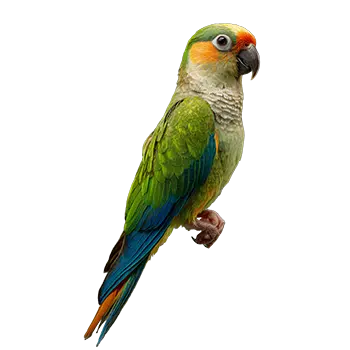
Photography books and field guides represent another dimension of the Half-Moon Conure's print media presence. Regional bird guides covering Mexico and Central America include the species in their plates and identification sections, and the bird's attractive combination of green plumage and distinctive orange forehead patch makes it a rewarding subject for wildlife photographers. Published images of wild Half-Moon Conures in flight or perched on flowering trees have appeared in birding magazines and conservation publications, contributing to the species' visual identity in the public imagination.

Influence on Parrot Keeping Culture

The Half-Moon Conure has exerted a quiet but persistent influence on the broader culture of parrot keeping, particularly in the United States and Mexico. During the decades when wild-caught birds were freely available, the species served as many people's first introduction to conure ownership, and by extension, to the wider world of psittacine companionship. Keepers who began with a Half-Moon Conure often went on to acquire other parrot species, carrying with them the handling skills and husbandry knowledge they had developed with their first bird.

Within the avicultural community, the Half-Moon Conure occupies a niche as a species that rewards patient, attentive ownership. Unlike some conure species that are valued primarily for their striking appearance or comedic behavior, the Half-Moon is more often appreciated for the depth and consistency of the bond it forms with its primary caretaker. This emphasis on relational quality over spectacle has helped shape a subset of parrot keeping culture that prioritizes the human-bird bond as the central value of the hobby.

The species' relatively modest noise output has also contributed to its cultural significance within urban and apartment-dwelling parrot keeping communities. In discussions about suitable parrot species for shared-wall living situations, the Half-Moon Conure is frequently recommended as a compromise between the desire for a parrot companion and the practical constraints of close-quarters living. This reputation has given the species a specific cultural identity as the thoughtful, considerate choice, an image that contrasts with the bold, attention-grabbing personas associated with larger parrots.

Breeder networks centered on the Half-Moon Conure have also influenced avicultural practices more broadly. Because the species can be challenging to breed in captivity, Half-Moon Conure breeders have developed specialized techniques for encouraging pair bonding, managing nest-site preferences, and hand-rearing chicks that have been adopted and adapted by breeders working with other species. The knowledge generated within the Half-Moon Conure breeding community has thus contributed to the broader craft of psittacine aviculture in ways that extend well beyond the species itself.

Ecotourism & Birdwatching Appeal

The Half-Moon Conure holds a recognized place in the ecotourism and birdwatching cultures of Central America, particularly in Costa Rica and western Mexico. In Costa Rica, where nature-based tourism is a major economic sector, the species is regularly encountered on birding tours of the Guanacaste region and the Nicoya Peninsula. Tour guides familiar with the local avifauna often point out Half-Moon Conure flocks as representative of the dry forest ecosystem, and the birds' conspicuous flight patterns and vocalizations make them relatively easy to locate and observe even for novice birders.

In Mexico, birding tourism has grown substantially in recent decades, and the Pacific coast states of Colima, Jalisco, and Oaxaca attract visiting birders seeking species endemic or near-endemic to the region. The Half-Moon Conure, while not a primary target species for most visiting birders, is a common and welcome sighting on trips focused on Mexican dry forest specialties. Its presence on regional checklists and in photographic trip reports helps maintain its visibility within the international birding community.

The species' nesting behavior has attracted particular interest from ecotourists and researchers alike. The Half-Moon Conure's habit of excavating nest cavities in active arboreal termite mounds is a striking and photogenic behavior that distinguishes it from most other parrot species. Guided tours that include observation of nesting colonies during the breeding season offer visitors a unique wildlife spectacle, and the behavior has been the subject of several natural history articles and short documentary segments aimed at general audiences.

Ecotourism centered on the Half-Moon Conure and other charismatic species has provided tangible economic incentives for habitat conservation in parts of the species' range. In communities where the economic value of living birds as tourist attractions exceeds the value of trapped birds in the pet trade, local attitudes toward parrot conservation have shifted measurably. This dynamic, while far from universal, represents a meaningful intersection of cultural appreciation, economic pragmatism, and conservation biology that benefits the Half-Moon Conure and its dry forest habitat.

The Half-Moon Conure's Cultural Identity

The Half-Moon Conure's cultural identity is defined less by fame or spectacle than by a steady accumulation of quiet appreciation across multiple domains. It is not the parrot that stars in blockbuster films or inspires best-selling books, but it is a species that has earned the devoted loyalty of its keepers, the respect of aviculturists, and the interest of conservation biologists and ecotourists. This understated profile has, paradoxically, become a defining element of the bird's cultural character.

Among conure enthusiasts, the Half-Moon is sometimes described as the thinking person's conure, a bird whose appeal lies not in flash but in substance. This characterization, while informal, reflects a genuine current within the species' cultural reception. Keepers who choose the Half-Moon Conure often do so deliberately, having researched multiple species and concluded that the Half-Moon's temperament, noise level, and relational qualities align most closely with their preferences and circumstances. This pattern of informed, intentional selection has contributed to a community of owners who tend to be knowledgeable, committed, and deeply attached to their birds.

The species' dual identity as both a wild bird of the Central American dry forests and a domesticated companion animal gives it a cultural resonance that extends beyond the avicultural sphere. For people living within the Half-Moon Conure's native range, the bird is a familiar element of the local landscape, associated with the rhythms of the agricultural calendar and the character of the Pacific lowlands. For keepers in North America and Europe, the bird represents a connection to a specific tropical ecosystem and a tradition of human-parrot companionship that stretches back centuries.

As the global conversation about wildlife conservation, ethical pet ownership, and the intrinsic value of biodiversity continues to evolve, the Half-Moon Conure's cultural significance is likely to grow. Its story, encompassing indigenous traditions, colonial commerce, modern aviculture, and contemporary conservation, offers a compact but richly layered case study in the complex relationships between humans and the animals they admire, keep, and strive to protect.

Always consult a qualified professional before making any health-related decisions. This content is provided for informational reference only and should not replace professional guidance specific to your animal.