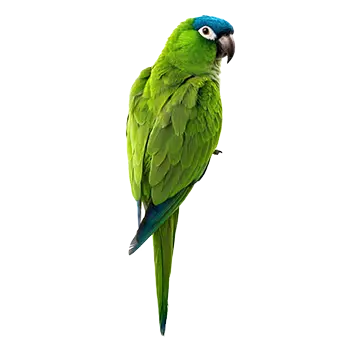

Origins & Natural Habitat

The Blue-Crowned Conure (Thectocercus acuticaudatus) is native to a vast swath of South America, ranging from eastern Colombia and northwestern Venezuela southward through Bolivia, Paraguay, northern Argentina, and into Uruguay and southern Brazil. Unlike many neotropical parrots that depend on dense primary rainforest, this species has adapted to a remarkably diverse array of habitats, including dry woodland, gallery forest along river corridors, savanna edges, and the thorny scrublands of the Gran Chaco. This ecological flexibility has been central to the species' long-term survival and its eventual appeal as a captive bird.

Within its range, the Blue-Crowned Conure occupies semi-open landscapes where scattered trees provide nesting cavities and roosting sites while adjacent grasslands and agricultural margins offer foraging opportunities. Wild flocks feed on seeds, fruits, berries, flowers, and occasionally insect larvae, moving through their home ranges in noisy, fast-flying groups that can number from a handful of individuals to several dozen. Their conspicuous calls serve both as contact signals within the flock and as warnings against aerial predators such as hawks.

The species' taxonomy has undergone several revisions over the decades. Originally placed in the large genus Aratinga alongside many other New World conures, the Blue-Crowned Conure was reclassified into the monotypic genus Thectocercus following molecular phylogenetic studies that clarified relationships among neotropical parakeets. Several subspecies have been described across the bird's extensive range, differing subtly in the extent and intensity of the blue crown feathering, overall body size, and bill coloration, though not all proposed subspecies are universally accepted.

The natural habitats occupied by the Blue-Crowned Conure have experienced varying degrees of pressure from agricultural expansion, cattle ranching, and urbanization. In some parts of Argentina and Bolivia, the species has adapted surprisingly well to modified landscapes, foraging in orchards and croplands and nesting in fence posts or the eaves of rural buildings. This adaptability has insulated wild populations from the sharp declines experienced by more habitat-specialist parrots, though localized losses remain a concern in areas where woodland clearing has been most intensive.

Early History with Humans

Indigenous peoples across the Blue-Crowned Conure's range have interacted with the species for centuries, though the relationship has historically been more practical than reverential. In the Gran Chaco and surrounding lowlands, various indigenous communities kept young parrots captured from nests as semi-tame companions within their settlements. These birds served social and utilitarian purposes, their loud alarm calls alerting villagers to approaching strangers or predators, while their colorful plumage provided feathers for personal adornment and trade.

European naturalists first documented the Blue-Crowned Conure during the colonial period as expeditions penetrated the interior of South America in the 18th and 19th centuries. French naturalist Louis Jean Pierre Vieillot provided one of the earlier formal descriptions, and subsequent collectors gathered specimens from multiple points across the bird's range, gradually mapping its distribution and recognizing regional variation. These early accounts frequently noted the species' gregarious nature and tolerance of human proximity, characteristics that foreshadowed its eventual popularity in aviculture.

The international pet trade in South American parrots expanded dramatically during the mid-20th century, and the Blue-Crowned Conure was among the many species exported in significant numbers from Argentina, Bolivia, and other range countries. During the 1970s and 1980s, wild-caught Blue-Crowned Conures were commonly available in pet shops across the United States and Europe at relatively modest prices. While these birds were often stressed and difficult to tame as adults, their availability introduced the species to a generation of aviculturists who recognized their potential as companion animals.

The passage of the Wild Bird Conservation Act in the United States in 1992 and parallel restrictions in the European Union curtailed the large-scale importation of wild-caught parrots. This regulatory shift forced a transition toward domestic captive breeding, which ultimately improved the quality of birds available as pets and reduced the direct pressure of the trade on wild populations. The Blue-Crowned Conure's journey from a frequently overlooked member of the Aratinga complex to a valued avicultural species reflects broader changes in how humans have related to neotropical parrots over the past several centuries.

Cultural Symbolism & Folklore

In the rural communities of northern Argentina and Paraguay, parrots including the Blue-Crowned Conure occupy a familiar place in everyday life and oral tradition. Farmers in the Chaco region have long regarded conure flocks with a mixture of affection and exasperation, as the birds' raids on maize and sunflower crops can be economically damaging. Local folklore sometimes casts the conure as a crafty opportunist, a character whose intelligence and boldness earn grudging respect even from those whose harvests suffer.

Among the Guarani-speaking peoples of Paraguay and adjacent regions, parrots feature in traditional stories as messengers and intermediaries. While the Blue-Crowned Conure does not hold the singular mythological status of larger, more visually dramatic species like macaws, it is part of the broader cultural tapestry in which parrots symbolize communication, cleverness, and the untamed energy of the natural world. Feathers from various parrot species have been used in ceremonial contexts, and the vibrant green and blue plumage of the Blue-Crowned Conure would have contributed to this tradition.

In Western avicultural culture, the Blue-Crowned Conure has earned a reputation as the gentle giant of the conure world. Breeders and enthusiasts frequently describe the species as among the most affectionate and least nippy of the medium-sized conures, a characterization that has given it a distinct cultural identity within the parrot-keeping community. Online forums and social media groups devoted to the species celebrate its cuddly temperament, its willingness to learn tricks, and its endearing habit of burrowing into blankets or clothing.

The species' cultural footprint, while more modest than that of African Greys or macaws, is nonetheless meaningful. For many parrot owners, the Blue-Crowned Conure represents an ideal balance between the personality and interactivity of a large parrot and the manageability of a smaller species. This positioning has given the bird a loyal following and a growing presence in the broader cultural conversation about companion birds and responsible avian stewardship.

Scientific Study & Recognition

The Blue-Crowned Conure's scientific history reflects the broader evolution of neotropical ornithology. Early specimens collected by European naturalists in the 18th and 19th centuries were classified under a succession of genus names as taxonomists struggled to organize the bewildering diversity of New World parakeets. The species was known for many years as Aratinga acuticaudata, a binomial that persisted in field guides and avicultural literature well into the 21st century. Molecular studies published in the 2010s ultimately resolved the bird's phylogenetic placement, transferring it to the genus Thectocercus and clarifying its relationship to other conure lineages.

Field research on wild Blue-Crowned Conure populations has been conducted in several parts of the species' range, with studies in Argentina and Bolivia providing the most detailed ecological data. Researchers have documented nesting behavior, dietary preferences, flock dynamics, and habitat use, contributing to a growing understanding of how the species interacts with both natural and human-modified landscapes. Studies of crop-raiding behavior have been particularly relevant in agricultural regions, where conflict between farmers and conure flocks has motivated efforts to develop non-lethal management strategies.

In avicultural science, the Blue-Crowned Conure has received attention for its breeding biology, nutritional requirements, and behavioral characteristics in captivity. Veterinary researchers have studied the species' susceptibility to common psittacine diseases including proventricular dilatation disease, psittacine beak and feather disease, and aspergillosis. Behavioral studies have examined the Blue-Crowned Conure's capacity for vocal learning, problem solving, and social bonding, placing it within the broader context of conure cognition.

While the Blue-Crowned Conure has not achieved the scientific celebrity of species like the African Grey or the Kea, its contributions to ornithological knowledge are meaningful. Research on this species has helped illuminate patterns of adaptation and resilience among neotropical parrots and has informed practical guidelines for captive management and conservation planning across the conure group.

The Species Today

The Blue-Crowned Conure occupies a stable but evolving position in contemporary aviculture. Captive-bred birds are widely available from specialty breeders across North America, Europe, and Australia, and the species is a regular presence at avian expos, bird fairs, and adoption events. Its reputation for a calm and affectionate temperament has made it a popular choice for families, first-time parrot owners, and experienced aviculturists alike, though its vocal output can be substantial and prospective keepers are advised to consider noise tolerance carefully.

Breeding programs have refined the captive population over several decades, producing birds that are well socialized, healthy, and genetically diverse. Responsible breeders emphasize early handling, varied diet, and appropriate weaning practices, resulting in companion birds that bond readily with their human families. The species' moderate size, manageable dietary needs, and relatively robust health profile make it one of the more practical medium-sized parrots for household keeping, though its lifespan of two to three decades still represents a significant long-term commitment.

In the wild, the Blue-Crowned Conure is classified as a species of Least Concern by the International Union for Conservation of Nature, reflecting its broad distribution and apparently stable overall population. However, regional declines have been noted in areas where deforestation and agricultural intensification have reduced suitable habitat. Conservationists have flagged the need for ongoing monitoring, particularly in parts of Bolivia and Brazil where land-use changes are accelerating.

The online community surrounding the Blue-Crowned Conure has grown considerably in recent years, with dedicated groups on social media platforms serving as hubs for advice, storytelling, and advocacy. These communities play an important role in educating new owners about the species' needs, connecting birds in need of rehoming with suitable adopters, and fostering a culture of informed, compassionate parrot keeping. The Blue-Crowned Conure's future as both a wild species and a companion animal depends on the continued engagement of these communities and the broader avicultural world.

Notable Individuals

Unlike some parrot species that have produced individually famous birds through scientific research or media exposure, the Blue-Crowned Conure's most notable representatives have largely made their mark within the avicultural community rather than the broader public consciousness. However, the species received a significant cultural boost from the 1998 film Paulie, in which a Blue-Crowned Conure served as the title character. The film depicted a talking conure on a cross-country journey and, despite mixed critical reception, introduced the species to millions of viewers who might never have encountered it otherwise.

The birds used in the production of Paulie became minor celebrities in their own right, with handlers and trainers sharing behind-the-scenes stories about the birds' personalities and the challenges of working with live parrots on a film set. The movie's release coincided with a noticeable spike in interest among prospective parrot owners, a pattern that aviculturists viewed with both enthusiasm and caution, recognizing that media-driven demand does not always translate into well-prepared ownership.

Within the community of Blue-Crowned Conure enthusiasts, certain individual birds have achieved local or online fame for their vocabulary, their trick repertoires, or their distinctive personalities. Social media accounts dedicated to pet Blue-Crowned Conures regularly accumulate large followings, with videos of the birds dancing, talking, or engaging in playful antics attracting viewers far beyond the core avicultural audience. These individual stories collectively reinforce the species' reputation for charm, intelligence, and companionability.

Rescue organizations have also highlighted individual Blue-Crowned Conures whose stories illustrate the challenges of long-lived parrot ownership. Birds surrendered due to changes in their owners' circumstances, behavioral issues stemming from inadequate socialization, or health problems resulting from poor diet have become ambassadors for adoption and responsible care. Their stories serve as both cautionary tales and testaments to the resilience and adaptability that define the species.

Always consult a qualified professional before making any health-related decisions. This content is provided for informational reference only and should not replace professional guidance specific to your animal.