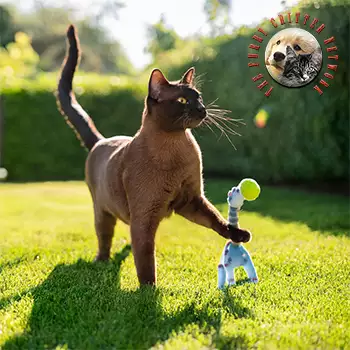

Play Style & Drive

The Burmese is one of the most play-driven cat breeds, retaining a kitten-like intensity well into middle age and beyond. This is not a cat that will watch a toy from a distance and decide it is not worth the effort. A Burmese in play mode is fully committed — leaping, pouncing, batting, and chasing with an enthusiasm that borders on obsessive. Understanding this intensity is key to selecting toys that satisfy the breed's drive without being destroyed in a single session.

Their play style tends to be highly interactive and socially oriented. While many cat breeds are content with solo play, the Burmese strongly prefers games that involve a human partner. Wand toys, laser pointers, and toss-and-fetch games are consistently more engaging for this breed than toys that operate autonomously. This does not mean they cannot play alone, but a Burmese that only has access to solo toys will likely seek attention in other, less desirable ways.

The breed also exhibits a noticeable fetch instinct that is relatively uncommon among cats. Many Burmese will naturally retrieve small thrown objects and bring them back for another round, making lightweight balls, crinkle toys, and soft mice excellent choices for interactive sessions. This retrieving behavior can be encouraged and refined through positive reinforcement, creating a structured play routine that exercises both body and mind.

Play sessions for the Burmese should be scheduled rather than left to chance. Two dedicated play periods of fifteen to twenty minutes each — one in the morning and one in the evening — provide a reliable outlet for pent-up energy and reduce the likelihood of destructive behavior, excessive vocalization, or nighttime hyperactivity. The cat will, of course, initiate additional play throughout the day, but the structured sessions form the backbone of a healthy enrichment routine.

Interactive & Puzzle Toys

Puzzle feeders and treat-dispensing toys are excellent enrichment tools for the Burmese because they engage the breed's intelligence and problem-solving instinct. Start with simple designs — a ball with adjustable openings that releases treats when rolled — and progress to more complex multi-stage puzzles as the cat builds proficiency. The Burmese learns quickly, so puzzle toys that cannot be increased in difficulty will lose their appeal within a few days.

Slider puzzles, flip-board feeders, and tower-style dispensers that require the cat to use paws and nose in combination provide the level of complexity this breed needs. Rotating a set of three or four puzzle toys, with only one available at a time, maintains novelty without requiring a continuous investment in new products. Swap them out every few days and the cat approaches each one with renewed interest.

Electronic interactive toys — motorized mice, erratic-movement balls, and app-controlled laser modules — can supplement human-led play but should not replace it entirely. The Burmese thrives on the social component of play, and a motorized toy, however clever, does not provide the eye contact, verbal interaction, and responsive unpredictability that a human play partner offers. Use electronic toys as warm-up entertainment or for periods when the household is briefly occupied.

Hiding treats in various locations around the home creates a low-tech scavenger hunt that engages the Burmese's natural hunting sequence — search, stalk, capture, consume. This approach requires no special equipment and can be varied daily by changing hiding spots. Start with obvious locations and gradually increase difficulty as the cat learns the game. This is especially effective for food-motivated Burmese that need mental engagement beyond standard mealtimes.

Chew Toys & Durability

While cats are not chewers in the way dogs are, the Burmese does have a stronger-than-average oral fixation compared to many breeds. Kicker toys — elongated, stuffed shapes designed for the cat to grab with front paws and rake with hind claws while biting — channel this energy effectively. Look for kicker toys with reinforced seams and durable outer fabric, as the Burmese's vigorous play style will expose weak construction quickly.

Catnip-infused toys add a layer of olfactory stimulation that many Burmese respond to enthusiastically, though sensitivity to catnip is genetic and roughly a third of cats show no reaction at all. Silvervine and valerian root are alternative attractants that may engage cats that are indifferent to catnip. Toys with refillable herb pouches offer better long-term value than those with catnip sewn permanently into the stuffing, as the scent fades over time and a refresh option extends the toy's useful life.

Dental chew toys designed for cats can provide both enrichment and oral health benefits. Mesh or netting textures that the cat gnaws on help reduce minor tartar buildup through mechanical abrasion. These are not a replacement for professional dental care, but they contribute to overall oral hygiene when used consistently.

Durability testing is an ongoing process. Inspect toys regularly for loose components — plastic eyes, button noses, ribbon tails — that could be chewed off and swallowed. The Burmese's persistent, thorough approach to play means that components rated for average feline use may fail sooner than expected. Discard any toy that shows signs of structural compromise, particularly those with small parts that could present a choking or intestinal obstruction risk.

Chase & Aerial Toys

Wand toys are the single most effective play tool for the Burmese. A flexible rod with a feathered, ribboned, or fuzzy attachment allows the owner to simulate the erratic movement of prey — darting, pausing, fluttering, and retreating — in a way that triggers the full hunting sequence. The Burmese will stalk, crouch, wiggle, and launch with athletic precision, providing intense physical exercise in a compact time frame.

Variety in wand attachments keeps play sessions fresh. Feathered attachments simulate bird prey and encourage leaping and aerial catches. String or ribbon attachments mimic snakes and trigger ground-level stalking. Fuzzy mouse attachments appeal to the pounce-and-grab instinct. Rotating between attachment types across play sessions prevents habituation and maintains peak engagement from the cat.

Laser pointers generate explosive chasing behavior in most Burmese cats and are useful for burning off energy in small spaces. However, laser play should always end with a physical toy or treat placed at the laser's final landing point so the cat experiences the satisfaction of a successful capture. Play sessions that consist entirely of chasing an uncatchable light point can produce frustration and obsessive behavior over time.

Ball tracks, spring-mounted bouncers, and suspended toys attached to door frames or furniture provide self-directed chase opportunities when the owner is not available for interactive play. These work best in combination with other enrichment rather than as standalone entertainment, since the Burmese's intelligence means it will decode the toy's movement pattern quickly and lose interest unless other stimulation is also available.

Comfort & Companion Toys

The Burmese's strong attachment to its people means that comfort toys can play a meaningful role in managing separation anxiety and settling behavior. Soft plush toys sized for carrying — small enough that the cat can grip them in its mouth and transport them around the house — often become surrogate companions that the Burmese sleeps with, grooms, and deposits near its food bowl or favorite resting spot.

Heated comfort toys that retain warmth from a microwave insert can be especially soothing for Burmese cats that experience stress during owner absences, thunderstorms, or household disruptions. The combination of warmth and a soft surface mimics the comfort of a companion body and can measurably reduce stress indicators like excessive grooming and vocalization.

Some Burmese develop attachments to specific toys and will protest vocally if the toy is removed or relocated. This is normal bonding behavior for the breed and should be accommodated rather than disrupted. If the favored toy begins to deteriorate, purchasing an identical replacement before the original is fully worn out allows for a smoother transition than presenting an unfamiliar substitute after the original is gone.

Toys infused with pheromone sprays designed to reduce feline anxiety can be useful during high-stress periods such as moves, new pet introductions, or changes in household composition. These synthetic pheromones mimic the facial marking scent that cats produce when they feel secure, and when applied to a familiar comfort toy, they create a portable source of reassurance that the cat can carry to its preferred retreat spot.

DIY & Budget Options

Some of the most engaging Burmese toys cost nothing at all. A crumpled ball of paper tossed across a hardwood floor triggers the fetch instinct in many Burmese and provides minutes of enthusiastic retrieval play. Cardboard boxes with entrance holes cut in the sides become instant hide-and-ambush stations. Paper bags — with handles removed for safety — create crinkly tunnels that the breed finds irresistible.

Sock toys filled with dried catnip or silvervine and tied off at the open end are simple to make and easy to refresh. The texture of the sock fabric is satisfying for biting and bunny-kicking, and the size is right for a cat to carry around the house. Replace the filling every few weeks to maintain potency, and discard the toy when the fabric thins to the point where filling could escape.

Rotation is the most cost-effective enrichment strategy available. Divide existing toys into three or four groups and make only one group available at a time, swapping every three to four days. Toys that have been out of circulation for a week feel novel again when reintroduced, effectively tripling or quadrupling the perceived value of your existing collection without additional spending.

Cardboard scratch pads are inexpensive, widely available, and provide both claw maintenance and play enrichment. Many Burmese will use a flat scratch pad as a wrestling surface, rubbing against it, rolling on it, and batting at loose corrugated edges. Sprinkle a small amount of dried catnip on the surface to increase engagement. These pads wear out over time but are cheap enough to replace regularly without concern, and spent pads can be recycled with standard cardboard.

Always consult a qualified professional before making any health-related decisions. This content is provided for informational reference only and should not replace professional guidance specific to your animal.