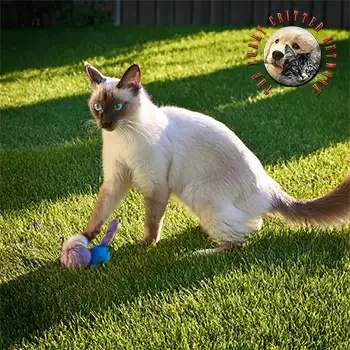

Play Style & Drive

The Balinese is one of the most playful and intelligent cat breeds, maintaining a kitten-like enthusiasm for play well into adulthood and even old age. Their play style is athletic and acrobatic — expect spectacular leaps, mid-air twists, and rapid directional changes during play sessions. Understanding this high-energy, agile play style is key to selecting toys that will actually hold their interest.

This breed has a strong prey drive that manifests as intense focus on moving objects. The Balinese excels at stalking, chasing, and pouncing, and they prefer toys that mimic the erratic movement of real prey. Toys that move in predictable patterns will bore a Balinese quickly, while those with unpredictable motion — feathers fluttering irregularly, balls with erratic bounce patterns — tend to sustain engagement for much longer.

The Balinese's intelligence adds another dimension to their play needs. Simple chase toys are enjoyable but not sufficient on their own. This breed craves mental stimulation alongside physical exercise, and cats that are not adequately challenged mentally will redirect their intelligence toward mischief — opening cabinets, unraveling toilet paper, or devising creative ways to access forbidden areas. A well-rounded toy selection should engage both body and brain.

Daily interactive play sessions are essential, not optional, for this breed. Plan for at least two sessions of 15 to 20 minutes each, using toys that require your active participation. The Balinese bonds deeply through play, and these sessions serve double duty as exercise and relationship building. A tired Balinese is a well-behaved Balinese, and structured play is the most effective way to channel their considerable energy.

Interactive & Puzzle Toys

Puzzle toys are where the Balinese truly shines. Their intelligence and persistence make them ideal candidates for food puzzles, treat-dispensing toys, and multi-step problem-solving games. Start with beginner-level puzzles and increase difficulty as your cat masters each one — the Balinese will progress through difficulty levels faster than most breeds.

Food puzzle boards with sliding covers, hidden compartments, and rotating elements keep mealtimes engaging and slow down cats that eat too quickly. Using a portion of the daily food ration in puzzle feeders rather than a standard bowl transforms a routine meal into an enrichment activity. The Balinese's dexterous paws and sharp mind make them adept at manipulating these devices, so choose puzzles rated for advanced difficulty.

Interactive toys that respond to the cat's actions — balls that change speed when batted, electronic mice that reverse direction when touched — maintain interest better than passive toys. The Balinese is more likely to engage with a toy that reacts to them because the responsive feedback loop mimics real prey behavior. Look for interactive toys with variable speed settings and randomized movement patterns.

Rotation is critical for maintaining novelty. Even the best puzzle toy becomes stale after daily use. Keep a library of puzzle and interactive toys and rotate three or four into active use at a time, swapping them out every few days. Storing unused toys out of sight ensures that each reintroduction feels fresh and exciting to the cat.

Wand Toys & Teasers

Wand toys and feather teasers are the gold standard for interactive play with a Balinese cat. These toys let you control the movement of the lure, mimicking the unpredictable flight of birds or the darting of small ground prey. The Balinese's aerial agility makes wand play particularly spectacular — expect your cat to leap impressive heights and execute acrobatic catches.

Choose wand toys with detachable lure attachments so you can vary the prey simulation. Feathered attachments mimic birds, while furry or fabric lures simulate ground prey. String or ribbon attachments create a snake-like movement that triggers a different predatory response. Having several attachment types lets you rotate the play experience and keeps the Balinese from becoming desensitized to a single stimulus.

Technique matters as much as the toy itself. Move the lure away from the cat rather than toward it — real prey flees, it does not approach predators. Vary the speed and direction unpredictably. Alternate between quick darting movements and brief pauses where the lure "hides" behind furniture or under a blanket. Let the cat catch the lure periodically to prevent frustration and maintain motivation.

Safety requires that wand toys be stored out of reach when not in active supervised use. The Balinese's persistence and dexterity mean they can and will pull stored wand toys off hooks, out of drawers, and from behind closed doors. Strings, ribbons, and feather attachments pose choking and intestinal obstruction risks if chewed or swallowed unsupervised. Treat wand toys as interactive-only tools, not leave-behind toys.

Chase & Motion Toys

Battery-operated and mechanical chase toys serve as excellent supplements to interactive play, particularly when you cannot actively engage with your Balinese. Automated laser toys that project moving dots in randomized patterns can keep a Balinese entertained independently, though it is important to pair laser play with a physical toy the cat can actually catch to prevent frustration from never capturing the "prey."

Track toys with balls that spin inside enclosed channels appeal to the Balinese's batting instincts and provide self-directed play opportunities. Multi-level track designs add complexity that keeps intelligent cats engaged longer. Some track toys incorporate scratch pads or dangling attachments in the center, combining multiple play motivations in a single product.

Robotic mouse toys that mimic realistic scurrying movements across the floor trigger strong chase responses from the Balinese. The best models feature erratic movement patterns, automatic directional changes when hitting obstacles, and variable speeds. Models with fur-like coverings tend to be more appealing than smooth plastic versions, as the texture enhances the prey simulation.

Spring-mounted toys that attach to surfaces and wobble when batted provide ongoing entertainment with minimal owner involvement. The unpredictable bouncing motion keeps the Balinese engaged through multiple play sessions. Mount these at different heights — floor level, on cat tree platforms, and on wall-mounted shelves — to encourage play throughout the cat's vertical territory.

Comfort & Companion Toys

While the Balinese is primarily driven by active, stimulating play, comfort toys still have a role in their enrichment toolkit. Soft plush toys that are roughly the size of natural prey can become favored comfort objects, especially for Balinese cats that are left alone during work hours. Some cats will carry these toys around the house, groom them, and sleep with them.

Catnip and silver vine toys provide a different kind of stimulation that many Balinese cats enjoy intensely. The Balinese's sensitivity and expressiveness make their response to catnip particularly entertaining — rolling, rubbing, vocalizing, and engaging in bursts of energetic play. Offer catnip toys in moderation, as the effect diminishes with overexposure. Limiting access to a few times per week keeps the response strong.

Kicker toys — elongated stuffed toys designed for the cat to grab with the front paws and kick with the hind legs — satisfy the Balinese's predatory instincts during solo play. Choose kicker toys that are proportional to your cat's body length and filled firmly enough to withstand vigorous bunny-kicking. Reinforced seams and durable outer fabric extend the life of these toys, which take considerable abuse.

Valerian root toys offer an alternative to catnip for cats that do not respond to it. Approximately 30 percent of cats lack the gene that triggers the catnip response, and valerian root activates a different but similarly stimulating pathway. The scent is strong and somewhat unpleasant to most humans, so storing valerian toys in a sealed container when not in use is advisable.

DIY & Budget Options

Some of the most engaging toys for a Balinese cat cost nothing at all. A crumpled ball of paper tossed across a hard floor triggers an immediate chase response and provides satisfying batting and pouncing opportunities. The unpredictable rolling pattern of a crumpled paper ball on smooth flooring is more engaging than many commercial toys, and the Balinese's intelligence does not require that stimulation come with a price tag.

Cardboard boxes remain one of the most universally beloved cat toys, and the Balinese is no exception. Cut entry and exit holes in various sizes and positions to create tunnels, hiding spots, and ambush points. Connecting multiple boxes with cut-through passages creates an inexpensive play structure that can be refreshed simply by rearranging or replacing the boxes. Add a few holes large enough for a paw to reach through and drop treats or small toys inside for added enrichment.

DIY puzzle feeders can be made from common household items. Muffin tins with treats placed in the wells and covered with tennis balls or small toys create an effective food puzzle. Toilet paper tubes with the ends folded closed and a few kibble pieces inside become treat-dispensing roll toys. Ice cube trays with treats frozen in low-sodium broth provide hot-weather enrichment that combines play with hydration.

Rotating homemade toys is even easier than rotating commercial ones since the materials are disposable and replaceable. The key principle is novelty — the Balinese's sharp mind habituates quickly to familiar stimuli, so changing the configuration, location, and type of DIY enrichment regularly keeps the experience fresh. Combine homemade options with a core collection of durable commercial toys for a well-rounded enrichment program that does not strain the budget.

Always consult a qualified professional before making any health-related decisions. This content is provided for informational reference only and should not replace professional guidance specific to your animal.