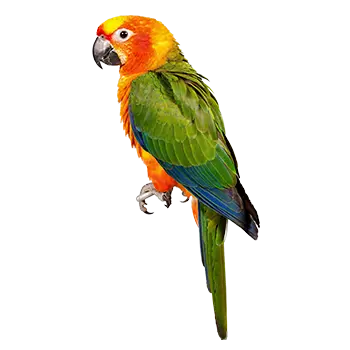

Housing Requirements

Jenday Conures are among the most physically active members of the conure family, and their housing must accommodate a lifestyle defined by climbing, swinging, flapping, and near-constant movement during waking hours. A cage that meets the minimum dimensional requirements but lacks the internal space for these behaviors is functionally inadequate regardless of its listed specifications. Housing decisions for this species should prioritize usable interior volume, bar configuration that supports climbing, and materials that withstand the strong beak of a determined chewer.

The minimum recommended cage size for a single Jenday Conure is 24 inches wide by 24 inches deep by 30 inches tall, but experienced owners and avian veterinarians consistently advise going significantly larger whenever space and budget allow. A cage measuring 30 by 24 by 36 inches or greater provides meaningful room for wing stretching, short flights between perches, and the installation of toys and foraging stations without creating a cluttered interior. For households where the bird spends extended hours in the cage during work or school days, a flight cage in the range of 36 to 48 inches in length offers a qualitative improvement in the bird's daily experience.

Bar spacing is a safety-critical specification. Jenday Conures require bar spacing between half an inch and three-quarters of an inch. Bars spaced wider than three-quarters of an inch create a genuine risk of the bird wedging its head between bars, which can result in injury or strangulation. Bars spaced too narrowly, such as those on cages designed for finches or budgies, impede climbing and may trap toes. Horizontal bar orientation on at least two sides of the cage is strongly preferred, as Jendays are enthusiastic climbers and horizontal bars function as a built-in climbing wall that provides exercise and mental engagement.

Cage material and coating matter for both safety and durability. Powder-coated steel and stainless steel are the two primary options. Powder-coated cages are more affordable and available in a wider range of sizes and styles, but the coating can chip over time under sustained chewing, exposing bare metal that may rust. Stainless steel cages represent a higher upfront investment but are virtually indestructible under normal use, will not rust, and eliminate any concern about coating ingestion. For a species that will live twenty to thirty years, the per-year cost of a stainless steel cage often compares favorably to replacing a powder-coated cage every several years.

Cage Types and Configurations

The cage market offers several distinct configurations, and understanding the practical differences helps owners select a style that fits both the bird's needs and the household's living arrangement. Traditional rectangular cages remain the most versatile option for Jenday Conures. Their flat walls maximize usable climbing surface, their predictable geometry simplifies interior arrangement, and they fit neatly against walls or into corners without wasting floor space. Most rectangular cages designed for medium parrots also include a playtop or a flat roof surface that can serve as an out-of-cage perching and play area.

Dome-top cages offer a slight increase in vertical headroom at the cage's center, which some Jendays appreciate as a high perching point. The curved top bars can also support hanging toys at varied heights. However, the sloped upper walls reduce usable climbing area compared to a flat-topped cage of equivalent footprint, and the dome makes it more difficult to mount accessories or use the cage roof as a play surface. For owners who plan to provide a separate playtop stand, the dome top is a reasonable choice that many birds find visually appealing from the inside.

Flight cages, sometimes marketed as indoor aviaries, are elongated enclosures that prioritize horizontal length over height. These cages allow Jenday Conures to take short sustained flights between perches placed at opposite ends, providing cardiovascular exercise that no amount of climbing or wing flapping can replicate. A flight cage measuring 48 inches or longer transforms the housing experience for this species, though the increased footprint requires dedicated floor space that not every home can accommodate. Some flight cages are designed with divider panels that allow the enclosure to be split into two sections when needed, offering flexibility for households with multiple birds.

Corner cages and decorative wrought-iron styles should be approached with caution. Corner cages often sacrifice interior volume for aesthetic integration with room decor, and many have bar spacing designed for smaller birds. Decorative cages with ornate scrollwork, lead-based solder joints, or zinc-heavy hardware present direct toxicity risks. Any cage under consideration should be verified as bird-safe by checking that all welds, clasps, and decorative elements are free of lead, zinc, and other heavy metals that birds ingest through habitual chewing and licking of cage surfaces.

Perch Selection and Placement

Perches are not merely resting places but active components of a Jenday Conure's physical health program. The diameter, material, texture, and placement of perches directly influence foot health, joint condition, beak maintenance, and the bird's willingness to move around its enclosure. A well-planned perch arrangement encourages the bird to travel through the cage rather than camping on a single preferred spot, distributing wear across different foot positions and engaging different muscle groups.

Natural wood perches are the single most important perch type for any conure cage. Branches from bird-safe trees such as manzanita, java wood, cholla, dragonwood, and untreated fruit woods like apple and pear provide irregular diameters and textured surfaces that exercise foot muscles and prevent the pressure sores associated with uniform dowel perches. The natural variation in branch diameter forces the bird to adjust its grip constantly, strengthening tendons and promoting healthy blood flow to the feet. Manzanita and java wood are exceptionally hard and resist the persistent chewing that Jendays inflict on their perches, making them a durable long-term investment.

Rope perches made from untreated cotton or sisal add a soft, flexible surface that many Jendays enjoy for sleeping and relaxed perching. These perches can be bent into curves, spirals, and bridges that create movement pathways through the cage interior. However, rope perches require regular inspection for fraying. Loose threads and fibers can entangle toes or be ingested, causing crop impaction or constriction injuries. Trimming frayed ends promptly and replacing rope perches at the first sign of significant wear prevents these risks.

Concrete and mineral perches serve a grooming function, gently filing nail tips and beak edges as the bird perches and shifts its grip. These should be positioned as secondary perches in lower-traffic areas of the cage rather than as the primary sleeping or resting perch, since their hard, abrasive surface can cause foot irritation with prolonged contact. A single concrete perch mounted near a food or water dish, where the bird visits frequently but does not linger for hours, strikes the right balance between grooming benefit and foot comfort. Dowel perches that ship with most cages should be removed and replaced, as their uniform diameter and smooth surface contribute to bumblefoot and repetitive strain over time.

Interior Layout and Setup

The interior arrangement of a Jenday Conure's cage has a direct impact on the bird's physical activity level, psychological well-being, and ease of maintenance. A thoughtfully arranged cage encourages exploration and movement throughout the entire enclosure rather than allowing the bird to establish a single perch as its permanent station. The guiding principle is to create distinct zones within the cage for eating, playing, resting, and foraging, connected by perches and climbing routes that require the bird to move between them.

Food and water dishes should be positioned at a comfortable perching height but not at the highest point in the cage. Birds instinctively seek the highest available position, so placing dishes at the top creates a situation where the bird perches near its food constantly and moves less. Mounting dishes at mid-height with the primary sleeping perch positioned higher encourages the bird to descend to eat and then return to preferred perching spots, generating regular movement. Stainless steel or high-grade ceramic dishes that lock securely into mounting brackets resist the tipping and dunking that Jendays are notorious for, and their non-porous surfaces are easier to sanitize than plastic alternatives.

Toy placement follows a similar zoning philosophy. Hanging toys and foraging devices should be distributed across different cage areas rather than clustered in one corner. This distribution transforms the cage into an activity circuit where the bird encounters different enrichment opportunities as it moves through the space. Leaving the center of the cage relatively open preserves flight and wing-stretching space, while perimeter areas and corners can accommodate toys, foraging stations, and perch junctions. Rotating toys on a weekly or biweekly schedule maintains novelty and prevents the bird from losing interest in its environment.

The cage floor setup influences both hygiene and enrichment possibilities. A removable grate positioned above the tray prevents the bird from walking in accumulated droppings and discarded food, which is important for foot health and disease prevention. The tray itself should be lined with plain newsprint, butcher paper, or cage-specific paper liners that allow easy visual monitoring of droppings for health assessment. Walnut shell litter and corn cob bedding are sometimes marketed for cage use but can harbor mold and bacteria and may be ingested, making paper-based liners the safer and more practical choice. Some owners place a shallow foraging tray of clean shredded paper or bird-safe substrate on top of the grate to encourage ground-level foraging behavior.

Cage covers serve an important function for establishing a consistent sleep schedule. Jenday Conures need ten to twelve hours of uninterrupted darkness for proper hormonal regulation and rest. A dark, breathable cage cover placed over the cage at a consistent time each evening signals the transition to sleep and blocks ambient light from screens, streetlights, and household lighting. Covers made from tightly woven cotton or purpose-built cage cover fabric in dark colors are most effective. The cover should be sized to drape fully over the cage without gaps while allowing adequate air circulation.

Outdoor and Travel Housing

Supervised outdoor time provides Jenday Conures with natural sunlight exposure that supports vitamin D synthesis, visual enrichment from the outdoor environment, and fresh air circulation that indoor settings cannot replicate. However, taking a conure outdoors requires purpose-built housing that eliminates the risks of escape, predator attack, temperature extremes, and exposure to wild bird diseases. An outdoor aviary or flight cage is not a casual accessory but a safety-engineered enclosure designed for a specific and inherently risky context.

Outdoor aviaries intended for regular use should be constructed from welded stainless steel or heavy-gauge galvanized mesh with spacing no wider than half an inch. The enclosure must include a solid roof or covered section to provide shade and rain protection, as Jenday Conures are tropical birds that can overheat rapidly in direct sunlight and are vulnerable to hypothermia if caught in a rain shower without shelter. Double-door entry systems, where the owner passes through an outer door into a small vestibule before opening the inner door to the aviary, prevent the bird from escaping during entry and exit. The enclosure should be elevated off the ground or placed on a concrete pad to prevent rodent burrowing and to reduce exposure to soil-borne pathogens.

Travel carriers serve a different purpose but are equally important as a housing product category. A sturdy travel carrier is essential for veterinary visits, emergency evacuations, and any situation requiring safe transport. The ideal conure travel carrier is constructed from high-impact plastic with a stainless steel wire door, is sized to allow the bird to turn around comfortably but not so large that the bird is thrown around during vehicle movement, and includes a secure door latch that the bird cannot manipulate open. A perch mounted low inside the carrier gives the bird something to grip during transport, reducing stress and preventing injury from sliding on the smooth floor.

Portable outdoor play stands and tabletop aviaries occupy a middle ground between full outdoor housing and simple travel carriers. These products allow supervised outdoor time on a porch, patio, or yard without the permanence and cost of a fixed aviary. When selecting a portable outdoor enclosure, look for sturdy construction that resists tipping in wind, bar spacing appropriate for the species, and a design that can be quickly collapsed or folded for storage. Any outdoor enclosure should include a solid area for shade, secure latches on all access points, and should never be left unattended with the bird inside, as predators including hawks, cats, raccoons, and snakes can breach lightweight enclosures with startling speed.

Cleaning and Maintenance Products

Consistent cage hygiene is one of the most impactful factors in preventing disease and maintaining a healthy living environment for a Jenday Conure. Birds are highly sensitive to airborne irritants and chemical fumes, which means that the cleaning products used in and around the cage must be both effective against pathogens and safe for avian respiratory systems. Standard household cleaners, particularly those containing bleach, ammonia, phenols, or aerosol propellants, should never be used on or near the cage without thorough rinsing and drying afterward, and many are best avoided entirely.

Bird-safe enzymatic cleaners and cage-specific disinfectants are formulated to break down organic waste, kill common avian pathogens, and evaporate without leaving harmful residues. These products are available as spray bottles for daily spot cleaning and as concentrated solutions for weekly deep cleaning. When comparing products, look for those that are effective against common avian bacteria and fungi, including gram-negative organisms like E. coli and fungal species such as Aspergillus, without relying on harsh chemicals that require extended ventilation after use.

A vinegar-and-water solution, typically mixed at a ratio of one part white vinegar to two parts water, serves as a safe and economical daily cleaning solution for dishes, perches, and cage surfaces. While vinegar is not a true disinfectant and cannot replace periodic deep cleaning with a more potent product, it effectively removes organic residue, neutralizes mild odors, and leaves no toxic residue. Many experienced bird owners use vinegar solution for daily wipe-downs and reserve commercial avian disinfectants for the weekly deep clean, striking a practical balance between thoroughness and chemical exposure.

Cleaning tools should be dedicated exclusively to cage maintenance and never shared with general household cleaning. A set of small bottle brushes for water tubes and dish crevices, a stiff-bristled scrub brush for grate and tray cleaning, a handheld steamer for sanitizing perches and cage bars without chemicals, and a supply of disposable paper towels form the basic toolkit. A handheld steam cleaner deserves particular mention as a cleaning tool, since the high-temperature steam kills bacteria and loosens dried droppings without any chemical involvement, making it one of the safest deep-cleaning methods available for bird enclosures.

Cage Placement and Environment

Where a cage is positioned within the home affects a Jenday Conure's stress levels, social engagement, sleep quality, and exposure to environmental hazards. These birds are intensely social and thrive when their cage is located in a room where the household spends significant time, such as a living room or family room. Placement against a wall or in a corner provides a sense of security by reducing the number of directions from which unexpected stimuli can approach, while still allowing the bird to observe and participate in household activity.

Direct sunlight through windows can create dangerous temperature spikes inside a cage, particularly for a species originating from tropical forest edges where filtered light is the norm rather than unshielded exposure. The cage should receive indirect natural light for circadian rhythm support without being positioned where direct sun can overheat the enclosure. If the only available location receives periodic direct sun, an adjustable shade or partial cage cover on the sun-facing side provides necessary protection. Monitoring the cage-side temperature with a simple thermometer during peak sun hours reveals whether the placement is safe.

Kitchens are widely regarded as the most dangerous room in the house for a caged bird. Overheated nonstick cookware releases polytetrafluoroethylene fumes that are rapidly fatal to birds even at a distance, and the combination of hot surfaces, boiling liquids, sharp objects, and cleaning chemical use creates a concentration of hazards unmatched by any other room. Birds housed in kitchens also face chronic low-level exposure to cooking fumes, grease particles, and temperature fluctuations that compromise respiratory health over time. The safest approach is to keep the cage entirely out of the kitchen and to ensure adequate ventilation when cooking even in adjacent rooms.

Drafts, air vents, and forced-air heating and cooling outlets should not blow directly on the cage. While Jenday Conures can tolerate a range of normal household temperatures between 65 and 80 degrees Fahrenheit, direct exposure to moving air, particularly cold drafts from windows or air conditioning vents, can cause respiratory stress and temperature regulation difficulties. Positioning the cage away from exterior doors, single-pane windows, and HVAC vents protects the bird from these invisible but significant environmental stressors. Conversely, the cage should not be placed directly adjacent to radiators, space heaters, or fireplaces, which can create localized overheating and introduce combustion byproducts into the bird's breathing zone.

Always consult a qualified professional before making any health-related decisions. This content is provided for informational reference only and should not replace professional guidance specific to your animal.