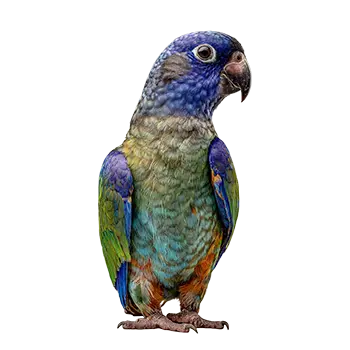

The Blue-Headed Pionus is a medium-sized parrot that measures roughly ten to twelve inches from head to tail, but its housing needs extend well beyond what its compact frame might suggest. As a species that spends a significant portion of its waking hours climbing, stretching, and repositioning itself within its enclosure, the cage must provide enough interior volume for the bird to fully extend its wings in at least two directions without contacting bars, toys, or perches. The absolute minimum cage dimensions for a single Blue-Headed Pionus are twenty-four inches wide by twenty-four inches deep by thirty inches tall, but these minimums should be treated as a floor rather than a target.
A more appropriate cage for a bird that spends meaningful time inside it — which describes most companion Pionus, even those that receive several hours of out-of-cage time daily — measures at least thirty inches in width, twenty-four inches in depth, and thirty-six inches in height. Width matters more than height for this species, as Pionus parrots are horizontal climbers and foragers rather than vertical acrobats. A cage that is tall but narrow forces the bird into an artificially compressed living space, no matter how impressive the exterior dimensions appear.
For owners who can accommodate it, a flight cage or small aviary provides the most enriching housing option. Flight cages typically measure sixty inches or more in width, allowing the bird to make short flights between perching stations inside the enclosure. This level of space permits a more naturalistic distribution of feeding stations, perches at varying heights and angles, and dedicated play areas, which collectively reduce stress and encourage physical activity. Flight cages are particularly valuable for birds that cannot safely be given free-flight time in the home.
The cage should be positioned in a room where the household spends time, as Pionus parrots are social birds that benefit from being near family activity without being in the center of chaos. A corner placement works well because it provides the bird with two solid walls behind it, which creates a sense of security. Avoid placing the cage directly in front of windows where temperature fluctuations, direct sunlight, and the visual stimulation of outdoor wildlife can cause overheating or chronic stress. Drafty locations near exterior doors or air conditioning vents are equally unsuitable, given the Pionus genus's predisposition to respiratory sensitivity.