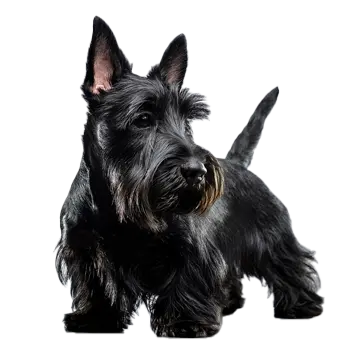

Scottish Terriers are a compact, sturdy breed, and their juvenile growth period reflects that solid build. Most Scotties reach their full height by around nine to ten months of age, though they will continue to fill out and develop muscle mass through their first year and slightly beyond. During the juvenile phase, which spans roughly three to twelve months, you will see your Scottie transform from a round, clumsy puppy into a more proportioned young dog with the breed's distinctive silhouette beginning to emerge.
Weight gain should be steady and gradual rather than rapid. A healthy juvenile Scottish Terrier will typically gain weight consistently each week, and you should be able to feel the ribs with light pressure without them being visually prominent. Because Scotties are low to the ground and barrel-chested, excess weight is particularly hard on their structure and can contribute to joint strain during a critical developmental window.
The breed's wiry double coat begins to change noticeably during adolescence. The soft puppy coat gradually gives way to the coarser, weather-resistant outer coat that defines the breed. Many owners notice a somewhat scruffy, uneven appearance during this transition. Regular brushing helps manage the changeover, and this is a good time to begin acclimating your Scottie to professional grooming if hand-stripping will be part of their long-term coat care.
Bone growth plates in Scottish Terriers typically close between ten and fourteen months. Until those plates have fully closed, high-impact activities such as repetitive jumping or extended running on hard surfaces should be moderated. Your veterinarian can advise on appropriate activity levels based on your individual puppy's development and may recommend radiographs if there is any concern about skeletal maturation.