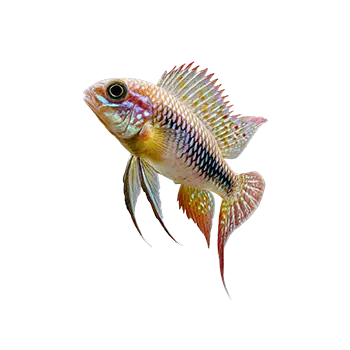

The genus Apistogramma encompasses one of the most diverse and colorful groups of dwarf cichlids found in South American waters. The name Apistogramma derives from Greek roots meaning "irregular lateral line," referencing a characteristic feature where the lateral line system may be incomplete or fragmented in these small cichlids. Aquarists commonly refer to these fish simply as "Apistos," a beloved abbreviation recognizing the group's dedicated following.
Over 90 described species and numerous undescribed variants fall within this genus, making complete documentation challenging even for experts. Popular species in the aquarium trade include Apistogramma cacatuoides (Cockatoo Dwarf Cichlid), A. borellii (Umbrella Cichlid), A. agassizii (Agassiz's Dwarf Cichlid), A. hongsloi, A. macmasteri, and A. panduro among many others. Each species displays unique coloration patterns and behavioral nuances.
The family Cichlidae contains these fish within the subfamily Geophaginae alongside other South American earth-eating cichlids, though Apistogramma are not true earth-eaters. Regional collection location codes often accompany undescribed species, creating names like "Apistogramma sp. Rio Mamore" or "Apistogramma cf. agassizii" indicating specimens similar to but potentially distinct from described species.
Different species carry common names reflecting their appearance or origin. The Cockatoo Dwarf Cichlid references the male's dramatic dorsal fin extensions. Umbrella Cichlid describes the spread-fin display of territorial males. Trade names sometimes cause confusion as the same species may carry different names from various exporters, making scientific names essential for accurate identification and breeding program management.