Saint Berdoodle
The Saint Berdoodle is a cross between the Saint Bernard and the Poodle. Because each hybrid inherits a unique combination of traits from both parents, we recommend thoroughly researching both breeds before choosing a Saint Berdoodle. Pay special attention to temperament, health issues, and care requirements, as your dog may express characteristics from either parent breed.
Saint Bernard
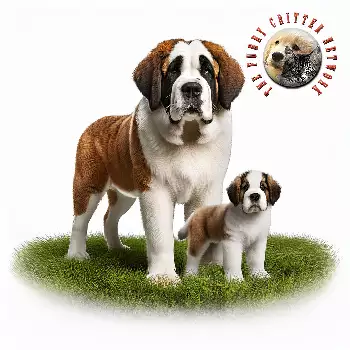
The Saint Bernard is a giant breed that commands attention with its impressive size and powerful build. Males typically stand 28 to 30 inches at the shoulder and weigh between 140 and 180 pounds, while females are slightly smaller at 26 to 28 inches and 120 to 140 pounds. Some exceptional individuals can exceed 200 pounds, placing them among the heaviest of all domestic dog breeds. The breed possesses a massive, muscular body with a broad chest and strong legs that reflect its heritage as a rescue dog in the treacherous Swiss Alps. Their heads are large and imposing with wide skulls that give a distinctive blocky appearance, complemented by a short muzzle set about an inch below expressive brown eyes. Saint Bernards come in two coat varieties: shorthaired and longhaired, with the shorthaired variety being preferred historically by the monks who developed the breed at the Saint Bernard Hospice. Both coat types feature a dense double coat that provides excellent insulation in cold weather, a necessary adaptation given their mountain origins. The coat is predominantly white with markings that can include red, mahogany, brindle, or various shades of brown. Most Saint Bernards display the characteristic dark mask around their eyes and ears, adding to their noble expression. The skin on their forehead is moderately wrinkled, particularly when the dog is alert or attentive, enhancing their thoughtful appearance. The breed's physical features include long, floppy ears that lie flat against the head, a wide and open nose with well-developed nostrils, and powerful jaws with droopy jowls that contribute to their tendency to drool significantly. Their deep-set, kindly eyes convey the gentle nature that lies beneath their imposing exterior. Saint Bernards carry their thick, long tail low, raising it level with the back when excited or in motion. Despite their enormous size, they move with surprising grace and dignity, demonstrating a smooth, easy gait that belies their massive frame. The breed is not built for speed or extended physical exertion and requires careful management to prevent overheating, particularly in warm weather conditions.
Key Characteristics
Temperament Temperament Temperament Temperament Temperament Temperament Saint Bernards are intelligent and eager to please, which makes them trainable despite occasional stubborn streaks. They require early socialization and consistent, positive training methods to develop into well-mannered adults. The breed has relatively low energy levels as adults, preferring leisurely activities over vigorous exercise, though they still need regular walks to maintain their health. They do not tolerate being left alone for extended periods and can develop separation anxiety if frequently isolated from their family. These sociable dogs are happiest when included in daily family activities and given opportunities to demonstrate their loyal, affectionate nature.
Health Considerations Health Considerations Health Considerations Health Considerations Health Considerations Health Considerations Cancer, particularly osteosarcoma, occurs at higher rates in Saint Bernards than in many other breeds, with genetic factors playing a significant role. Wobbler syndrome, also known as cervical spondylomyelopathy, is a neurological condition affecting the neck vertebrae and spinal cord that can cause an unsteady gait. Eye problems including entropion and ectropion, where the eyelids roll inward or outward respectively, may require surgical correction. The breed is also prone to epilepsy and can develop skin conditions in their facial folds if not kept clean and dry. Saint Bernards have a relatively short lifespan of 8 to 10 years and are particularly susceptible to overheating due to their size and thick coat.
Poodle

The Standard Poodle presents an elegant and athletic appearance that belies its origins as a hardworking water retriever. Standing over 15 inches at the withers, with most individuals reaching 18 to 24 inches, the Standard Poodle weighs between 45 and 70 pounds, with males typically ranging from 55 to 60 pounds and females from 45 to 50 pounds. The breed displays a distinctive square outline when properly proportioned, with the length of body from breastbone to rump approximately equal to the height at the withers. Their carriage is proud and dignified, moving with a light, springy gait that demonstrates their athletic capability and sound structure. The Poodle's most recognizable feature is its dense, curly coat, which can also form cords if allowed to grow naturally without brushing. This single-layer coat is notably low-shedding and is often considered more suitable for allergy sufferers, though no dog is truly hypoallergenic. The breed comes in a stunning array of solid colors including black, white, brown, apricot, red, silver, gray, cream, blue, silver beige, and café-au-lait, with the coat color being uniform throughout. The coat texture is naturally harsh and dense, providing protection during water work while requiring regular professional grooming to maintain its health, prevent matting, and achieve the various clip styles associated with the breed. Beyond their famous coat, Poodles possess elegant physical features including a long, fine muzzle with a defined but moderate stop, and dark oval-shaped eyes that convey intelligence and alertness. The ears are set at or slightly below eye level, hang close to the head, and are long and wide with thick feathering. Their neck is long and elegant, flowing into a straight, short back with a level topline that slopes slightly toward the hindquarters. The tail is set high and traditionally docked to a length that creates balance, carried upright when moving. Standard Poodles have a leggy appearance with well-angulated hindquarters that contribute to their powerful swimming ability and graceful, efficient movement. Their feet are oval-shaped and compact, with arched toes and thick pads designed for efficient propulsion both on land and in water.
Key Characteristics
Temperament Temperament Temperament Temperament Temperament Temperament Socialization plays an important role in Poodle development, as the breed can be somewhat reserved or shy around strangers without early exposure to various people and situations. They generally get along well with other pets and children when properly introduced. Poodles do not thrive when left alone for extended periods and prefer to be involved in family activities. They make excellent watchdogs, alerting their families to visitors or unusual occurrences without excessive barking. Their combination of intelligence, trainability, loyalty, and affectionate nature has made them one of the most popular breeds worldwide, excelling in virtually every canine sport and serving capably as therapy dogs, guide dogs, and beloved family companions.
Health Considerations Health Considerations Health Considerations Health Considerations Health Considerations Health Considerations Progressive retinal atrophy is a genetic eye condition that causes gradual vision loss and eventual blindness in affected dogs. Genetic testing can identify carriers and affected individuals, allowing responsible breeders to make informed breeding decisions. Sebaceous adenitis is an immune-mediated skin condition that affects the sebaceous glands and occurs more frequently in Standard Poodles than other breeds, with studies suggesting that up to 50 percent of Standards may be carriers or affected. Epilepsy, believed to have genetic components in the breed, can usually be controlled with medication. Other conditions to monitor include Von Willebrand's disease, a bleeding disorder, hypothyroidism, and patellar luxation, though the latter more commonly affects smaller Poodle varieties.
Important to Remember
Each hybrid dog is unique and may inherit any combination of traits from either parent breed. The information above represents the characteristics of the purebred parent breeds. Your Saint Berdoodle may favor one parent over the other or display a blend of both. We strongly encourage you to read the complete breed profiles for both the Saint Bernard and Poodle to fully understand the range of possible temperaments, health concerns, and care requirements.