Miniature Ausseippet
The Miniature Ausseippet is a cross between the Whippet and the Miniature Australian Shepherd. Because each hybrid inherits a unique combination of traits from both parents, we recommend thoroughly researching both breeds before choosing a Miniature Ausseippet. Pay special attention to temperament, health issues, and care requirements, as your dog may express characteristics from either parent breed.
Whippet
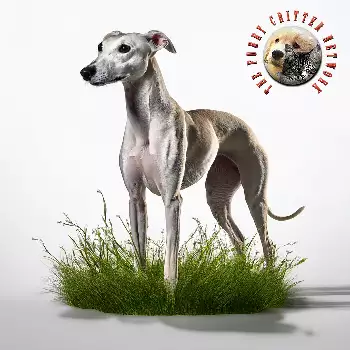
The Whippet is an elegant medium-sized sighthound that embodies grace, speed, and athletic refinement. Males typically stand between 19 and 22 inches at the shoulder, while females measure slightly smaller at 18 to 21 inches. Weight ranges from 25 to 40 pounds, with males generally being heavier than females. The breed possesses a distinctively streamlined silhouette characterized by a deep chest that provides ample heart and lung capacity, a naturally arched loin, and long, powerful hindquarters designed for explosive acceleration. The overall body proportions are slightly longer than tall, creating the classic sighthound profile that allows for the remarkable double-suspension gallop that can propel these dogs at speeds approaching 35 miles per hour. The Whippet's coat is short, smooth, and lies close to the body with a firm texture that requires minimal grooming. This sleek covering offers little protection from cold temperatures, making the breed sensitive to harsh weather conditions. Coat colors are remarkably diverse and include solid shades of black, blue, fawn, red, cream, and white, as well as various brindle patterns and combinations with white markings. The breed standard accepts virtually any color or pattern. The head is long and lean with a fairly flat skull, and the ears are small, fine in texture, and folded back against the neck in a rose-ear position when relaxed. Distinctive physical features include large, round to oval eyes that convey an alert and intelligent expression, typically dark brown to nearly black in color. The muzzle is long and powerful, tapering to a black nose, with strong jaws capable of catching prey. The neck is long and muscular, flowing smoothly into well-laid shoulders. The tail is long and tapered, carried low with a gentle upward curve, serving as a rudder during high-speed pursuits. The feet are well-formed with thick, hard pads and arched toes, described as more hare-like than cat-like, providing excellent traction during sprinting.
Key Characteristics
Temperament Temperament Temperament Temperament Temperament Temperament Socially, Whippets are generally friendly toward people and can be good with children who handle them respectfully. They typically coexist peacefully with other dogs, especially other sighthounds. However, their strong prey drive is deeply ingrained from centuries of selective breeding for coursing small game. This instinct means they should never be trusted off-leash in unfenced areas and may pose a risk to small pets like cats, rabbits, or guinea pigs unless raised together from puppyhood. Despite their gentle appearance, Whippets possess remarkable speed and agility, capable of sudden acceleration that can catch owners off guard.
Health Considerations Health Considerations Health Considerations Health Considerations Health Considerations Health Considerations Orthopedic concerns, while less common than in larger breeds, can include hip dysplasia and occasional injuries related to their high-speed activities. Their thin skin and lack of protective fat make them susceptible to cuts, abrasions, and lacerations during running, particularly in rough terrain. Some Whippets may experience deafness, which can be congenital or develop later in life. Responsible breeders screen for hereditary conditions and can provide documentation of health testing. Additional considerations include hypothyroidism and allergies, including a condition called symmetrical lupoid onychodystrophy affecting the nails. Exercise-induced hyperthermia can occur in hot conditions, requiring careful management during warm weather activities.
Miniature Australian Shepherd

The Miniature Australian Shepherd is a compact herding dog that maintains all the characteristics of its larger Australian Shepherd relative in a smaller, more manageable package. Standing between 13 and 18 inches at the shoulder and weighing 20 to 40 pounds, this breed exhibits the same balanced, athletic build that makes the standard Aussie such an effective working dog. The body is slightly longer than tall, with a height-to-length ratio that provides agility and endurance. Well-muscled without appearing heavy or coarse, the Miniature Australian Shepherd possesses moderate bone structure and substance appropriate for its size, allowing for the quick, nimble movements essential in herding work. The breed's double coat is medium in length and may be straight or slightly wavy, providing excellent weather resistance for outdoor activities. The outer coat has a moderate texture while the undercoat varies in density depending on climate. Feathering appears on the backs of the forelegs and hindquarters, with a moderate mane and frill more pronounced in males. The most striking feature of this breed is its remarkable coat coloration, which includes blue merle, red merle, solid black, and solid red, all with or without white markings and copper points. The merle patterns create unique, marbled effects that make each dog distinctively beautiful. The head is clean-cut and proportionate to the body, with a moderately defined stop and a muzzle that tapers slightly to the nose. Eyes are one of the breed's most captivating features, appearing in brown, blue, amber, or any combination thereof, including heterochromia where each eye is a different color. Ears are triangular and set high on the head, breaking forward or to the side when alert. The tail may be naturally bobbed, docked where legal, or left naturally long and carried low. The overall expression conveys intelligence, alertness, and eager attentiveness that reflects the breed's keen working instincts.
Key Characteristics
Temperament Temperament Temperament Temperament Temperament Temperament Family compatibility is generally excellent, as Miniature Australian Shepherds typically adore children and integrate well into active households. Their herding instincts may cause them to attempt to herd young children, requiring supervision and training to manage appropriately. They usually coexist well with other dogs and can adapt to cats, especially when raised together. The breed's sensitivity means they respond best to positive reinforcement training methods and can become stressed or shut down with harsh corrections. Their versatility and adaptability make them suitable for various roles, from working ranch dogs to therapy animals and beloved family companions.
Health Considerations Health Considerations Health Considerations Health Considerations Health Considerations Health Considerations Orthopedic concerns include hip and elbow dysplasia, conditions where joints develop abnormally causing pain and mobility issues. Responsible breeders obtain hip and elbow certifications through organizations like the Orthopedic Foundation for Animals before breeding. Epilepsy occurs in the breed, manifesting as recurrent seizures that may require lifelong medication management. Degenerative myelopathy, a progressive spinal cord disease, has been identified in the breed and can be screened through DNA testing. Additional considerations include autoimmune conditions, thyroid disorders, and certain cancers. The merle gene, when inherited in double dose from both parents, can cause severe hearing and vision impairments, making it critical to avoid breeding two merle-colored dogs together.
Important to Remember
Each hybrid dog is unique and may inherit any combination of traits from either parent breed. The information above represents the characteristics of the purebred parent breeds. Your Miniature Ausseippet may favor one parent over the other or display a blend of both. We strongly encourage you to read the complete breed profiles for both the Whippet and Miniature Australian Shepherd to fully understand the range of possible temperaments, health concerns, and care requirements.