English Bull Dane
The English Bull Dane is a cross between the English Bulldog and the Great Dane. Because each hybrid inherits a unique combination of traits from both parents, we recommend thoroughly researching both breeds before choosing a English Bull Dane. Pay special attention to temperament, health issues, and care requirements, as your dog may express characteristics from either parent breed.
English Bulldog
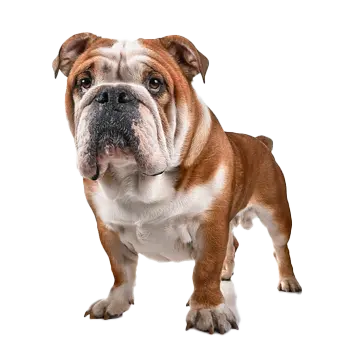
The English Bulldog is a medium-sized dog with a distinctive, heavily-built appearance characterized by a wide, low-slung body and massive head. Males typically weigh between 50 and 54 pounds, while females range from 40 to 50 pounds, with both sexes standing approximately 14 to 16 inches at the shoulder. Despite their relatively compact height, Bulldogs possess a thick-set, muscular frame with wide shoulders and sturdy limbs that give them considerable substance and presence. The body is short and well-rounded, with a broad chest and tucked-up belly, creating the characteristic silhouette that distinguishes the breed. The head is the most iconic feature of the English Bulldog, appearing large and spherical with pronounced cheeks that extend to the sides of the eyes. The face is extremely short and flat, with a deeply indented stop and broad, square jaw that displays a distinct undershot bite where the lower teeth project beyond the upper teeth. The muzzle is very short, broad, and turned upward, with the nose set back deeply between the eyes. Heavy folds and wrinkles of skin cover the head and face, with two loose, pendulous folds forming the distinctive dewlap from the jaw to the chest. The coat is straight, short, fine, and smooth in texture, lying close to the body with a glossy appearance. Acceptable colors include brindle in various shades, solid white, solid red, fawn, or piebald combinations of these colors. The skin is soft and loose, particularly around the head, neck, and shoulders, where the characteristic folds and wrinkles are most prominent. The ears are small and thin, set high on the head in a rose-ear position that folds inward at the back lower edge. The eyes are round, moderate in size, and set low and wide apart in the front of the skull, conveying a kind yet determined expression.
Key Characteristics
Temperament Temperament Temperament Temperament Temperament Temperament The breed's social behavior varies depending on the situation and individual dog. Bulldogs typically get along well with familiar people and animals but may display territorial or protective behavior toward strangers and unfamiliar dogs. Some individuals may exhibit resource guarding tendencies, particularly around food. Due to their sensitivity to temperature extremes, they prefer indoor living and are well-suited to apartment life. Their moderate exercise needs and calm indoor demeanor make them excellent companions for those seeking a loyal, affectionate pet that enjoys relaxed companionship rather than high-energy activities.
Health Considerations Health Considerations Health Considerations Health Considerations Health Considerations Health Considerations Reproductive challenges are substantial in English Bulldogs, with over 80 percent of litters requiring cesarean section delivery due to the puppies' large heads and the dam's narrow pelvis. This makes natural breeding and whelping difficult or impossible for many individuals. Hypothyroidism, heart disease, and various cancers also affect the breed at higher than average rates. The combination of these health issues results in a shorter lifespan of 8 to 10 years compared to many other breeds. Potential owners should be prepared for significant veterinary care and associated costs throughout the dog's life, making thorough research and selection of a health-conscious breeder essential.
Great Dane
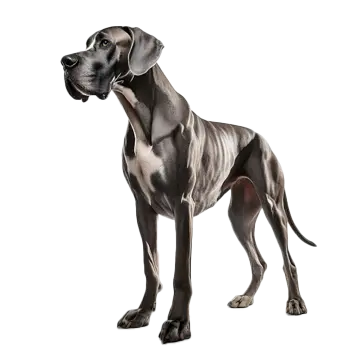
The Great Dane is a giant breed that combines regal elegance with impressive strength, standing as one of the tallest dog breeds in the world. Males must be at least 30 inches at the shoulder but typically stand 32 to 34 inches, while females have a minimum height of 28 inches with most measuring 30 to 32 inches. Weight is not specified in the breed standard but generally ranges from 110 to 175 pounds depending on height and build. Despite their massive size, Great Danes should appear well-proportioned and balanced, never clumsy or awkward in their structure. The body is square in profile, meaning the length from chest to rear equals the height at the withers. The Great Dane's appearance conveys dignity, strength, and elegance, combining great size with a powerful, smoothly muscled body. The head is long and rectangular, distinguished and expressive, with parallel planes of the skull and muzzle separated by a moderate stop. The muzzle is broad and deep, never pointed or pinched, with clean lines beneath the eyes. The expression is intelligent and alert, enhanced by medium-sized, dark eyes that are moderately deep-set with a lively appearance. The ears are set high and may be cropped to stand erect or left natural to fold forward close to the cheek. The coat is short, thick, smooth, and glossy, lying close to the body and requiring minimal grooming despite the dog's enormous surface area. The breed displays seven accepted color varieties including fawn with a black mask, brindle, blue, black, harlequin (pure white base with irregular black patches), mantle (black with white markings resembling a Boston Terrier pattern), and merle (gray with dark patches). The neck is long, firm, and muscular, flowing smoothly into well-angulated shoulders. The topline is level and strong, and the tail is set high, thick at the base, and tapers to a point, reaching the hock joint when at rest.
Key Characteristics
Temperament Temperament Temperament Temperament Temperament Temperament Great Danes are typically sociable with other dogs and household pets, especially when raised together from a young age. They crave human companionship and do not thrive when isolated from their families for extended periods. Their calm indoor demeanor contrasts with their need for regular exercise to maintain muscle tone and joint health. While they do not require extensive exercise, daily walks and opportunities for controlled running help keep them physically and mentally satisfied. The breed's combination of imposing presence and gentle nature makes them excellent companions for those prepared to accommodate their significant space and care requirements.
Health Considerations Health Considerations Health Considerations Health Considerations Health Considerations Health Considerations Orthopedic issues are common due to the breed's rapid growth and immense size. Hip dysplasia, developmental osteodystrophy, and wobbler syndrome (cervical vertebral instability) affect significant numbers of Great Danes. Wobbler syndrome causes compression of the spinal cord in the neck, resulting in an unsteady gait and potentially paralysis. Hypothyroidism and Addison's disease are endocrine disorders seen in the breed, and eye conditions including cataracts and entropion may occur. Proper nutrition during growth is critical to minimize orthopedic problems, and puppies should be fed large-breed puppy formulas to control growth rate.
Important to Remember
Each hybrid dog is unique and may inherit any combination of traits from either parent breed. The information above represents the characteristics of the purebred parent breeds. Your English Bull Dane may favor one parent over the other or display a blend of both. We strongly encourage you to read the complete breed profiles for both the English Bulldog and Great Dane to fully understand the range of possible temperaments, health concerns, and care requirements.