EngAm Bulldog
The EngAm Bulldog is a cross between the American Bulldog and the English Bulldog. Because each hybrid inherits a unique combination of traits from both parents, we recommend thoroughly researching both breeds before choosing a EngAm Bulldog. Pay special attention to temperament, health issues, and care requirements, as your dog may express characteristics from either parent breed.
American Bulldog

The American Bulldog is a large, powerful, and athletic breed that exemplifies strength and agility in a muscular package. Males typically stand 22 to 28 inches at the shoulder and weigh 70 to 120 pounds, while females are slightly smaller at 20 to 26 inches and 60 to 100 pounds. The breed presents a stocky yet athletic build with well-developed muscles throughout the body, particularly in the chest, shoulders, and hindquarters. Despite their substantial size and muscular frame, American Bulldogs should move with agility and purpose, reflecting their working heritage as farm dogs capable of catching livestock and protecting property. The head is large and broad with a distinctively powerful jaw structure that demonstrates the breed's historic bull-baiting ancestry. The skull is flat to slightly rounded with a well-defined stop, and the muzzle is broad and square. Unlike their English Bulldog cousins, American Bulldogs have a longer muzzle that allows for better breathing and more efficient cooling. The eyes are medium-sized, set well apart, and can be any color though brown is most common. Heterochromia, where each eye is a different color, occasionally occurs. The ears are typically medium-sized and may be rose-shaped, half-pricked, or pendant. The coat is short, close, and smooth, requiring minimal grooming beyond regular brushing to remove loose hair. The breed is a light to moderate shedder year-round. Historically, American Bulldogs were predominantly white with patches of red, black, or brindle, but today's breed standards accept a wider range of colors including solid white, various shades of brindle, brown, red, tan, and fawn. Black pigmentation on the nose and eye rims is traditionally preferred, though some pink is acceptable. Two distinct types exist within the breed: the Bully or Johnson type, which is larger and heavier with a shorter muzzle, and the Standard or Scott type, which is more athletic with a longer muzzle and leaner build. Many modern American Bulldogs represent a combination of both types.
Key Characteristics
Temperament Temperament Temperament Temperament Temperament Temperament American Bulldogs are intelligent and eager to please their owners, which makes them highly trainable when approached with consistency and positive reinforcement. However, they can also be strong-willed and may test boundaries, particularly during adolescence. They require confident, experienced handlers who can provide firm but fair leadership. The breed has high energy levels and needs substantial daily exercise to remain physically and mentally healthy. Without adequate outlets for their energy, they may become bored and potentially destructive. Activities such as long walks, jogging, hiking, weight pulling, and interactive play sessions help channel their drive productively. With proper training, socialization, and exercise, the American Bulldog makes a loving, loyal, and impressive family companion.
Health Considerations Health Considerations Health Considerations Health Considerations Health Considerations Health Considerations The American Bulldog is susceptible to several genetic conditions that responsible breeders test for. Neuronal ceroid lipofuscinosis is a fatal inherited neurological disease that affects the breed, and DNA testing is available to identify carriers. Ichthyosis is a skin condition causing dry, flaky, thickened skin that can range from mild to severe. Allergies are common and may manifest as skin irritation, ear infections, or digestive issues. The breed can also be prone to hypothyroidism, a hormonal condition that affects metabolism. Some lines, particularly those with shorter muzzles, may experience brachycephalic-related breathing issues, though this is generally less severe than in English Bulldogs. Cancer, particularly bone cancer, affects the breed at higher rates than some other breeds. Regular veterinary checkups, maintaining a healthy weight, and providing appropriate exercise help ensure American Bulldogs live long, healthy lives.
English Bulldog
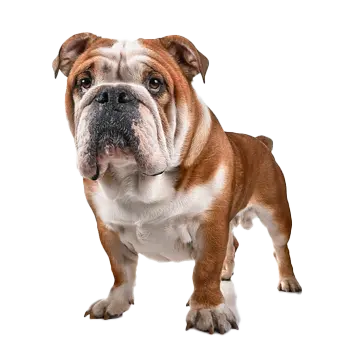
The English Bulldog is a medium-sized breed with a distinctive, unmistakable appearance characterized by a massive, short-faced head and a thick-set, low-slung body. Males typically weigh around 50 to 55 pounds while females weigh approximately 40 to 50 pounds, with both standing about 14 to 16 inches at the shoulder. Despite their relatively moderate size, English Bulldogs appear much larger due to their wide, muscular build and substantial bone structure. The body is broad and low to the ground with a characteristic roach back that rises toward the hindquarters, and the chest is very deep and wide, creating the breed's distinctive silhouette. The head is the breed's most prominent feature, appearing massive and square with a deeply furrowed brow and extensive wrinkles and folds of skin around the face. The skull is flat to slightly rounded, and the forehead is flat with loose, wrinkled skin. The muzzle is extremely short, broad, and turned upward, with the lower jaw projecting considerably in front of the upper jaw, creating the breed's characteristic undershot bite. The nose is broad, large, and black, set between large, prominent eyes. The eyes are set low and wide apart in the skull, round in shape, and dark in color. The ears are rose-shaped, small, and set high on the head, folding backward to expose part of the inner ear. The coat is short, flat, smooth, and glossy, lying close to the body. Despite its brevity, the coat is surprisingly dense and may have a fine texture. English Bulldogs come in a variety of colors and patterns including red, white, fawn, fallow, piebald, and various brindle patterns. Black is not a preferred color in the breed standard. The skin is soft and loose, particularly around the head, neck, and shoulders where it forms heavy wrinkles. The tail can be straight or screwed but should never be curved or curly. These distinctive features combine to give the English Bulldog its unique appearance that has made it one of the most recognizable breeds worldwide.
Key Characteristics
Temperament Temperament Temperament Temperament Temperament Temperament English Bulldogs are generally friendly toward other pets and people, though they can be courageous and protective if they perceive a threat to their family. They are not typically aggressive but will stand their ground if challenged. The breed does have some unique behaviors including snoring, snorting, and drooling, which potential owners should be prepared for. They are sensitive to extreme temperatures, particularly heat, and require climate-controlled living environments. Their affectionate, loyal nature and distinctive personality make them beloved companions, and their comical expressions and antics provide endless entertainment for their families. With proper care and attention, the English Bulldog makes a devoted and charming family member.
Health Considerations Health Considerations Health Considerations Health Considerations Health Considerations Health Considerations Skin problems are extremely common due to the breed's numerous wrinkles and folds, which can trap moisture and bacteria, leading to skin fold dermatitis and infections. Regular cleaning and drying of facial folds is essential for prevention. Eye conditions including cherry eye, entropion, dry eye, and corneal ulcers occur frequently. Joint problems including hip and elbow dysplasia affect many English Bulldogs, exacerbated by their heavy build and often exacerbated by obesity. Patellar luxation, intervertebral disc disease, and various heart conditions are also concerns. Dental disease is prevalent due to their undershot jaw and crowded teeth. The breed's unique anatomy means that many females cannot give birth naturally and require cesarean sections, adding to breeding costs and risks. Despite these challenges, many English Bulldogs live happy, comfortable lives when provided with appropriate care, regular veterinary attention, and responsible ownership.
Important to Remember
Each hybrid dog is unique and may inherit any combination of traits from either parent breed. The information above represents the characteristics of the purebred parent breeds. Your EngAm Bulldog may favor one parent over the other or display a blend of both. We strongly encourage you to read the complete breed profiles for both the American Bulldog and English Bulldog to fully understand the range of possible temperaments, health concerns, and care requirements.