Collie Pyrenees
The Collie Pyrenees is a cross between the Collie and the Great Pyrenees. Because each hybrid inherits a unique combination of traits from both parents, we recommend thoroughly researching both breeds before choosing a Collie Pyrenees. Pay special attention to temperament, health issues, and care requirements, as your dog may express characteristics from either parent breed.
Collie
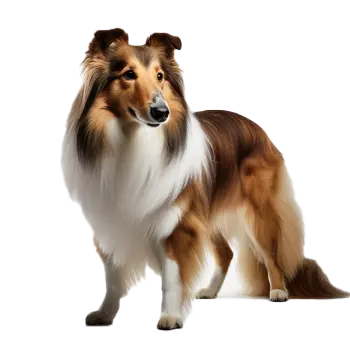
The Collie is a large, elegant herding dog that exudes grace, strength, and beauty in harmonious proportion, with no single feature appearing exaggerated or out of balance. Males typically stand 24 to 26 inches at the shoulder and weigh 60 to 75 pounds, while females are smaller at 22 to 24 inches and 50 to 65 pounds, with both sexes presenting a picture of athletic refinement. The breed presents a lithe, strong appearance without any trace of coarseness or clumsiness, carrying itself with natural dignity and poise. The body is slightly longer than tall, with a deep chest reaching to the elbows, well-sprung ribs, and a level back that conveys both strength and agility suited to their herding heritage in the Scottish Highlands. The head is a defining characteristic of the Collie and is of utmost importance in breed evaluation, appearing light and refined in proportion to the body while resembling a well-blunted lean wedge when viewed from front or side. The skull is flat with a slight stop creating a gentle break between the eyes, and the backskull and muzzle are of approximately equal length. The muzzle is smooth, well-rounded, and parallel to the backskull, never appearing snipy, heavy, or Roman-nosed. The almond-shaped eyes are medium-sized, set somewhat obliquely, and express a sweet, intelligent, and alert character that is essential to the breed's proper expression. Eye color is typically dark brown, except in blue merles where blue, merle, or wall eyes are permitted. The ears are carried about three-quarters erect with the tips breaking forward when alert. The Collie exists in two coat varieties: the Rough Collie with a long, abundant coat that is the breed's crowning glory, and the Smooth Collie with a short, dense flat coat. The Rough variety features a profuse mane and frill around the neck and chest, with long feathering on the forelegs, abundant rear feathering creating a pantaloon effect, and a well-plumed tail. Both varieties possess weather-resistant double coats with a soft, furry undercoat. Recognized colors include sable and white ranging from light gold to rich mahogany, tricolor (predominantly black with tan markings), blue merle, and white (predominantly white with colored markings). The long, low-carried tail reaches at least to the hocks and features a characteristic upward swirl at the tip.
Key Characteristics
Temperament Temperament Temperament Temperament Temperament Temperament Collies can be vocal dogs who use barking to communicate and alert their families to unusual activity. This tendency may require management to prevent excessive barking. They are generally friendly with strangers once properly introduced but may be reserved initially. The breed thrives on human companionship and does not do well when isolated or left alone for long periods. They adapt well to various living situations, including apartments, provided they receive adequate daily exercise and mental stimulation. Once settled indoors, Collies are calm and content to relax with their families, making them excellent house dogs despite their medium to large size.
Health Considerations Health Considerations Health Considerations Health Considerations Health Considerations Health Considerations Dermatomyositis (DMS) is an autoimmune inflammatory disease affecting the skin and muscles, primarily seen in Collies and Shetland Sheepdogs. The condition typically appears before 6 months of age, causing skin lesions on the face, ears, and feet that may progress to muscle weakness in severe cases. Genetic risk testing is available. The breed can also experience hip dysplasia, though at lower rates than some other large breeds. Idiopathic epilepsy occurs in some Collies, with seizures typically beginning between 6 months and 3 years of age. Gray Collie Syndrome (cyclic neutropenia) is a rare but fatal condition affecting puppies born with light gray coats. With proper health screening and veterinary care, Collies typically enjoy a lifespan of 12 to 14 years.
Great Pyrenees

The Great Pyrenees is a giant breed that conveys an impression of elegance and unsurpassed beauty combined with immense size, great majesty, and powerful presence. Males stand 27 to 32 inches at the shoulder and typically weigh 100 to 160 pounds, while females range from 25 to 29 inches and weigh 85 to 115 pounds, making them one of the largest guardian breeds. Despite their massive size, the breed appears balanced and well-proportioned rather than bulky, with sufficient bone and muscle to match their substantial frame while maintaining an air of elegance and grace. The body is slightly longer than tall, with a level topline, moderately broad chest, and well-sprung ribs that provide ample heart and lung capacity for their original work as tireless mountain guardians protecting flocks from wolves and bears. The head is wedge-shaped with a slightly rounded crown, proportionate to the body size without appearing heavy or coarse, conveying nobility and intelligence. The expression is elegant, intelligent, and contemplative, reflecting the breed's thoughtful and discerning character. Medium-sized, almond-shaped eyes are set slightly obliquely and rich dark brown in color, with close-fitting black-rimmed eyelids that give a kindly yet alert appearance. Small to medium V-shaped ears with rounded tips are set at eye level and carried low, flat, and close to the head, often with long hair meeting at a line from the outer corner of the eye to the ear base. The muzzle is approximately equal in length to the backskull, blending smoothly with the skull without a pronounced stop. The nose and lips are black, and teeth meet in a scissor or level bite. The weather-resistant double coat is one of the breed's most distinctive features, consisting of a long, flat, thick outer coat of coarse hair over a dense, fine, woolly undercoat that provides excellent insulation against harsh mountain weather. The coat is more profuse around the neck and shoulders, forming a pronounced mane or ruff that is more prominent in males than females. Longer hair on the tail creates an elegant flowing plume, and feathering appears along the back of the legs creating a distinctive pantaloon effect. The coat is primarily white but may include markings of gray, badger, reddish brown, or varying shades of tan on the ears, head (including a full face mask), tail, and scattered body spots. The breed possesses characteristic double dewclaws on each rear leg, which are a defining breed feature.
Key Characteristics
Temperament Temperament Temperament Temperament Temperament Temperament Great Pyrenees are notably nocturnal and may patrol and bark during nighttime hours, reflecting their guardian heritage when predators were most active. This tendency to bark can be problematic in suburban settings and requires management. The breed is generally reserved with strangers, taking time to assess new people before accepting them. They typically get along well with other animals, particularly those they view as part of their flock, but may not tolerate unfamiliar dogs, especially those of the same sex. Despite their calm indoor demeanor, Great Pyrenees require secure fencing and supervision, as they are prone to wandering and will expand their patrol territory if given the opportunity.
Health Considerations Health Considerations Health Considerations Health Considerations Health Considerations Health Considerations Neuronal degeneration is an inherited neurological condition specific to Great Pyrenees that causes progressive loss of coordination and mobility, typically appearing before one year of age. Genetic testing is available to identify carriers. Chondrodysplasia (dwarfism) is another inherited condition where affected dogs have shortened limbs, trunk, and muzzle, often accompanied by hearing loss and dental problems. The breed is also prone to bone cancer (osteosarcoma), various eye conditions including cataracts and entropion, Addison's disease (hypoadrenocorticism), patellar luxation, and certain cardiac conditions. With proper care and health monitoring, Great Pyrenees typically live 10 to 12 years, somewhat shorter than smaller breeds due to their giant size.
Important to Remember
Each hybrid dog is unique and may inherit any combination of traits from either parent breed. The information above represents the characteristics of the purebred parent breeds. Your Collie Pyrenees may favor one parent over the other or display a blend of both. We strongly encourage you to read the complete breed profiles for both the Collie and Great Pyrenees to fully understand the range of possible temperaments, health concerns, and care requirements.