Bostalian
The Bostalian is a cross between the Boston Terrier and the Italian Greyhound. Because each hybrid inherits a unique combination of traits from both parents, we recommend thoroughly researching both breeds before choosing a Bostalian. Pay special attention to temperament, health issues, and care requirements, as your dog may express characteristics from either parent breed.
Boston Terrier
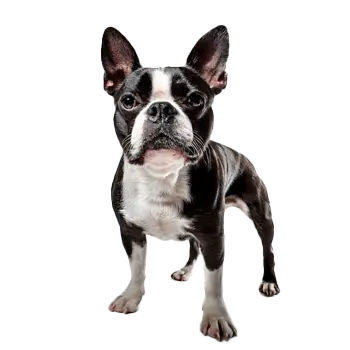
The Boston Terrier is a small, compact, and well-muscled dog that presents a square appearance with a distinctive tuxedo-like coat pattern that has charmed dog lovers since the breed's development in the late 1800s. Standing between 15 and 17 inches at the shoulder and weighing between 12 and 25 pounds, this breed is divided into three weight classes: under 15 pounds, 15 to 20 pounds, and 20 to 25 pounds. The body is short and sturdy with a slightly arched neck, a broad chest, and a short, naturally bobbed tail that may be straight or have a slight corkscrew shape. The legs are strong and well-proportioned, giving the dog a balanced and athletic stance despite its compact frame. One of the most recognizable features of the Boston Terrier is its distinctive head, which is square and flat on top with a short, wide muzzle and a well-defined stop. The large, round, dark eyes are set wide apart and convey an alert, intelligent expression that has earned this breed the nickname "American Gentleman." The ears are small, erect, and may be natural or cropped, standing prominently on the corners of the skull. The breed is brachycephalic, meaning it has a shortened skull that creates its characteristic flat-faced appearance. The jaw is broad and square with a slightly undershot bite that contributes to the breed's distinctive profile. The coat is short, smooth, and fine in texture, requiring minimal grooming to maintain its sleek appearance. Boston Terriers are found in distinctive color patterns including black and white, brindle and white, or seal and white, with the white markings typically appearing on the muzzle, between the eyes, on the chest, and on part or all of the forelegs and hind legs below the hocks. These markings give the breed its signature tuxedo appearance that makes them immediately recognizable. The skin fits tightly over the body without wrinkles except on the head, where some wrinkling may be present around the short muzzle. Their compact build and moderate bone structure make them suitable companions for various living environments.
Key Characteristics
Temperament Temperament Temperament Temperament Temperament Temperament Boston Terriers form strong bonds with their family members and do well with children when properly supervised, though interactions with very young children should be monitored due to the breed's tendency toward boisterous play. They generally coexist peacefully with other pets, especially when socialized from an early age. Their alert nature makes them adequate watchdogs who will bark to announce visitors, but they are not typically aggressive. The breed thrives on companionship and may develop separation anxiety if left alone for extended periods, making them best suited for households where someone is frequently home.
Health Considerations Health Considerations Health Considerations Health Considerations Health Considerations Health Considerations Additional health concerns include deafness, which can be partial or complete and is often hereditary in the breed, and hemivertebrae, a spinal condition where malformed vertebrae can cause neurological problems or back pain. Boston Terriers may also suffer from allergies, Cushing's disease, and various skin conditions. The average lifespan for this breed ranges from 11 to 13 years. Responsible breeding practices, including health testing of parent dogs, can help reduce the incidence of these genetic conditions. Regular veterinary checkups, maintaining a healthy weight, and providing appropriate exercise are essential for ensuring a long, healthy life.
Italian Greyhound
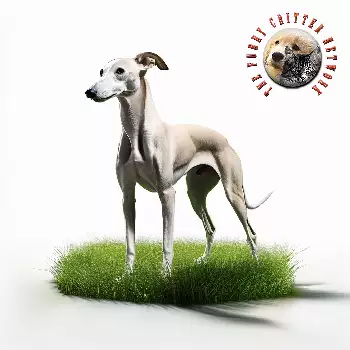
The Italian Greyhound is the smallest member of the sighthound family, presenting a true miniature Greyhound in appearance with supreme elegance and grace. Standing between 13 and 15 inches at the shoulder and weighing only 7 to 14 pounds, this delicate breed possesses a slender, fine-boned structure that combines aristocratic beauty with athletic capability. The body is square to slightly off-square in proportion, with the length from the forechest to the point of the rump being just slightly greater than the height at the withers. The deep, narrow chest extends down to the elbows, while the tucked-up abdomen and arched loin create the distinctive curved silhouette characteristic of sighthounds. The head is long, narrow, and refined, tapering elegantly toward the nose with a skull that is nearly flat on top and a muzzle of equal length to the skull. The stop is slight but definite, and the fine-boned structure gives the face a delicate, aristocratic appearance. The eyes are medium-sized, dark, and expressive, conveying an alert and intelligent expression with pigmented eye rims. The ears are small, fine, and folded back along the head in what is called a rose ear, though they stand semi-erect when the dog is alert, with the tips folding outward. The neck is long, graceful, and arched, blending smoothly into the sloping shoulders. The Italian Greyhound's coat is short, smooth, and glossy, with a texture that feels satiny to the touch. The supple skin fits closely over the body, highlighting the breed's elegant muscle definition. The coat comes in virtually all colors and patterns except brindle markings or the tan markings typically found on black and tan dogs, which are disqualifications in the breed standard. Common colors include shades of gray, blue, fawn, red, black, white, and cream, with various combinations and markings. The long, slender tail tapers to a curved end and is carried low, completing the graceful outline. The distinctive gait features a high-stepping, free movement with the foreleg lifted with a slight bend at the wrist, producing an elegant, springy action.
Key Characteristics
Temperament Temperament Temperament Temperament Temperament Temperament Italian Greyhounds tend to be reserved and sometimes shy around strangers, often requiring time to warm up to new people before accepting them. Early and ongoing socialization is crucial to help them develop confidence and prevent excessive timidity or fearfulness. While they generally get along well with other dogs, particularly other Italian Greyhounds or similar-sized breeds, their delicate build means they should be supervised around larger, more boisterous dogs that could accidentally injure them during play. They can coexist with cats and other small animals if raised with them, though their prey drive may cause them to chase smaller creatures. This breed thrives in calm, quiet households and may not be ideal for families with very young children due to their fragile structure.
Health Considerations Health Considerations Health Considerations Health Considerations Health Considerations Health Considerations Progressive retinal atrophy is an inherited eye disease that causes gradual vision loss and eventual blindness, typically beginning with night blindness and dilated pupils. Genetic testing can identify carriers before breeding. Primary closed-angle glaucoma, cataracts, and other eye conditions also occur in the breed. Italian Greyhounds may experience epilepsy, hypothyroidism, von Willebrand's disease (a blood clotting disorder), and color dilution alopecia, which causes hair loss in dogs with diluted coat colors like blue or fawn. Portosystemic shunt, a liver disorder where blood bypasses the liver, can also affect this breed. Additionally, Italian Greyhounds are sensitive to anesthesia and certain medications, making it important to work with veterinarians experienced with sighthounds.
Important to Remember
Each hybrid dog is unique and may inherit any combination of traits from either parent breed. The information above represents the characteristics of the purebred parent breeds. Your Bostalian may favor one parent over the other or display a blend of both. We strongly encourage you to read the complete breed profiles for both the Boston Terrier and Italian Greyhound to fully understand the range of possible temperaments, health concerns, and care requirements.